




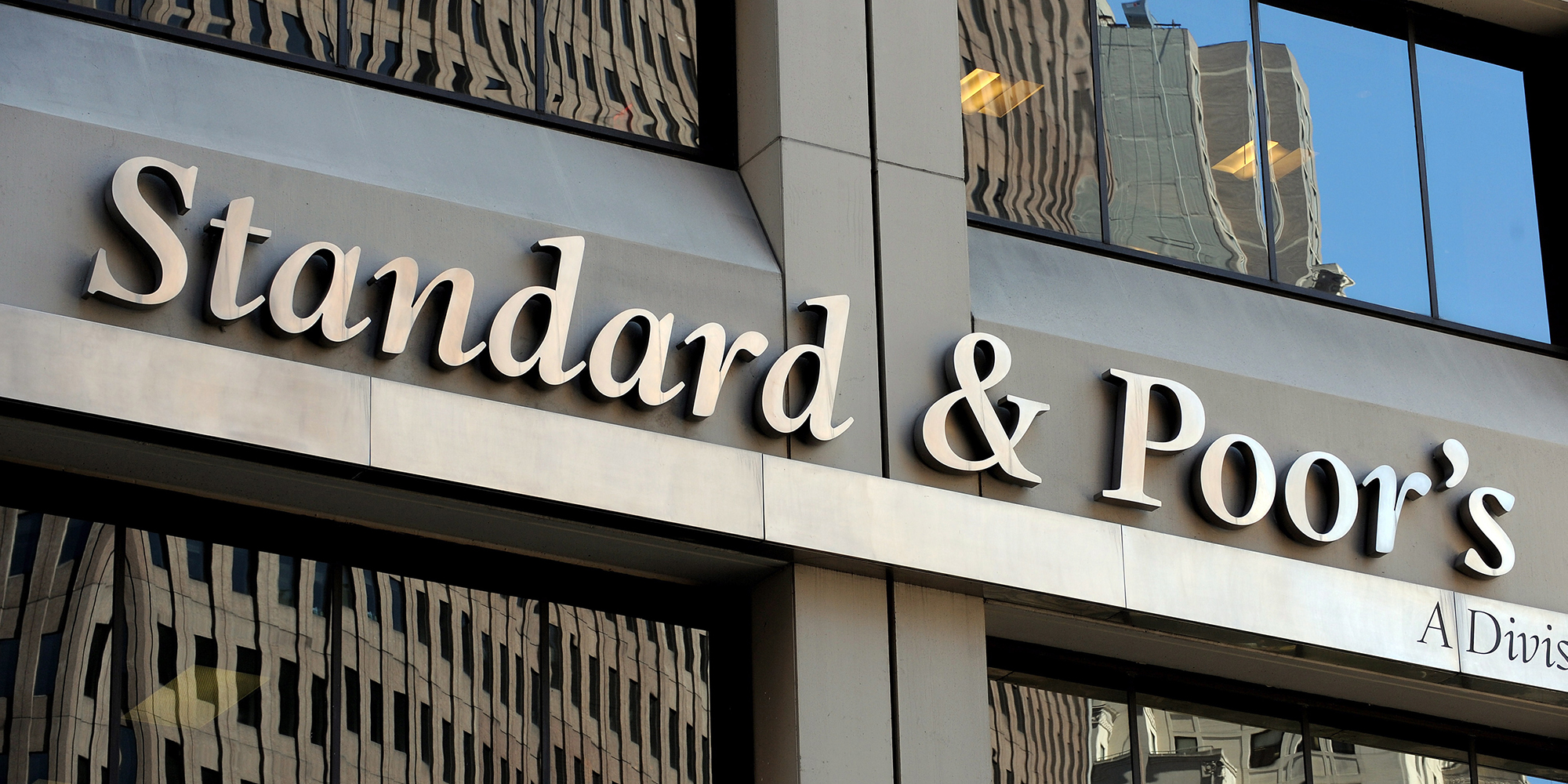
 A view of the offices of Standard and Poor's in New York. (Photo: EPA/JUSTIN LANE)
 The S&P 500 hovered near 5,500 in an advance led by its most-influential group: technology. The Nasdaq 100 briefly surpassed the historic 20,000 mark and is on track for its best month since November. Treasuries lost steam after rising in the immediate aftermath of the data. Swap traders project almost two rate cuts this year, with a quarter-point reduction fully priced in by November.
Stocks set for a fresh record.
US consumer sentiment declined by less than initially estimated on expectations inflationary pressures will moderate. The Fed’s preferred measure of underlying US inflation decelerated. Household spending rebounded and incomes showed solid growth, offering some hope that price pressures can be tamed without lasting damage to consumers.
“From the market’s perspective, today’s PCE report was near perfect,” said David Donabedian at CIBC Private Wealth US. “The Fed’s favourite inflation indicator not only showed inflation was moving towards the Fed’s inflation target, but that the economy is resilient. Consumer spending was on the rise and take-home pay was also up after a couple of sluggish months.”
The S&P 500 headed toward its 32nd record in 2024. Nvidia Corp., which has been on a roller-coaster ride, led gains in megacaps. Nike Inc. tumbled almost 20% on a disappointing outlook. Treasury 10-year yields rose five basis points to 4.33%. A selloff in French markets resumed Friday as traders ditched assets ahead of Sunday’s elections.
The S&P 500 may be headed for another record closing high, but JPMorgan Chase & Co.’s Marko Kolanovic says the benchmark will falter in coming months in the face of mounting headwinds, from a slowing economy to downward earnings revisions. The gauge is poised to plunge to 4,200 by year-end, a roughly 23% drop from Thursday’s close, he said.
“There is a clear disconnect in the huge run-up in US equity valuations and the business cycle,” the strategists wrote, adding that the S&P 500’s 15% year-to-date gain isn’t justified, given waning growth projections. “There is a risk that an opposite of the hopeful expectation could play out in coming quarters where growth decelerates, inflation remains firm, and long-term rates don’t move sharply lower.”
Softening in the measure of inflation favoured by the Fed highlights a slowing economy that’s upping the risk of a policy error by the central bank, Mohamed El-Erian said.
“The economy is slowing faster than most economists expect and faster than what the Fed expected,” El-Erian, the president of Queens’ College, Cambridge and a Bloomberg Opinion columnist, told Bloomberg Television on Friday.
The so-called core personal consumption expenditures price index, which strips out volatile food and energy items, increased 0.1% from the prior month. That marked the smallest advance in six months. On a two-decimal basis, it was up just 0.08%, the least since late 2020.
Separate data showed the University of Michigan’s final June index eased less than a point to 68.2. Consumers expect prices will climb at an annual rate of 3% over the next year, down from the 3.3% expected in May and the lowest in three months.
To Seema Shah at Principal Asset Management, while the inflation data is a relief and will be welcomed by the Fed, the policy path is not yet certain.
“A further deceleration in inflation, ideally coupled with additional evidence of labour market softening, will be necessary to pave the way for a first rate cut in September,” she noted.
Fed Bank of San Francisco President Mary Daly told CNBC that the latest inflation data indicates monetary policy is working, but said it’s too early to tell when it will be appropriate to lower borrowing costs. Earlier Friday, her Richmond counterpart Thomas Barkin said the inflation battle still hasn’t been won, and the US economy is likely to remain resilient as long as unemployment remains low and asset valuations high.
“The soft inflation data will build the case that the Fed can start cutting rates in the coming months,” said Jeffrey Roach at LPL Financial. “As long as incomes grow at a healthy clip, consumers will keep spending. The key is the labour market and so now, we should shift our attention to next week’s nonfarm payroll release for a fresh look into the job market.”
The timing of the first rate cut matters because bonds rally in anticipation of that cut, according to Joe Kalish at Ned Davis Research.
“Any second half bond market outlook is contingent on Fed policy,” he said. “The timing of the first rate cut has historically been important for the bond market, as yields tend to peak 2-3 months before the first rate cut.”