




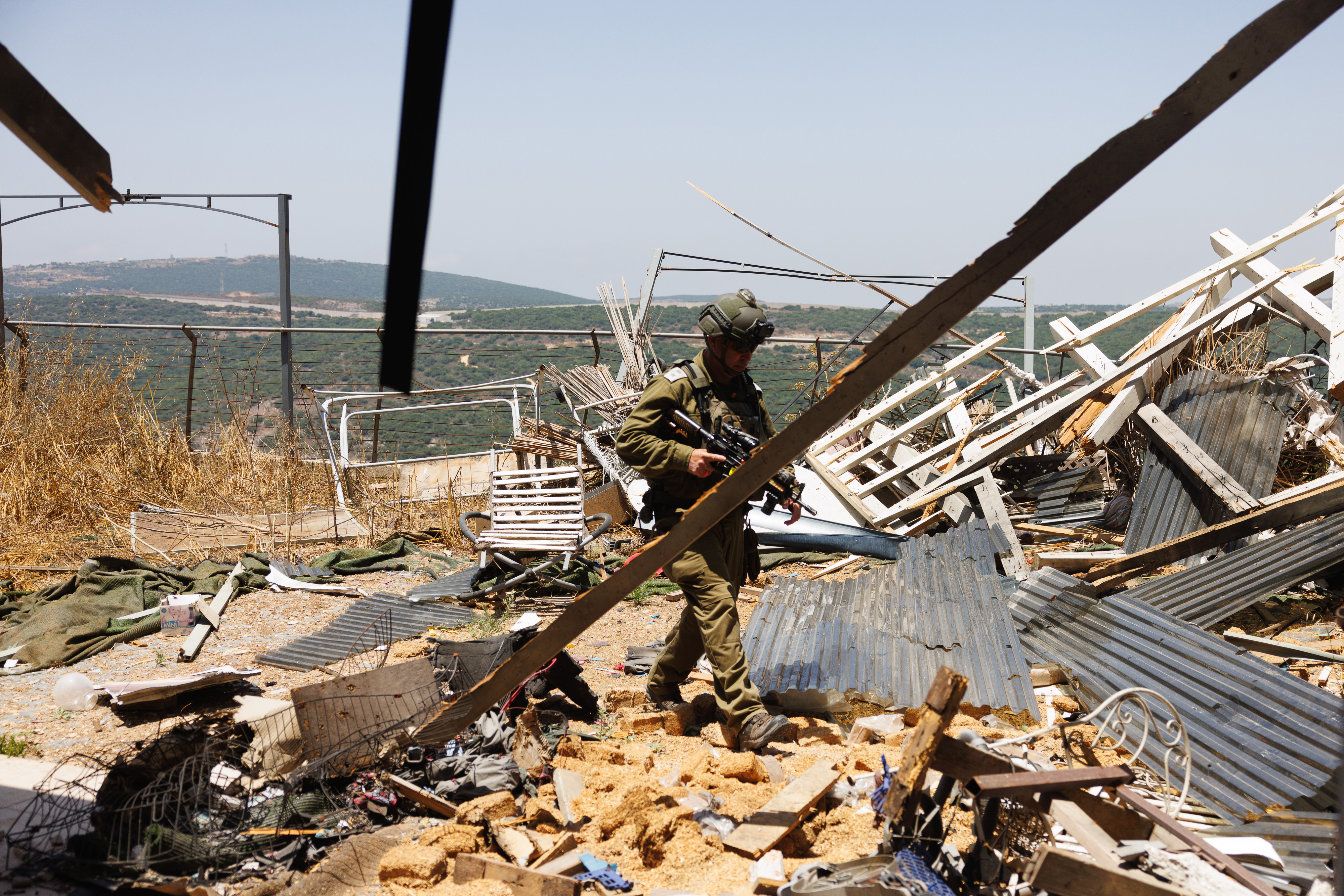
 An Israeli soldier at the site of a Hezbollah anti-tank missile direct hit on a house near the Lebanon border in Moshav Shtula, northern Israel, on 19 June 2024. (Photo: Kobi Wolf / Bloomberg via Getty Images)
 Houthi militants are attacking commercial ships off Yemen with increasing — and sometimes deadly — effectiveness, exposing the limits of a US-led coalition to quell the violence in some of the world’s most important waterways.
The Houthis struck the commodities carrier Transworld Navigator in a suspected drone attack early on Sunday, marking the fourth time the vessel has been targeted, according to US Central Command. The ship continued on its path through the Red Sea, following moderate damage and minor injuries to the crew.
Israel to ease off Gaza fighting as focus moves to Hezbollah
Israeli Prime Minister Benjamin Netanyahu said intense fighting with Hamas would soon be paused and some forces redeployed to the north of the country, where violence is escalating with Lebanon-based Hezbollah.
The military would continue its campaign to eradicate Hamas from Gaza but switch to more targeted operations, Netanyahu told Israel’s Channel 14 on Sunday. He had been asked about the duration of fighting in the enclave’s southern city of Rafah, where more than one million people have been displaced to allow Israel to target what it said were the last remaining Hamas battalions.
Read more: A new war is brewing on Israel’s second front: Balance of Power
“It will be very soon,” Netanyahu said of the planned de-escalation, in his first interview with Israeli media since the Hamas attacks on 7 October triggered the near nine-month war. About 1,200 people were killed in that invasion, with 250 more taken hostage.
The focus would then turn to northern Israel, Netanyahu said, where cross-border exchanges with Hezbollah have been taking place since October. Israel’s military said last week that operational planning for an offensive in Lebanon had been approved, with the aim of driving back the group and allowing tens of thousands of Israelis evacuated from the border area to return home.
A similar number of people have had to move out of southern Lebanon.
“If we can, we’ll do this by diplomatic means, if not it’ll be achieved in another way,” Netanyahu said, echoing weeks of escalating rhetoric between Israel and Hezbollah, a heavily armed militia that has been fighting in solidarity with Hamas.
Both Hezbollah and Hamas are backed by Iran and are considered terrorist organisations by the US.
The US has for months been striving to prevent open warfare from breaking out between Israel and Hezbollah, and a top military official warned on Sunday that Washington may not be able to assist Israel to the same extent as when it helped intercept missiles from Iran in April.
It would be harder to fend off the shorter-range rockets favoured by Hezbollah, Charles Brown, chairman of the US Joint Chiefs of Staff, said on Sunday in comments reported by the Associated Press. Such a conflict would also risk drawing a fresh response from Tehran, he added.
Israel’s ground invasion of Gaza last year — aimed at returning hostages taken on 7 October and uprooting Hamas as a military and political entity — has killed about 37,000 Palestinians, according to authorities in the Hamas-run enclave who don’t distinguish between fighters and civilians. About 313 Israeli soldiers have died in the ensuing conflict, according to the Israel Defense Forces.
The war has left much of Gaza in ruins and the enclave’s population battling shortages of food, water and healthcare, according to the United Nations. Aid companies have struggled to get enough assistance to those who need it due to tightly controlled borders and customs checks, as well as ongoing warfare.
In the interview, Netanyahu rejected the prospect of a ceasefire deal with Hamas that could eventually lead to the end of the war — as laid out in a speech by US President Joe Biden at the end of May.
“If there is an agreement, it will be on our terms and that would not mean ending the war, withdrawing from Gaza and leaving Hamas rule intact,” he said.
“I am willing to agree to a partial deal that will see some of the Israeli hostages come home, and after such ceasefire ends, we will be committed to continuing the fighting until the goal of eliminating Hamas is completed,” he said.
His interview angered families of hostages, who blame him for abandoning those who remain in Gaza. He was “violating the country’s moral duty toward its citizens”, a statement by hostage family members issued after the interview said.
Netanyahu’s office issued a later statement saying he was committed to bringing back all the hostages. Around half were released during a week-long truce — the only one so far — that ended on 1 December. Of those remaining, Israeli officials believe around 40, at least, have died.“It is Hamas that opposes a deal, not Israel,” the prime minister’s statement read. “Netanyahu has made clear we will not leave Gaza until we return all hostages, living and deceased.”
Hamas has repeatedly said it won’t agree to a ceasefire deal that doesn’t include the permanent withdrawal of Israeli troops from Gaza.
Tens of thousands of Israelis took to the streets of Tel Aviv again on Saturday, demanding new elections and a ceasefire to get the hostages out.
Houthi attacks on commercial shipping ramp up and get deadlier
Houthi militants are attacking commercial ships off Yemen with increasing — and sometimes deadly — effectiveness, exposing the limits of a US-led coalition to quell the violence in some of the world’s most important waterways.
The Houthis struck the commodities carrier Transworld Navigator in a suspected drone attack early on Sunday, marking the fourth time the vessel has been targeted, according to US Central Command. The ship continued on its path through the Red Sea, following moderate damage and minor injuries to the crew.
Earlier this month, a seafarer died after an attack on the Tutor, a ship hauling coal that was built in 2022. The vessel sank in what appeared to be the first successful Houthi strike from a seaborne drone.
Since late last year, the Iran-backed Houthis have targeted merchant ships for what they say is a response to the Israel-Hamas war. But there are clear signs that — as well as stepping up attacks — the militants are doing more damage.
In another recent incident, crew members on the cargo carrier Verbena abandoned ship in the Gulf of Aden following two Houthi missile attacks that caused fires on board, according to the US military. The mariners were rescued by another bulk carrier.
The recent barrage, following a lull, raises questions about whether the coalition can prevent the attacks in waters that in normal times are a major trade route for oil, liquefied natural gas and other commodities. Vessel traffic in the Red Sea region has dropped about 70% since December, with many commercial ships now taking the more expensive and time-consuming route around Africa.
The head of the European Union’s naval force in the region last week said it needs to double in size to effectively combat the Houthis.
Meanwhile, the USS Dwight D Eisenhower aircraft carrier strike group is leaving the region as it has come to the end of its scheduled deployment. It will be replaced by the USS Theodore Roosevelt strike group. DM
Read more in Daily Maverick: Middle East Crisis news hub
Comments
Scroll down to load comments...