




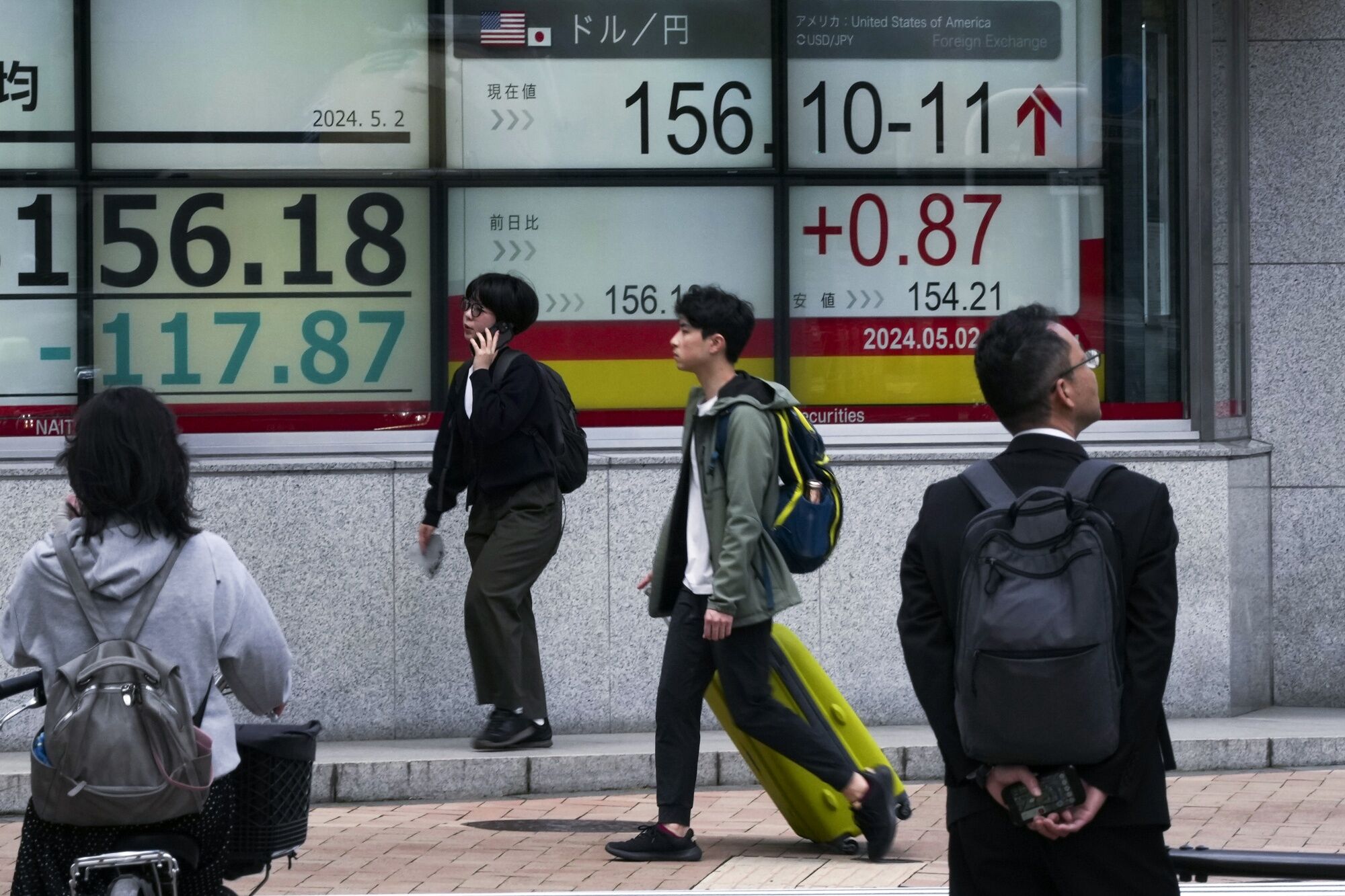
 The rate of the US dollar against the yen displayed on an electronic stock board outside a securities firm in Tokyo. (Photo: Toru Hanai/Bloomberg)
 Bloomberg’s Asia dollar index fell. The yen stayed below 160 per dollar and Japan’s top currency official, Masato Kanda, said authorities are ready to intervene to support it 24-hours a day, if needed. Traders have been wary of an escalation in official rhetoric after the yen’s 1.5% slide this month, while retail investors appear to be reloading bets for a rebound.
An index for the region’s stocks also declined, with equities in South Korea, Hong Kong and mainland China all falling. Those for Japan fluctuated. European and US share futures were also softer.
The moves come as markets are at a critical juncture for positioning into the second half of 2024 with the outlook for central bank policy rates from New Zealand to Japan and the US unclear. Inflation prints in Australia and Tokyo, as well as the Federal Reserve’s preferred gauge of consumer costs, may yield clues, but political risks loom large.
“How the US dollar trades into month-end will be important to the direction of risk across markets,” said Bob Savage, head of markets strategy and insights at BNY Mellon in New York.
The first UK prime ministerial and US presidential debates are scheduled, and the first round of voting in the French legislative election is set to take place this weekend. This should “set the tone for fiscal risks,” Savage said.
Treasury 10-year yields were steady in Asian trading. Later this week, the Federal Reserve’s favored inflation yardsticks are poised to show the tamest monthly advances since late last year — which may pave the way for officials to begin lowering interest rates.
Meanwhile, China’s currency fixing was little changed at 7.1201 per dollar on Monday, after the country’s assets sold off again last week as legislators showed no urgency to roll out more stimulus.
The yuan’s weakness is symptomatic of deteriorating sentiment toward the world’s second-largest economy, which is also seeing a bond market rally as investors seek out haven assets. Benchmark yields have tumbled toward record lows amid mixed economic data and expectations of further stimulus.
“In the short term, especially in the third quarter, we do see the CNY under more depreciation pressure,” Becky Liu, head of China macro strategy at Standard Chartered Plc, said in a Bloomberg TV interview.
Separately, China and the European Union have agreed to start talks on the bloc’s plans to impose tariffs on electric vehicles imported from the Asian nation.
The S&P 500 fell on Friday, and traders and strategists begin to question how long this year’s rally can persist given shifting bets on central bank rate cuts and election uncertainties in Europe.
The S&P 500 Index has likely logged most of the gains it will see this year as investors are growing increasingly nervous about the stock market’s rich valuations, according to the latest Bloomberg Markets Live Pulse survey published on Monday.
Signs of skittishness are evident as about half of survey takers say stocks will see the beginning of a correction of at least 10% this year.
“The bottom line is that the ongoing policy mix of heavy fiscal spending and tight interest rate policy is crowding out many companies and consumers in a way that is unsustainable,” Morgan Stanley strategist Michael Wilson wrote in a June 23 note. “Investors have recognized this outcome by bidding up the few stocks of the companies that are doing well in this environment.”
In commodities, oil extended the previous session’s decline toward $80 a barrel amid a stronger greenback and a technical indicator suggesting the recent rally has gone too far. Gold was little changed, having racked up a loss the previous week as investors pared bets on US rate cuts.