




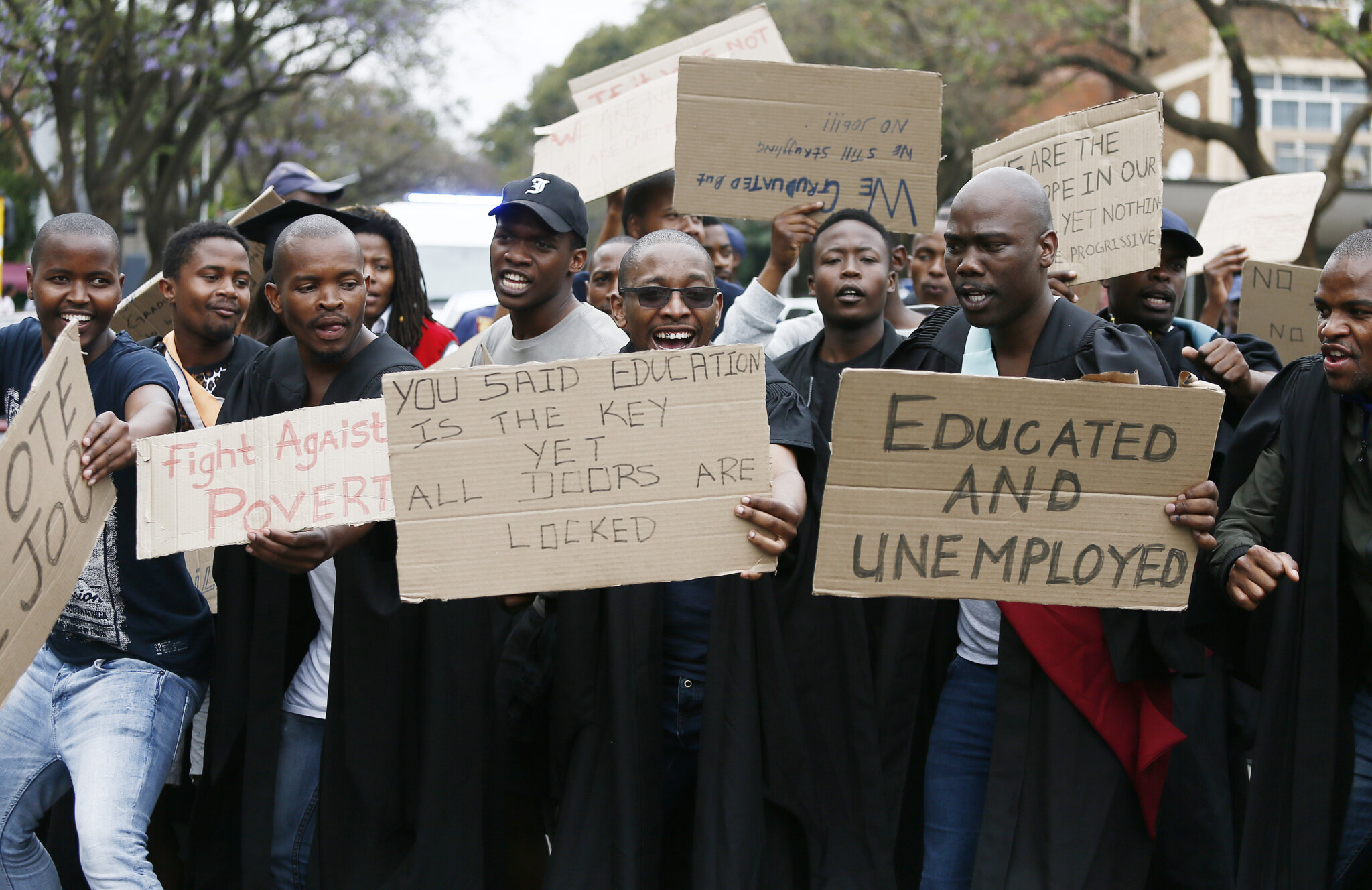
 Unemployed graduates march to the Union Buildings in Pretoria on 6 November 2018. The graduates, some wearing their graduation regalia, had qualifications ranging from economics degrees, fine arts diplomas and teaching diplomas. They demanded that the government find solutions to tackle the rising unemployment rate. (Photo: Gallo Images / Phill Magakoe)
 As June 16 approaches, marking the annual Youth Day to honour the Soweto Uprising of 1976, it is apposite to evaluate a few of the key opportunities currently offered to South African youth in an effort to curb the dire unemployment rates. The question however arises: is enough being done in this regard?
Government interventions
Education and training:
The Department of Women, Youth & Persons with Disabilities, has formulated a National Youth Policy. It aims to ensure that the youth have meaningful opportunities to enhance their capabilities, and enable them to become responsible and contributing members to society. The Policy addresses the key concerns and issues critical to the youth and provides direction for youth programmes and services offered by government and non-government organisations. Since its inception, the Policy has mandated the education and training of youth as artisans and technicians to support economic growth.
The National Skills Development Plan (“NSDP”) is aimed at ensuring that the private sector provides workplace training. In light of this, the Skills Development Act requires businesses to invest in employee training, funded by the Skills Development Levy.
Job creation:
Schemes such as the Expanded Public Works Programme (“EPWP”), the Community Works Programme, infrastructure maintenance, and the Rural Roads Maintenance and Upgrading Programme, provide temporary employment for the youth in infrastructure projects. In essence, these programmes aim to offer immediate job opportunities for the benefit of the youth while developing skills.
Policy and legislative measures:
The National Development Plan 2030 outlines specific long-term strategies for economic growth and job creation. It emphasises youth employment, access to high-quality education and training, and the importance of universities producing graduates who possess skills and knowledge in step with the global economic trends resulting from the Fourth Industrial Revolution.
Furthermore, the Employment Tax Incentive Act encourages businesses to hire young workers by reducing the cost of employment. Similarly, the National Youth Policy provides that the National Treasury, the NYDA and the Department of Employment and Labour must ensure that the Employment Tax Incentive (“ETI”) Initiative does not exclude start-ups and youth-owned business for the benefit of larger established enterprises.
Private sector interventions
Internships and Apprenticeships:
The private sector Youth Employment Service (“YES”) programme offers practical experience to the youth by empowering businesses to create jobs for unemployed youth. To achieve this, companies are increasingly offering internships and apprenticeship programmes to bridge the gap between education and employment.
Corporate Social Responsibility:
In addition to Corporate Social Responsibility (CSR) initiatives, some businesses incorporate youth employment into their CSR strategies. One example is the South African Breweries’ (“SAB”) KickStart Initiative, a youth entrepreneurship programme aimed at providing business skills training, business development support, and mentorship initiatives designed to support young entrepreneurs.
Public-Private Partnerships
Public-Private Partnerships such as the Harambee Youth Employment Accelerator have also emerged. This initiative plays a pivotal role in connecting employers with young job seekers by facilitating meaningful employment opportunities. Additionally, the Harambee Youth Employment Accelerator provides essential work readiness training to equip the youth with the skills and capabilities needed to succeed in the workforce.
The interventions outlined above are certainly laudable and in many instances a step in the right direction. However, the reality is that the South African youth currently faces an unemployment rate of over 45% and there is still much work to be done to reduce these dire rates. Perhaps employers can learn lessons from abroad (for example, Germany, which has implemented a dual system of vocational training)? Perhaps youth employment initiatives could be borne in mind in collective bargaining processes within workplaces? While there are no simple answers or solutions, Youth Day offers prime opportunities for employers to take stock of how they can play their part in reducing youth unemployment. DM