




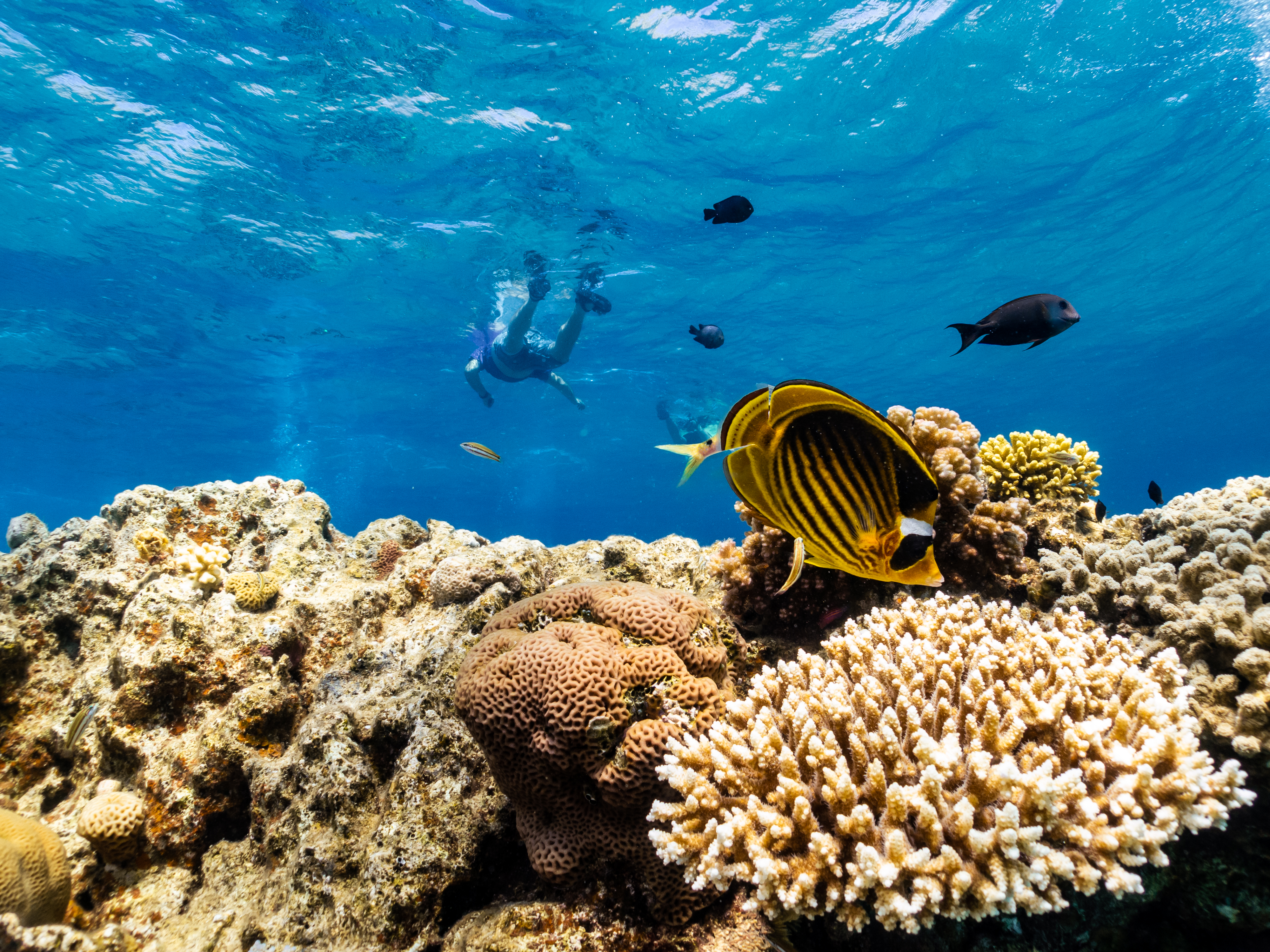
 Swimmers, snorkelers and beach goers enjoy a swim at the Coral Beach Nature Reserve in Eilat on July 16, 2022, in Eilat, Israel. Coral reefs are complete ecosystems, and although the coral reef in Eilat may be capable of withstanding climate change, it is also under threat from anthropogenic factors: large-scale development, waste run-offs into the sea and light pollution. Despite sea temperatures rising faster in the Gulf of Aqaba (also known in Israel as the Gulf of Eilat) than the global average rate, the coral reef of the northernmost point of the Red Sea exhibit remarkable resistance and seem immune to the effects of global warming. Scientists are trying to understand the biological capacity of these corals to live at higher temperatures, hoping this knowledge could help reefs elsewhere in the world. The scientific community estimates that over 90% of reefs will die by 2050 due to climate change and direct human impact. The corals in this Red Sea gulf might be one of the last remaining complete ecosystems by 2100. However, there is a possibility that this surviving coral reef could be used as a blueprint for an entirely new climate-resistant ecosystem. (Photo by Lukasz Larsson Warzecha/Getty Images).
The particular species of sea urchin impacted is a well-known protector of coral reefs and the deaths put the already fragile reef ecosystem in even more peril.
The pandemic was first noticed in the Gulf of Aqaba a year ago and researchers say they have since identified the pathogen behind it through molecular analysis. They are linking it to mass deaths across the Red Sea, the Arabian peninsula, and as far as Reunion Island off Madagascar.
The pathogen kills fast and violently - in just two days colonies can be lost - making it hard to assess how many are dying, said Omri Bronstein, a zoologist from Tel Aviv University and the Steinhardt Museum of Natural History.
It seems to be heading east towards the tropical waters of the Coral Triangle that extends off southeast Asia and Australia's Great Barrier Reef.
"I fear that at the current situation this is the trajectory, so this is where it's going," he said.
Their findings were published in the journal Current Biology.
'LAWN MOWERS'
Bronstein described the affected sea urchin species as the "lawn mowers" of coral reefs, since they remove algae that otherwise blocks sunlight, allowing the coral to thrive.
In the Gulf of Aqaba, no other creature has taken over that role and Bronstein's team is already seeing extensive growth in algae cover.
"When mortalities started in the Red Sea, they were so strong and so abrupt and so violent that the first thoughts were this must be some kind of pollution, or something very severe but very local," he said.
Then the phenomenon was seen at a wharf farther south in Sinai where a ferry from Aqaba docks. Two weeks later it spread another 70 kms (44 miles). They described thousands of skeletons of the once dominant species rolling on the sea bottom.
There is no known way to stop the disease, Bronstein said. But there is still a chance to create an isolated population, or broodstock, of the sea urchins remaining elsewhere that could hopefully be reintroduced later on.
The Israeli team is now cooperating with scientists across the region to map the pandemic and gather more details. This includes collecting continuous samples of environmental DNA from the different bodies of water that show how sea life interacts with the surroundings.
"You must have people on site to provide you with data, because within 48 hours you have no evidence of the mortalities even taking place," Bronstein said. "This coordination and this collaboration is one of the keys of being able to be on top of this rapidly evolving situation."
(Reporting by Ari Rabinovitch; Editing by Emelia Sithole-Matarise)
Comments
Scroll down to load comments...