




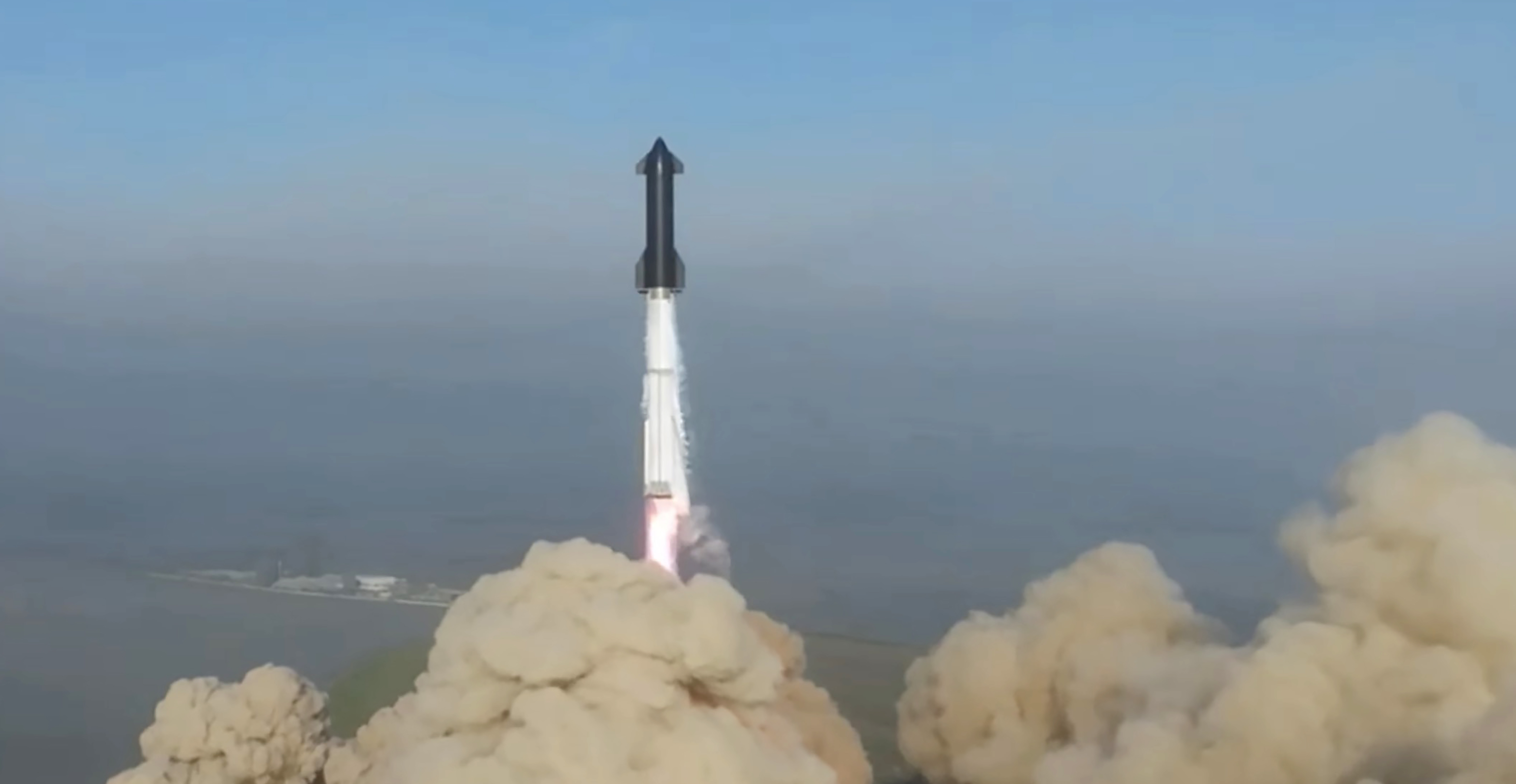
 A frame grab from a handout livestream video released by SpaceX showing the launch of inaugural test flight of Starship on the second attempt at the SpaceX launch facility in Boca Chica, Texas, USA, 20 April 2023. The initial launch attempt was scrubbed on 17 April, due to a stuck valve. EPA-EFE/SPACEX HANDOUT
 Appearing to shed pieces of debris as it hurtled through the atmosphere under the extreme heat, Starship finally landed in the Indian Ocean mostly intact on Thursday, a little more than an hour after it thundered off SpaceX’s launch pad on the southern tip of Texas.
The vehicle continued to broadcast a signal longer than it did on its third test flight in March. SpaceX also sent a command to Starship to reignite its engines just before splashing down in the ocean, a maneuver designed to slow it down and reorient it before impact. The engines appeared to reignite on the company’s livestream, but it’s unclear how smoothly that maneuver went.
Having Starship survive the plunge through the atmosphere was the biggest objective for SpaceX ahead of this test flight.
Elon Musk eventually plans to bring Starship it into regular commercial operation as a reusable rocket, but it still has a long way to go until people can take trips to deep space. This will require landing the spacecraft in one piece, life support systems and how to refuel in orbit.
A few minutes into the flight, the Super Heavy booster, used to propel Starship toward orbit, separated as planned and fell back down to Earth. The booster then fired its engines a final time to slow its impact just before touching down softly in the Gulf of Mexico — achieving a new milestone and igniting cheers inside SpaceX mission control.
SpaceX’s Starship – billed as the most powerful rocket ever created – will eventually be used to launch SpaceX’s larger, upgraded Starlink satellites. Ultimately it is intended to further Musk’s ambitions of sending cargo and people to destinations like the moon, and, eventually, Mars.
Depending on how satisfied SpaceX is with Thursday’s demonstration, it’s possible the company may move forward with trying to land portions of Starship on land during the next test flight.
“If the landing on the virtual tower with the booster works, then we will actually try with flight five to come back and land on the tower,” Musk told employees in April at its Starbase facility in Texas.
“That’s very much a success oriented schedule, but it is in the realm of possibility,” Musk said.
Standing nearly 400 feet (122 meters) high, the Starship launch system is taller than the Saturn V that sent Neil Armstrong to the moon. SpaceX holds a multibillion-dollar NASA contract to land people on the surface of the moon with Starship. NASA is closely monitoring SpaceX’s progress with each Starship launch, with the goal of landing astronauts on the moon as early as 2026. However, that timeline is likely to be delayed.
SpaceX didn’t plan to recover Starship or its Super Heavy booster on this flight. It wasn’t immediately clear whether the Federal Aviation Administration would open up a mishap investigation into Thursday’s mission, which the US agency has done in the past when Starship broke apart or caused damage. However, prior to the flight, the FAA laid out various possible outcomes that would not trigger a mishap investigation, and the flight seemed to meet that criteria.
An FAA spokesman said that the agency was assessing the operation, and would let the public know later whether an investigation is warranted.
SpaceX has been able to improve incrementally with each successive test launch of Starship. During the first two flights — in April 2023 and in November — the vehicle prematurely exploded before being able to perform the majority of the mission goals.
For SpaceX, these test flights are all part of Starship’s development process, with the company not necessarily expecting fully successful launches but with hopes of pushing the envelope further with each new mission.
Subscribe to Business of Space: The inside stories of investments beyond Earth, from satellite networks to moon landings. Delivered weekly.
Comments
Scroll down to load comments...