




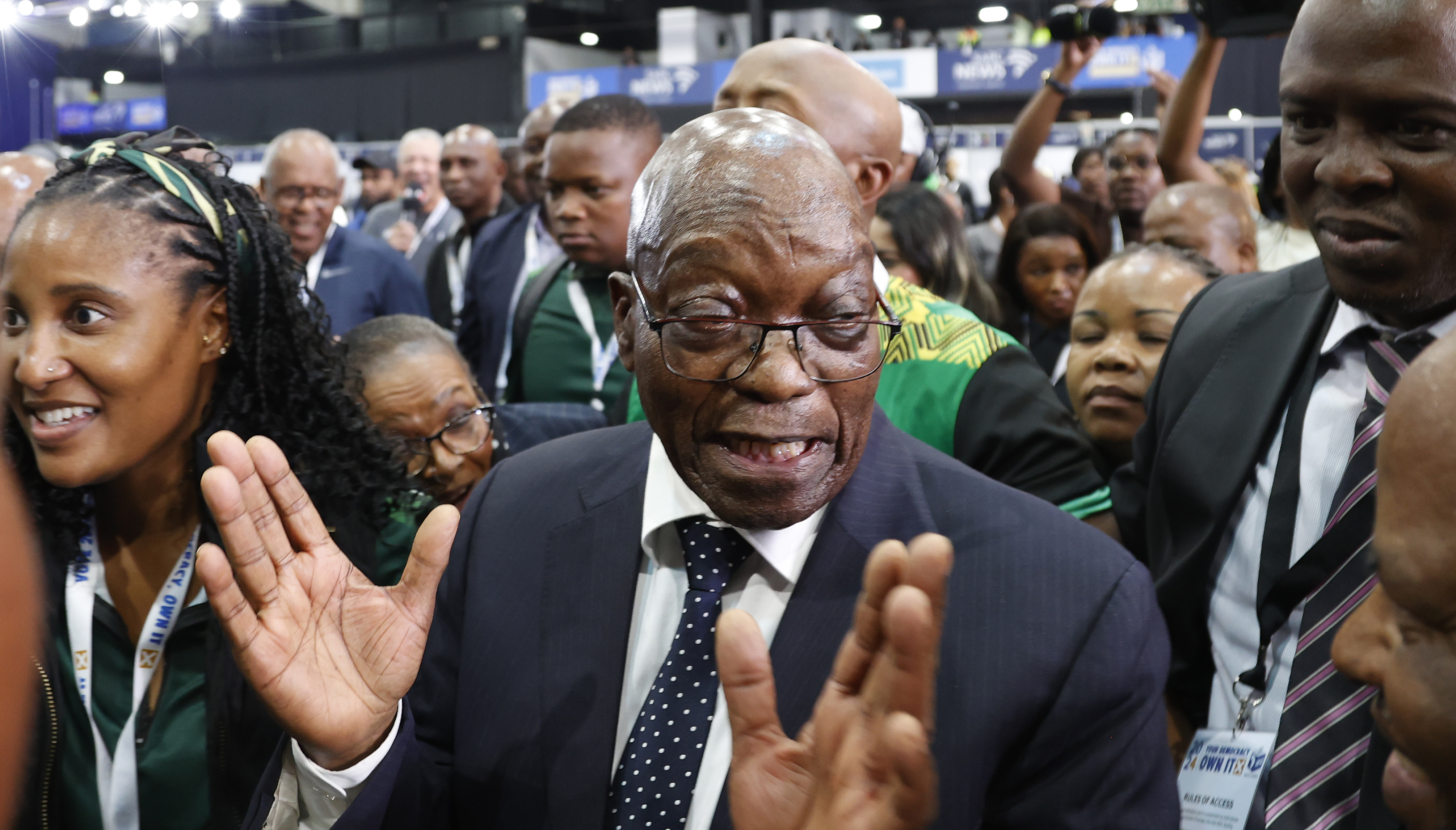
 uMkhonto Wesizwe party leader Jacob Zuma arrives at the IEC National Results Operations Centre in Midrand on 1 June 2024.(Photo: Felix Dlangamandla)
The English-language media is likely to focus intensely in the next few days on how it was that a party led by Zuma, the man whose name will forever be next to State Capture and KZN riots, could have received so much support.
This is an important question — to understand this is to understand a large chunk of our politics, and of our society, and could inform predictions about the future.
While some explanations still rely almost solely on former president Jacob Zuma’s ability to communicate with his supporters, this is a bit like saying the only reason Barack Obama or Donald Trump became president of the US was because of their communication skills.
Of course, communication is an important factor, especially in modern democracies that came of age with the television age. But it is not everything.
At the same time, there is still a risk for MK that it ends up without any power at all.
When combined, the support of the EFF, MK and the Patriotic Alliance (PA) in this poll tells us that a very large percentage of our society (more than one quarter) either wants to radically change, or to remove entirely, the Constitution.
This is a massive percentage, and a grave threat to democratic South Africa of the age of Nelson Mandela.
The reasons for this near-meltdown are complex, and each voter will have their own precise reason for their choice.
Certainly, service delivery issues, frustration with food price inflation, violent crime increases, joblessness crisis, load shedding, etc, etc, etc — they all combine to account for the general deterioration of the quality of life since the previous elections.
Also, many voters in many democracies around the world vote for the candidate most like them. This may explain the party’s support in KZN. And the recent passing of both King Goodwill Zwelithini and Prince Mangosuthu Buthelezi may also have created a void, meaning Zuma was the only provincial leader of his generation.
Read more in Daily Maverick: A 2024 Scramble for South Africa begins – party cooperation deals to emerge after Sunday
While the wishes of the voters who support MK obviously matter, what is clear is that the party’s leader has a very simple agenda: to remove Cyril Ramaphosa as president.
First, as results came in this week, Duduzile Zuma-Sambudla said MK would not enter a coalition with the ANC. Then she appeared to indicate that they could work with the ANC, on condition that Ramaphosa be removed. (She also attended the EFF press conference given by Julius Malema on Saturday.)
This is surely a demand the ANC cannot accept; no genuine party can afford to remove its leader at the behest of another party.
This is about revenge
But it also indicates how personal Zuma’s agenda is, this is about revenge. MK has said many times, in public, that all the party’s decisions are taken by Zuma, and no one else.
As he cannot go to Parliament, this is going to raise questions about how MK will manage itself.
And it is here that what could be its greatest weakness will surface. This is a party that has not had a conference or a leadership election. No one in any of its structures, apart from Zuma, can have any kind of legitimacy. No one can administer the caucuses in Parliament or provincial legislatures and claim it has a proper mandate.
Also, no party can survive in a democracy with representatives in multiple chambers over the long term, with just one person making the important decisions.
It may also be that many of the people who represent MK don’t know each other and have not worked together before. This is impossible to assess because the process used by MK to select people for the party lists is a complete mystery (unlike the ANC and the DA, which have well-established processes).
It is also possible that some well-known ANC figures in KZN now jump to MK, and will want seats in Parliament or the KZN legislature. This could also create instability, as those who are currently on the list might resist this.
At the same time it is likely that once in these chambers, both MK and the EFF will share the politics of spectacle, working together to cause intense and constant disruptions.
Over the next few days there are likely to be many hints and nudges and attendances, and perhaps even a very public tea or two, which will be designed to suggest the two parties are working together.
While this might give the appearance of Malema and Zuma working together, the main aim could actually be to put pressure on the ANC during coalition negotiations.
At the same time, there is still a risk for MK that it ends up without any power at all. This could only happen if every other party in the KZN legislature worked together against it and the EFF (together MK and the EFF come to around 48.5% of the vote in KZN, while the ANC, IFP and DA come to around 47.6% — meaning it would be up to tiny parties to make up the difference one way or another).
If that were the case, MK’s only possible role would be to cause the most intense disruption possible.
Already on Saturday, without providing any evidence, MK spokesperson Nhlamulo Ndhlela said the party would be calling for a commission of inquiry into the elections.
The next few days are likely to see MK begin to reveal itself more fully as it has to take decisions, and perhaps as more leaders emerge in some way. Zuma himself may take questions in public at some point.
But, while it has won a significant share of the vote, in an era of coalitions that is only half the work. It is the decisions Zuma will make in the next few days that could determine whether it will actually have real political power. DM
Comments
Scroll down to load comments...