




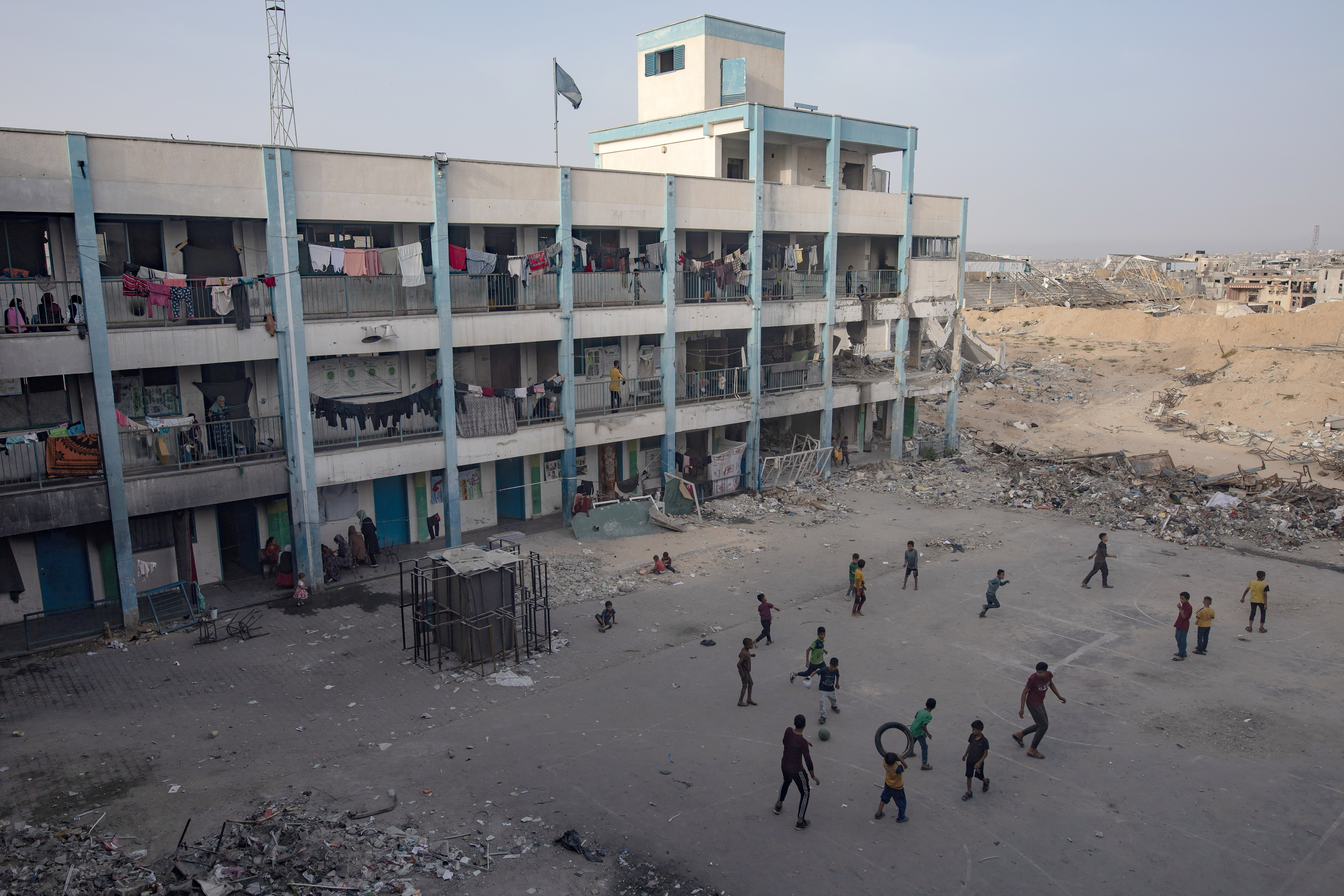
 Displaced Palestinians live in a destroyed UNRWA school after the Israeli army asked them to evacuate the city of Rafah, in the Khan Yunis camp in the southern Gaza Strip. 19 May, 2024. Since 07 October 2023, up to 1.7 million people, or more than 75 percent of the population, have been displaced throughout the Gaza Strip, some more than once, in search of safety, according to the United Nations Relief and Works Agency for Palestine Refugees in the Near East (UNRWA), which added that the Palestinian enclave is 'on the brink of famine', with 1.1 million people (half of its population) 'experiencing catastrophic food insecurity' due to the conflict and restrictions on humanitarian access. EPA-EFE/HAITHAM IMAD
Israel describes Rafah, which abuts the Gaza Strip's border with the Egyptian Sinai, as the last stronghold of Hamas Islamists whose governing and combat capabilities it has been trying to dismantle during the more than seven-month-old war.
After weeks of public disagreements with Washington over the Rafah planning, Israel on May 6 ordered Palestinian civilians to evacuate parts of the city and began troop and tank incursions.
"We are committed to broadening the ground operation in Rafah to the end of dismantling Hamas and recovering the hostages," a statement from Gallant's office quoted him as telling visiting U.S. National Security Adviser Jake Sullivan.
Israel believes dozens of hostages from the cross-border Hamas rampage on Oct. 7 are being held in Rafah.
Western powers and Egypt have voiced concern for the fate of hundreds of thousands of displaced Palestinians sheltering there, despite Israeli assurances about humanitarian safeguards.
The U.N. agency for Palestinian refugees UNRWA said on Monday that it estimated 810,000 people had fled Rafah since May 6 - potentially more than half of the city's wartime population.
There was no immediate U.S. comment on the Gallant talks.
The statement from Gallant's office said he "presented to (National Security) Adviser Sullivan the provisions Israel implemented for evacuating the population from the Rafah area and for setting up the appropriate humanitarian response".
Israel says its forces in Rafah have discovered dozens of tunnels from the Sinai, a potential embarrassment for Cairo. The Egyptian state information service has previously dismissed speculation about cross-border smuggling to Gaza as "lies".
(Writing by Dan Williams Editing by Ros Russell)
Comments
Scroll down to load comments...