




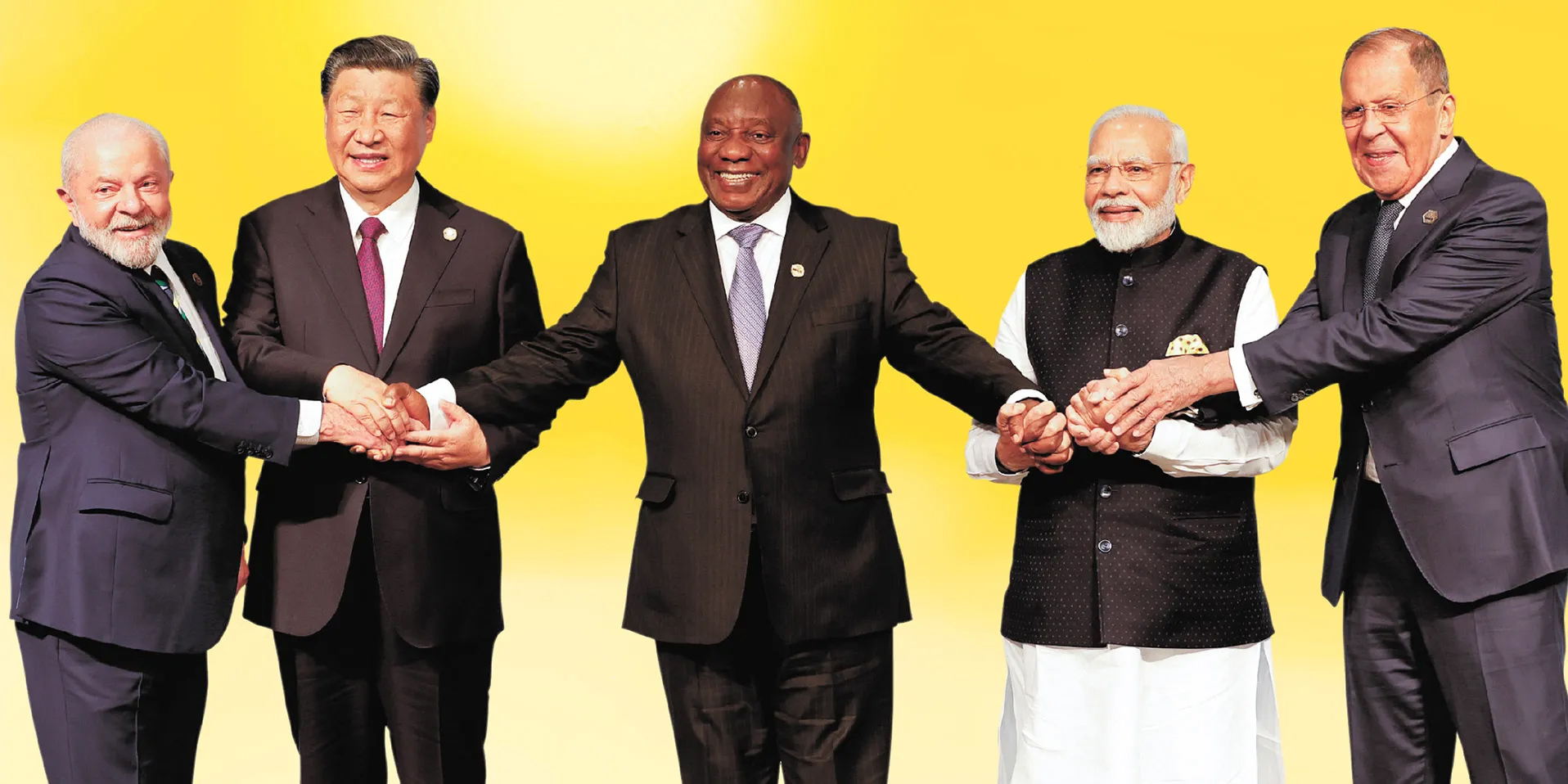
 President of Brazil Luiz Inácio Lula da Silva, President of China Xi Jinping, President of South Africa Cyril Ramaphosa, Prime Minister of India Narendra Modi and Russia Foreign Minister Sergei Lavrov during the 2023 BRICS Summit in Sandton, Johannesburg. (Photo: Gianluigi Guercia / EPA-EFE / Pool) | Graphic background: Vecteezy
 For many countries in Africa, Asia, Latin America and the Pacific, discomfort with Western overlordship and the bitter aftertaste of colonialism are daily realities. They and their populations do not have the luxury of opining on the existence of a “Global South”.
This article is a response to the piece “It’s time to rethink the chimera of the ‘Global South’” by Ray Hartley and Greg Mills.
As I wrote in my PhD thesis more than a decade ago, the labels “Third World” and “Global South” describe something no more uniform than they did at the height of their use.
“However,” I wrote, “the persistent trait of a subjective sense of marginalisation from power equations in international politics, along with unrelenting challenges of economic development, retain the relevance of the ‘Third World’ or ‘Global South’, if not as an objective, quantifiable reality, then at least as a collective mentality, or identity.
“More than an identity, the category still serves as a ‘political platform’ embracing development, fairer trade and transparent, accountable global financial practices, along with the democratisation of multilateral institutions.”
If you take a cold, hard look at global politics over the last five to 10 years, you may see the resurgence of the Global South as the conscience of the world. And this is precisely where the “agency” of the Global South lies. It has been the Global South, which forms the large majority in the UN General Assembly, that has featured strongly in debates on ceasefires in the Ukraine and Gaza conflicts. It has been the Global South that has maintained focus on issues of global economic development since the 1960s and 1970s, and sustainable development goals since the start of the 21st century.
It is only groups that are powerful, or that side with the current hegemonic bloc, that say “dispense with blocs” or “blocs don’t exist”. For the powerless, alternative power blocs are vital and provide a sense of hope. This is not to say that formations or ideas such as “the Global South” cannot be exploited or abused for the wrong reasons, but this is a different issue to asserting that the Global South does not exist.
The Global South is so much more than a rabble of countries that have a “grievance” with the West. The members of the Global South are by and large countries that suffered from colonial domination and are still dealing with the after-effects. They are also communities that have grappled with the cultural, social and psychological impacts of this colonial domination. This is far more than “grievance”: it is the struggle over the value of black life and black livelihoods, which continues all over the world today.
The Global South, dear South Africans, is us. Far from being a “deeply problematic” paradigm, as asserted by Hartley and Mills, it is the most empowering paradigm to have emerged from the colonised masses. Despite having deep-seated issues with the current world order, the Global South uses different aspects of this order to bring about greater equity in global affairs. What is at stake is ensuring that international law is implemented fairly and that global institutions are representative of the world today.
The Global South has voiced its distaste for the unfairness of major powers. If we are attuned to the agency of the Global South, we may see that Global South institutions, such as the Non-Aligned Movement established in 1961, have been based on principles of peace, disarmament, independence and self-determination, economic equality, universalism and multilateralism. It was countries of the Global South (India, China and Brazil) that voted against UN Resolution 1973 that saw a no-fly zone implemented over Libya that ultimately resulted in the capture and death of Muammar Gaddafi.
Much of the rhetoric ascribed to the Global South in the Hartley/Mills article has largely been operationalised by countries at the very fringes of the Global South, and not by the “mainstream” of the Global South for many years. Even BRICS Summit declarations since the inception of the BRICS partnership have used very careful language concerning the current world order and BRICS’s place in it. Yet, whether BRICS is actually “the centrepiece” of the Global South as Hartley and Mills assert is also an open question.
Also neglected in the article is the crisis of democracy and legitimacy that is currently being experienced in Europe and the US, and in their foreign policies. Where will the next set of “universal principles” come from? Why shouldn’t there be a critique of “the West”, or should we simply swap one form of remote control for another?
Instead of trying hastily to do away with the Global South, we should seek to revitalise its institutions, such as the Non-Aligned Movement, the Group of 77, and others; and solidarity should once again be the rallying cry of a world that is crying out for a new internationalism. DM
Candice Moore is a senior lecturer in international relations at Wits University.