




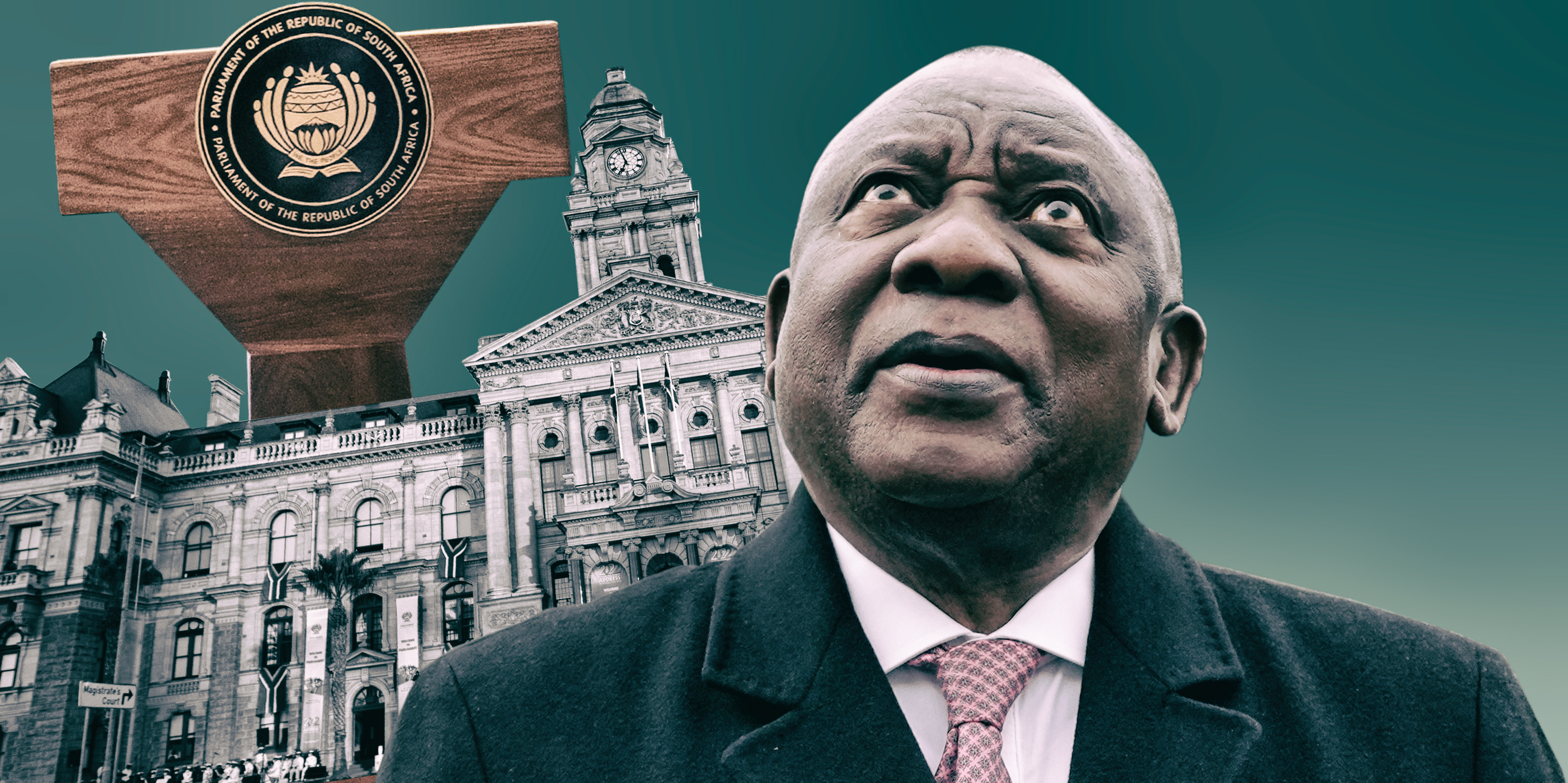
 President Cyril Ramaphosa and the ANC leadership will have to make some very big decisions in the 14 days after the elections are proclaimed. (Photo: Kirsty Wigglesworth - WPA Pool / Getty Images)
 Although it is impossible to predict the future of our politics, the Constitution does impose some structure which forces a timetable on elected politicians. In particular, it says the new MPs must meet in the National Assembly within 14 days of the election being proclaimed (which is probably the Saturday or Sunday immediately after the election). At that meeting, MPs must elect a President.
Within those two weeks there will be intense political activity, as the Constitution stipulates that any decisions have to be made quickly.
The ANC’s leadership will have to decide who to work with in national government (should the party fall short of the 50% mark), who to work with in provincial governments (probably in Gauteng, KwaZulu-Natal and possibly the Free State or the Northern Cape), who the premiers of most provinces will be, who the Speaker and Deputy Speaker will be, and finally, the composition of the Cabinet, which can feature only two non-members of Parliament.
The pace of events should give people in certain positions an interesting amount of power. Any group that has the best-laid plans in place could emerge from this period in a good place.
In many democracies where a prime minister or president is limited to two terms, the peak of their political power is often in the period immediately after they start their second term.
Our system is slightly different, because Ramaphosa started his second term as ANC leader in December 2022 and will probably not be president of the party after late 2027. He may now have the opportunity to be more assertive than at any other time, as politically he will have nothing to lose.
This will also depend on how much support he has in the upper echelons of the ANC.
Certainly, the results of the 2022 ANC conference suggested he had consolidated his support and was stronger than he was during his first term as ANC leader.
As often happens during election campaigns, the ANC is putting on a united front, all supporting the policies of their leader.
Even former president Thabo Mbeki, previously very critical of Ramaphosa over his lack of policy implementation and the Phala Phala scandal, is on the campaign trail.
The incumbent has some critical advantages.
Any decisions about coalitions or internal manoeuvres in the ANC will depend on the result of the election. And it is likely that Ramaphosa, and those closest to him, will have polling data that will tell them, fairly accurately, what the result will be.
This will give them more time to plan.
At the same time, while there has been muted speculation about whether Ramaphosa could lose his job if the ANC does badly, the only likely contender, Deputy President Paul Mashatile, has been quiet recently.
He has been dutifully making campaign stops, and there hasn’t been much murmuring about any kind of move against Ramaphosa. Mashatile’s own problems may make that difficult.
It may also simply be a better strategic choice for him to support Ramaphosa for the moment, particularly during the campaigning period.
However, Mashatile and others in the party must be aware of the full-scale chaos that could ensue if Ramaphosa were forced to leave the leadership, resigned as ANC leader or said he was not available to be President. (Imagine, for a moment how this could play out: the ANC gets a low share of the vote, the Multi-Party Coalition — MPC — does relatively well and in Parliament, Julius Malema backs an MPC candidate for President just to prove he is relevant).
Big blowback
However, there could still be big blowback in the ANC against its current leadership if the election goes badly for the party.
This would require meticulous planning because of the tight timelines — planning that would have to be done in secret.
Ramaphosa’s other presumed big advantage is that, as the person most likely to be President after the election, he will be responsible for doling out positions — which might well make anyone think twice about criticising him during that phase.
One of the more difficult questions around this time is, how much information will emerge about all of these processes and how will it emerge?
There may be secret coalition negotiations, in closed rooms with cellphones left in cars. Considering how coalitions and “informal working relationships” have been formed in the past, this is a likely scenario.
However, some parties may try to force these discussions into the open because they feel that negotiating through the media, in public, strengthens their position.
As can happen in our country, despite the original intention for all parties to keep a process secret, it could well end up playing out on live television.
In the meantime, Ramaphosa, and crucially, the Cabinet he heads, would still legally be in office and the current ministers would still make decisions about police, defence, etc.
This may become very necessary as some who fare badly in these elections could refuse to accept the results. Former president Jacob Zuma’s MK party might, for example, claim that he has had his “two-thirds majority” stolen and try to use violence to achieve their ends.
Hopefully, the police and other authorities will be prepared for any post-election violence.
Certainly, there will be people who have the legal authority (if not a political mandate) to make the necessary decisions if there is a problem. Depending on the result of the elections, this period could see the most intense political activity in South Africa, with the widest number of different permutations, since 1994.
This is what makes it so important and so interesting. DM