




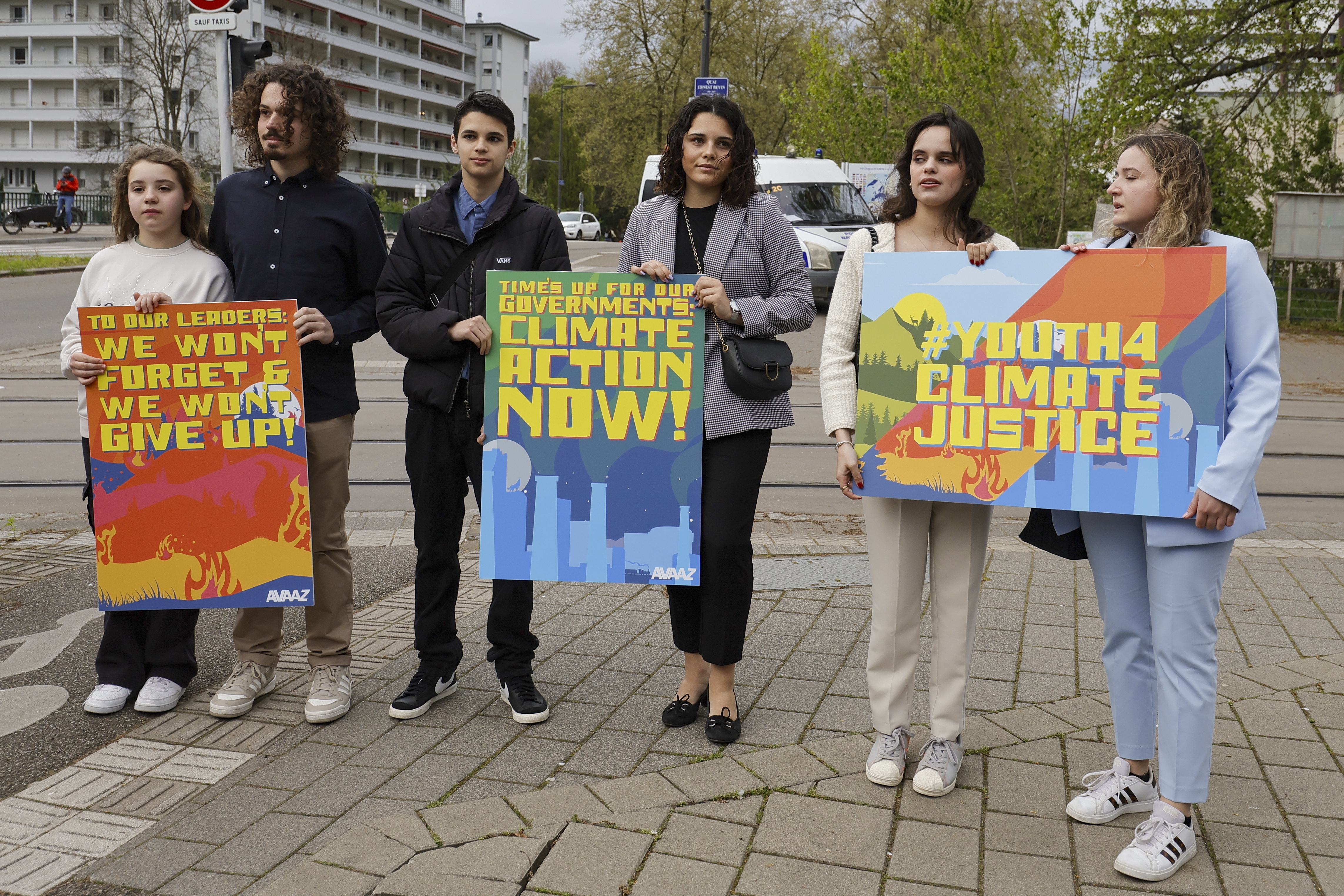
 Activists hold protest placards, as they stand in front of the European Court of Human Rights (ECHR), before the judgment in a case against different European countries accused of climate inaction, at the European Court of Human Rights in Strasbourg, France, 09 April 2024. The Strasbourg-based court was asked to rule in a trio of cases brought by a French mayor, six Portuguese young people, and more than 2,000 members of Switzerland's Senior Women for Climate Protection. Judges are to rule on complaints brought against Portugal, Switzerland, and France over carbon emissions. The ruling of the European Court of Human Rights could set a precedent for all its signatory members. EPA-EFE/RONALD WITTEK
The European court's decision on the case, brought by more than 2,000 women, could have a ripple effect across Europe and beyond, setting a precedent for how some courts deal with the rising tide of climate litigation argued on the basis of human rights infringements.
Court President Siofra O'Leary said the Swiss government had violated the human right to a private and family life, by failing to put in place sufficient domestic policies to tackle climate change.
"This included a failure to quantify, through a carbon budget or otherwise, national greenhouse gas emissions limitations," O'Leary told the courtroom.
She also noted the Swiss government had failed to meet its past greenhouse gas emission reduction targets, by not putting in place measures to ensure the goals were achieved.
Global civic movement Avaaz said the court's ruling had opened a new chapter in climate litigation.
"The Swiss ruling sets a crucial legally binding precedent serving as a blueprint for how to successfully sue your own government over climate failures," said Ruth Delbaere, legal campaigns director at Avaaz.
However, the court threw out two other similar cases, the first brought by six Portuguese youth against 32 European governments and another by a former French mayor against the French government.
"I really hoped that we would win against all the countries so obviously I’m disappointed that this didn’t happen," Sofia Oliveira, one of the Portuguese youngsters said in a statement.
"But the most important thing is that the Court has said in the Swiss women’s case that governments must cut their emissions more to protect human rights. So, their win is a win for us too and a win for everyone!"
The Swiss verdict, which cannot be appealed, could compel the government to take greater action on reducing emissions, including revising its 2030 emissions reductions targets to get in line with the Paris Agreement goal of limiting warming to 1.5 degrees Celsius.
The cases before the 17-judge panel in Strasbourg, France, joined a growing trend of communities bringing climate lawsuits against governments with arguments resting on human rights law.
(Reporting by Gloria Dickie and Kate Abnett; Editing by Kevin Liffey and Richard Lough)
Comments
Scroll down to load comments...