



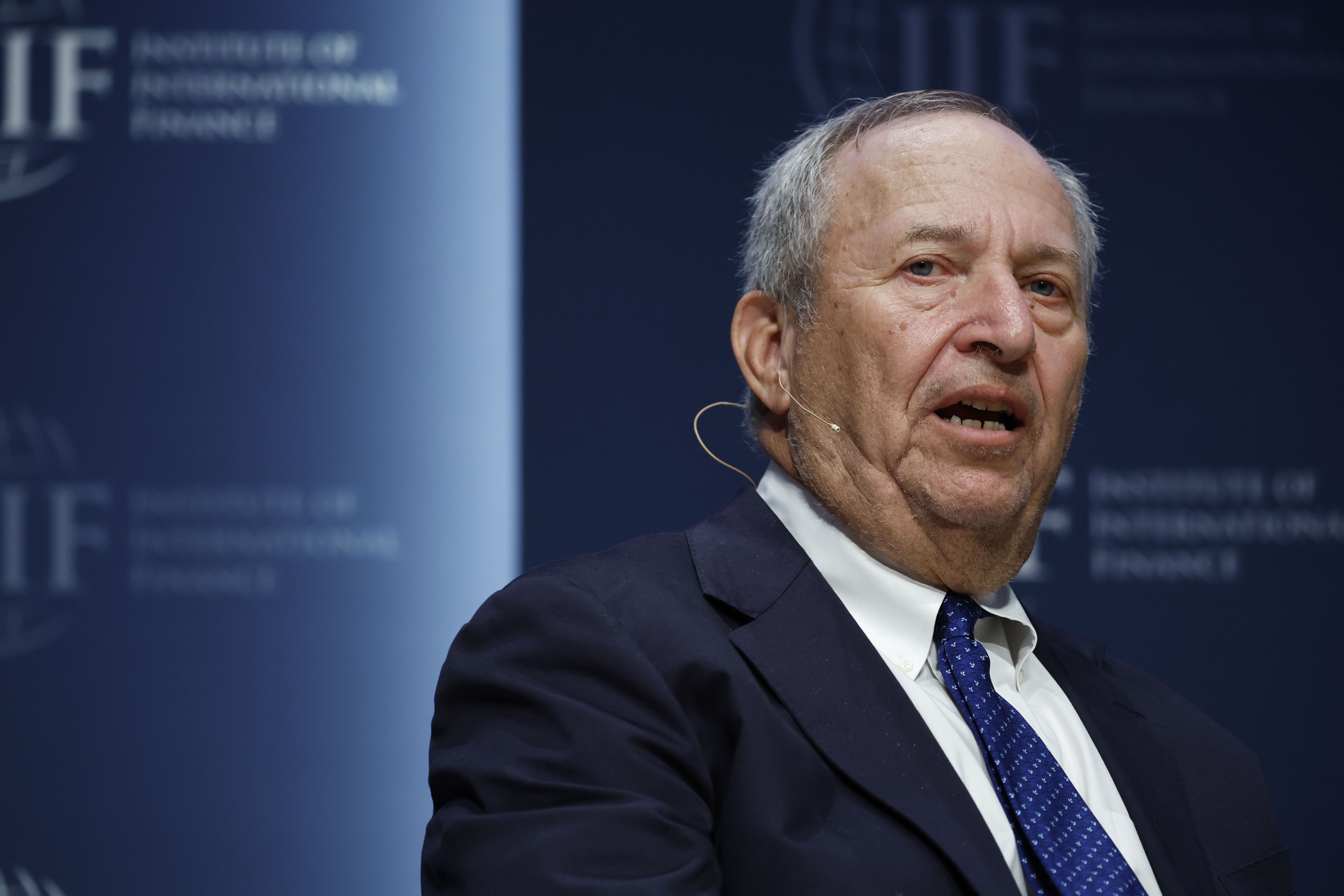
 Lawrence Summers, president emeritus and professor at Harvard University, speaks during the Institute of International Finance (IIF) annual membership meeting in Washington, DC, US, on Friday, Oct. 14, 2022. This year's conference theme is "The Search for Stability in an Era of Uncertainty, Realignment and Transformation."
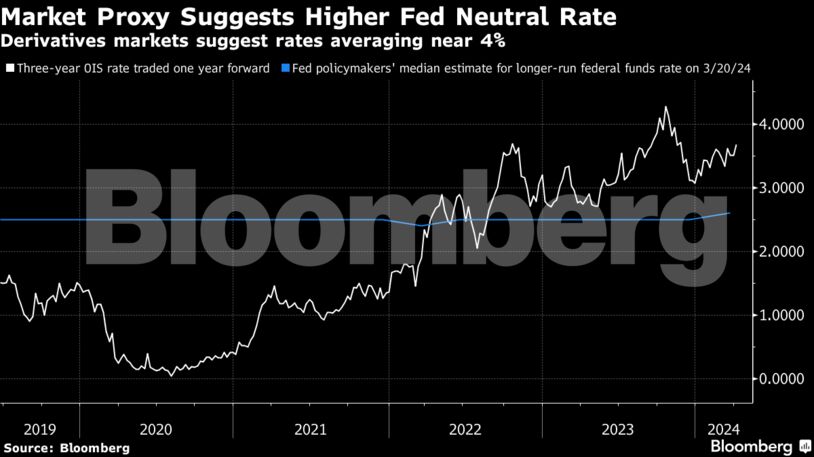
The neutral rate is the theoretical level for the Fed’s benchmark that neither stimulates nor restrains growth. Fed policymakers last month estimated it at around 2.6% — the median estimate of their forecasts. Summers reiterated his own view is that neutral is 4% or higher. That compares with the current target range of 5.25% to 5.5%.
“There’s a slight element of restriction, but only a slight one” given the Fed’s current rate setting, said Summers, a Harvard University professor and paid contributor to Bloomberg TV.
Earlier this week, Fed Chair Jerome Powell reiterated his skepticism about the idea of using estimates of a neutral rate as a guide for policy. The question of what the neutral rate will be going forward “doesn’t really matter for policy today,” he said in answering questions at a Stanford University event.
Last year, Powell said that it’s possible the short-term neutral rate might be higher than the long-term one, and also that the long-term one itself might be higher, but ultimately the calculation is “unknowable.”
Summers, by contrast, said it’s important to have a guide-post in setting current policy. “There’s no way to judge what policy is without knowing what would be a neutral policy,” he said.
“Saying ‘we don’t need to know what the neutral rate is’ is like saying you should drive your car on feel, without looking at the speedometer,” Summers said. “It is just a mistake,” he said, while noting that he hadn’t seen Powell’s specific remarks this week.
The former Treasury chief spoke after the March jobs report showed a 303,000 increase in payrolls that outstripped every economist’s forecast in Bloomberg’s survey, with the unemployment rate ticking down to 3.8% even as the size of the labor force expanded.
Read more: US Jobs Roar Again as Payrolls Jump 303,000, Unemployment Drops
“I don’t want to make a prescription for monetary policy in June, but on current facts and current trends, I think it would be an inappropriate act to cut rates” at that meeting, Summers said.
Futures trading suggests traders are increasingly betting that September will be the most likely meeting for the Fed to start lowering rates. They also suggest doubts about whether policymakers will follow through on the three rate reductions for 2024 that were indicated in their projections, known as the dot-plot.
“My best guess is that the right thing to do is going to be to stick where we are for considerably longer than the Fed dot-plot supposes,” Summers said. While it’s “certainly more likely than not that the next move will be down and should be down” in rates, there’s still “a real possibility that it should be up,” he said.
Comments
Scroll down to load comments...