



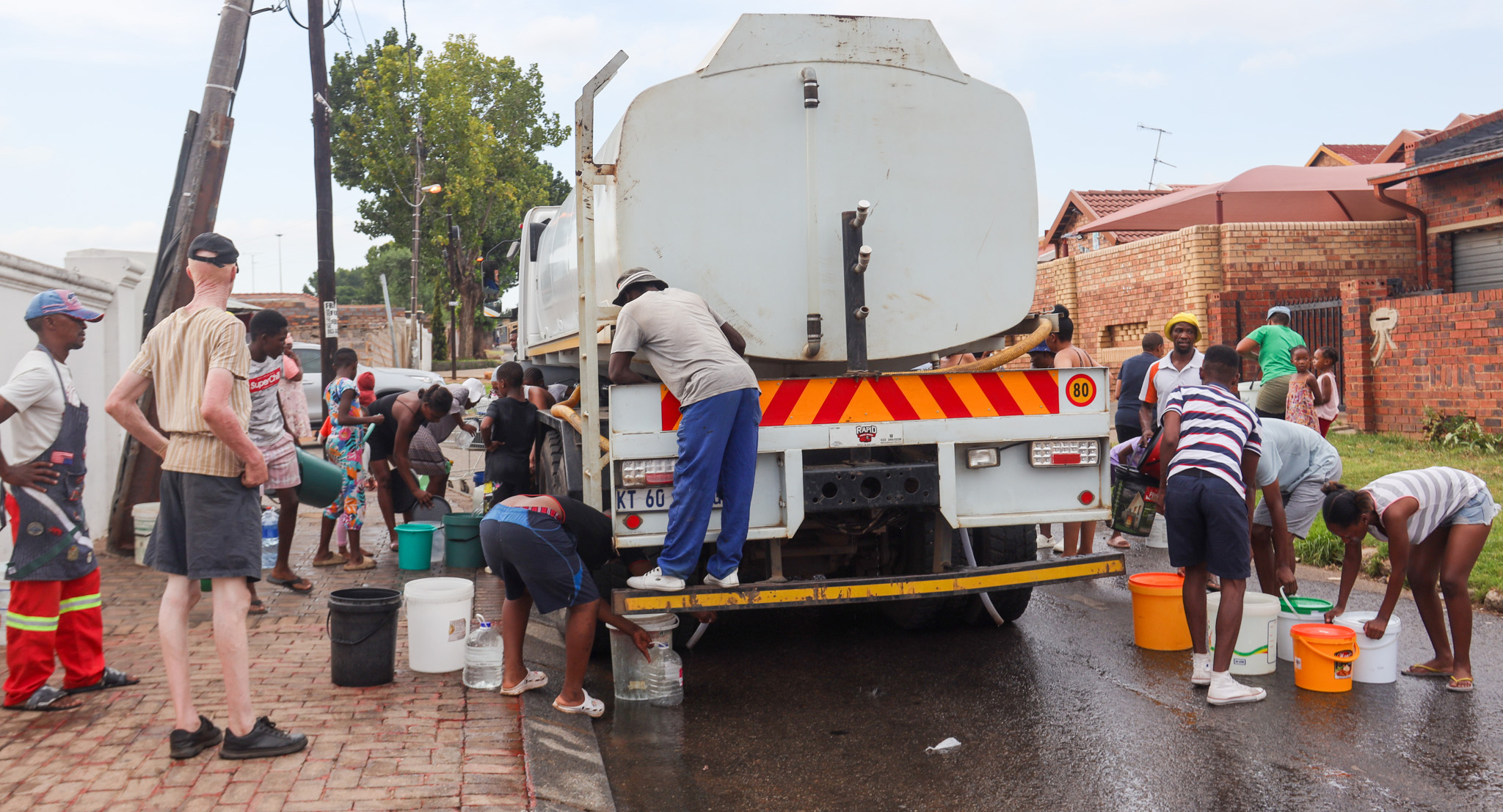
 Residents of Dube and Meadowlands in Soweto seek alternative means of water supply on 18 March 2024 in Soweto. (Photo: Gallo Images / Fani Mahuntsi)
 After denying that Johannesburg was grappling with a water crisis, Mayor Kabelo Gwamanda and MMC for Environment and Infrastructure Services Jack Sekwaila released the city’s water security plan at the Joburg Theatre on Tuesday.
It includes seven strategic responses and 67 action plans and was approved five months ago, on 31 October 2023.
“Recent water shortages faced by the citizens of Joburg serve as a stark reminder that water security is not a luxury but an imperative requiring concerted action,” said Gwamanda.
While the Johannesburg water crisis left many residents dry for weeks during March, Gwamanda’s spokesperson, in an interview with Daily Maverick’s Ferial Haffajee, denied there was a water crisis in the city.
Speaking about the new strategy, mayoral spokesperson Mlimandlela Ndamase said: “It is designed to confront challenges to the city’s urban water cycle while seizing opportunities to transform Johannesburg into a sustainable, resilient and adaptable city.”
The city said the seven strategic responses could be implemented simultaneously. They include:
- Achieve equitable access to safe, reliable water services;
- Achieve a coordinated good water government;
- Proper management of the water systems;
- Promote resilience and a sustainable urban water environment;
- Secure supply of water;
- Nurture a water-conscious society; and
- Manage water demands and losses.
Ndamase did not respond to Daily Maverick’s request for details of the plan and it does not appear to have been published on the municipality’s website.
On Tuesday, Gwamanda acknowledged the escalating challenges posed by water scarcity, pollution and the “looming threat” of climate change.
“As your mayor and guardian of our city’s most precious asset – our water – I stand before you. It is our collective responsibility to ensure the availability and quality of this vital resource for generations to come.
“To this end, the city, in collaboration with various stakeholders, has developed a comprehensive water security strategy crucial for ensuring community wellbeing, economic prosperity and environmental health.
“This multifaceted approach demands collaboration, innovation and sustained investment across all sectors of society.”
/file/dailymaverick/wp-content/uploads/2024/03/WhatsApp-Image-2024-03-27-at-17.10.34.jpeg "People fetch cooking and washing water in Protea, Soweto last week as the Joburg water crisis unfolded.(Photo: Bheki Simelane)")
National Water and Sanitation Minister Senzo Mchunu reportedly met Gwamanda and city officials last week after he asked the city earlier in March to present a plan to address infrastructure challenges and non-revenue water – water lost to leaks and theft or non-payment, currently sitting at 46.1%.
“We have set aside about R100-million for the electricity supply entity, City Power, to put alternative power supply infrastructure into key infrastructure that contributes to the water supply network,” Gwamanda said during the meeting last week.
Mchunu said, “It is clear that the city requires serious interventions and funding to deal with its water infrastructure renewal programme, and the department will work with Joburg Water in packaging some of their key infrastructure projects that require blended finance, including from the private sector.”
‘PR exercise’
WaterCAN senior manager Dr Ferrial Adam said that before releasing its water plan, the city should have devised a consultative strategy and engaged civil society and other stakeholders in the fight to protect water systems.
WaterCAN is an Outa initiative and describes itself as “a growing network of citizen science activists who are committed water guardians”.
“It is clear that the pressure they have been feeling from people on the ground has resulted in this PR exercise,” Adam said.
“Having a strategy is part of their responsibility in terms of water. There are many things in the strategy that should already be underway. So the event that they had may have been unnecessary. What is important is the way that they plan to track achievements. Strategies can be very broad, so it is the detail that we need to assess.”
Read more in Daily Maverick: As Rand Water warns of wider system collapse, Soweto and Johannesburg taps still dry
Gwamanda noted the need to explore alternative water sources, which Adam agreed was a crucial step.
“We must continue to explore the use of groundwater and water recycling and re-use to supplement the bulk supply we receive from Rand Water,” said Adam.
“The concern here is the use of groundwater. It is not being monitored well and I think that we are not giving it enough attention in Gauteng,” she added.
“Government must also commit to avoid wasting water and to fix leaks timeously. Joburg Water [should] provide timeframes to respond to failures. This should be a KPI [key performance indicator] and tracked monthly to show how response time has improved.
“In addition, the municipality must hold companies responsible for overuse and pollution.” DM