




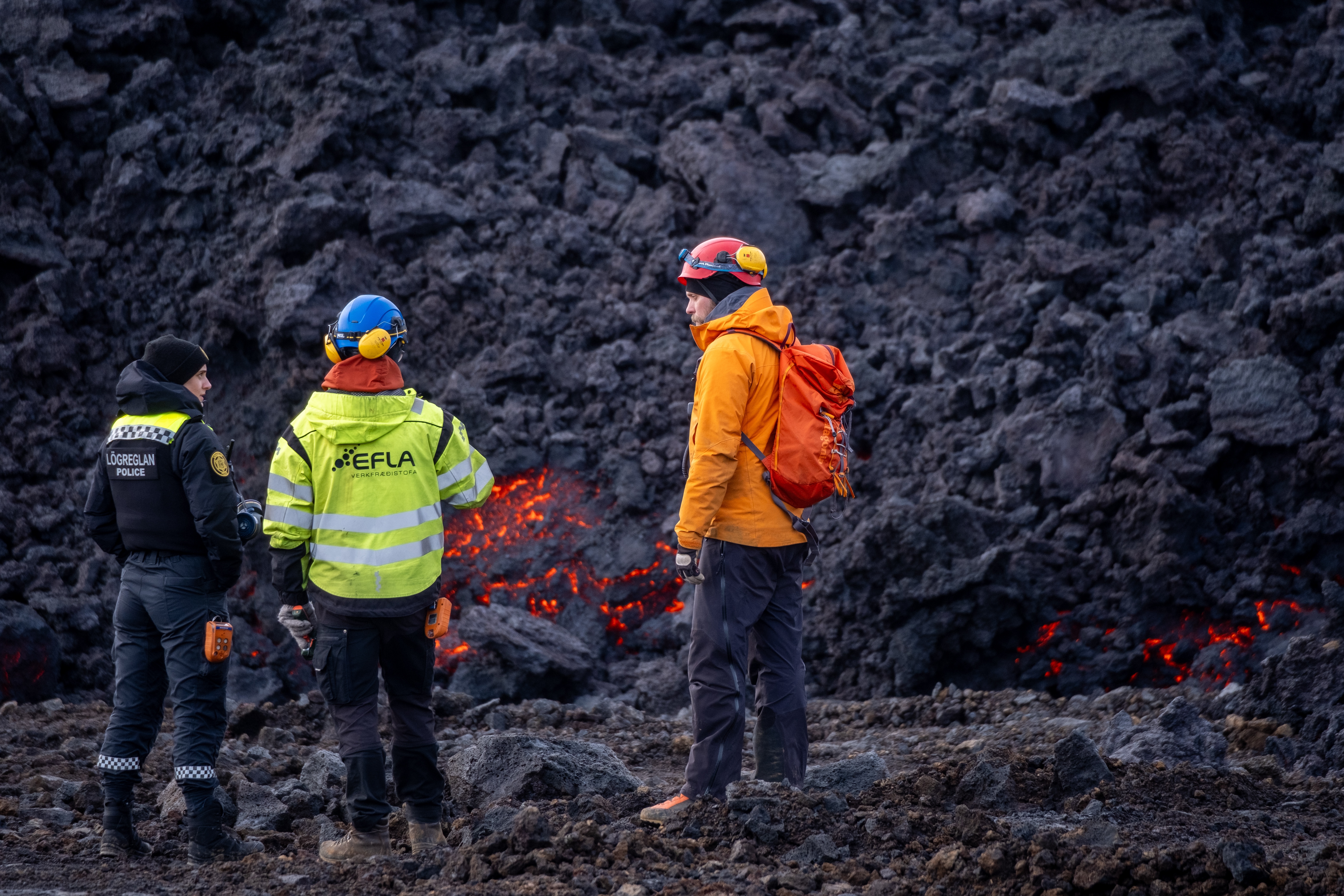
 A police officer and engnineers stand near a lava field formed after a volcano erupted, near Hagafell in the Reykjanes Peninsula, Southwestern Iceland, 17 March 2024. According to Icelandic authorities, a state of emergency was declared on 17 March after a volcanic eruption between stora Skogfell and Hagafell in the Reykjanes Peninsula of Iceland. EPA-EFE/Anton Brink
The eruption was the seventh on the Reykjanes peninsula near Iceland's capital Reykjavik since 2021 when geological systems that had lain dormant for around 800 years again became active.
Man-made barriers have been successful in steering the lava away from infrastructure including the Svartsengi geothermal power plant and Grindavik, a fishing town of some 4,000 residents.
Footage from public broadcaster RUV showed lava flowing a few hundred metres from the town which was evacuated during an eruption in November and again during another one in February.
"The defences at Grindavik proved their value ... they have guided the lava flow in the intended direction," local utility HS Orka said, adding that infrastructure running to the Svartsengi power plant was intact.
Magma had been accumulating underground since the last eruption in February, prompting authorities to warn of an imminent eruption.
The warning time late on Saturday was only 15 minutes before fountains of molten rock began soaring from a 3km-long (1.9 mile) fissure, roughly the same size and at the same place as the eruption in February.
Lava flows continued at a steady pace on Monday, and it was too early to project when it would end, Magnus Tumi Gudmundsson, professor of geophysics at the University of Iceland, told RUV.
"It was surprisingly stable overnight and certainly majestic, but is still only between 2-5% of what it was at the beginning," he said.
The February eruption lasted less than two days while volcanic activity continued for six months at a nearby system in 2021.
(Reporting by Jacob Gronholt-Pedersen;Editing by Andrew Cawthorne and Ed Osmond)
Comments
Scroll down to load comments...