




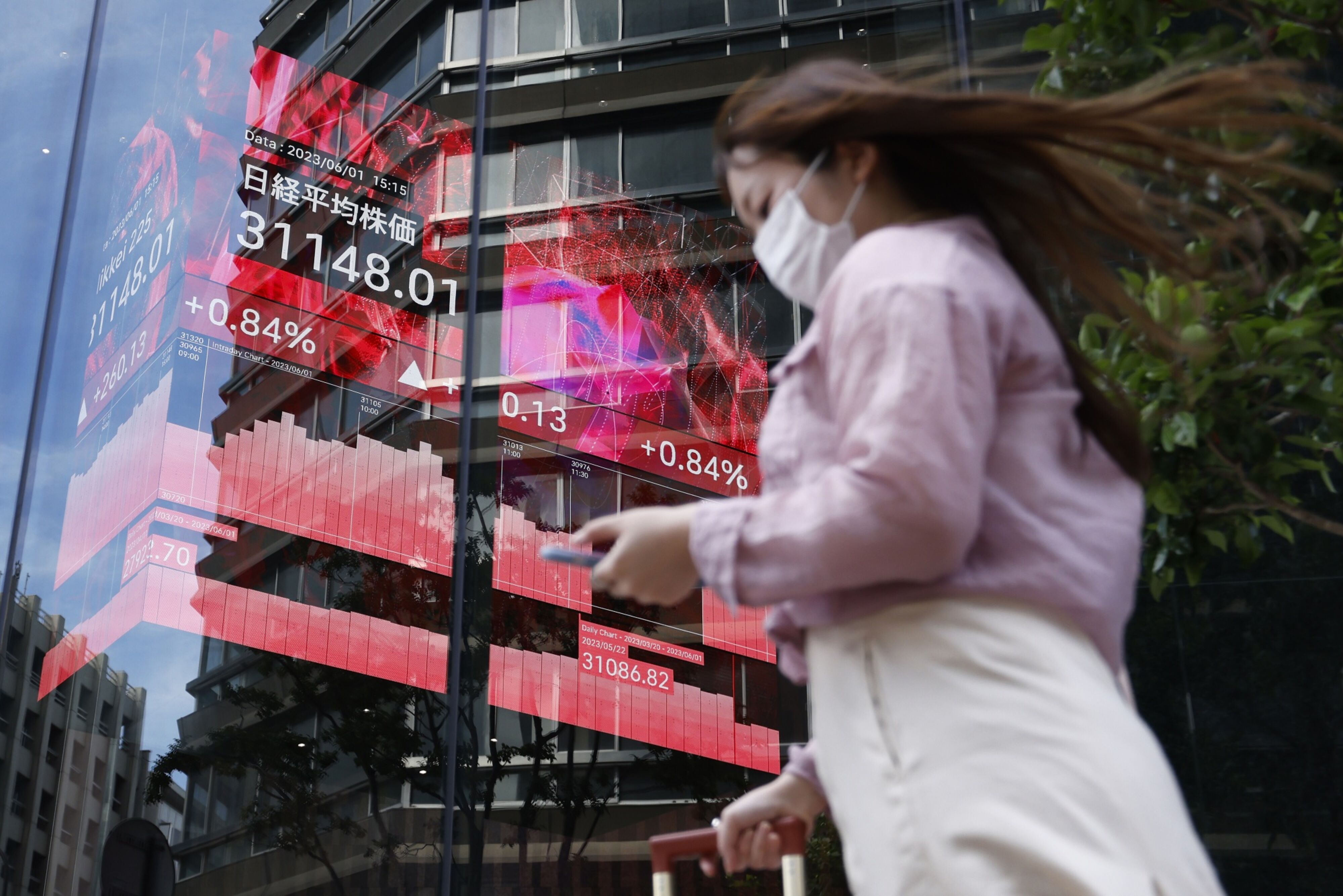
 An electronic stock board showing the Nikkei 225 Stock Average figure displayed inside the Kabuto One building in Tokyo, Japan, on Thursday, 1 June 2023.
Technology shares were the biggest gainers in Asia, with Taiwan Semiconductor Manufacturing Co. rising as much as 6.2% and SK Hynix Inc. climbing 5%. The blue-chip gauge Nikkei-225 Stock Average in Japan also surpassed 40,000 for the first time while South Korea’s Kospi index rose as much as 1.5%. Their advances followed the strong rallies in US peers on Friday.
“The Nikkei 225’s 40,000 is certainly a key psychological level, which could offer some resistance for the index and bring volatility,” said Charu Chanana, strategist at Saxo Capital Markets based in Singapore. “But when structural factors remain in favour, and yen weakness continues, it is likely to be more of a bullish signal rather than fueling any concerns of Japanese stocks being overbought.”
Chinese stocks edged lower as the nation’s equities and the yuan are in focus ahead of the 14th National People’s Congress, an annual parliamentary gathering in Beijing, that will begin Tuesday as markets await more stimulus measures to aid a soft economy. A cut to key mortgage rates and encouraging state funds to buy shares have done little to spur confidence as policy makers battle a property crisis, stubborn deflation and angry retail investors caught in a $7-trillion stock rout.
Oil steadied near the highest level this year after OPEC+ extended its production cuts to stave off a global crude surplus. US crude traded around $80 a barrel in Asia, holding the level it hit for the first time in almost four months on Friday.
Treasury yields edged higher in Asian trading after the rate on the policy sensitive two-year fell nine basis points on Friday following weaker than expected activity data and cautious comments from Fed officials. The dollar traded in tight ranges against its Group-of-10 peers, while the South Korean won strengthened to the highest level in a week amid improving exports.
In credit, Adani Group began marketing it first dollar bond since a report by short seller Hindenburg Research in an attempt to rebuild investor confidence.
Powell’s testimony
The rally in US markets will likely hinge on jobs data and Powell’s testimony this week as bets for the start of the Fed’s easing cycle were refined amid recent data indicating a resilient US economy. Swaps traders now see the first cut in July, compared with the May estimate they were pricing at the beginning of last month, according to data compiled by Bloomberg.
“We don’t expect the chair to stray very far from the Fed’s recent messaging — officials are in a “wait-and-see” mode as there’s still a lot of ambiguity in the data,” John Briggs, global head of desk strategy at NatWest Markets wrote in a note. Government bond yields “have pushed toward their highs of recent ranges, and we think further large corrections towards higher yields is a lot less likely from here”.
The stock rally is showing little signs of slowing as US corporate earnings grew nearly 8% in the fourth quarter, helping offset macroeconomic uncertainty. Meanwhile, the frenzy around artificial-intelligence has blindsided Wall Street forecasters, spurring a race among strategists to keep up with a stock market rally that’s already blowing past their expectations when 2024 began.
Bank of America ratcheted up its forecast for the S&P 500 to 5,400 by year-end amid a surprising profit margin resilience, Savita Subramanian wrote in a note to clients.
Elsewhere this week, traders will be keeping an eye on Tokyo inflation, Australian growth data and a policy decision from the European Central Bank. The so-called Super Tuesday Republican and Democratic party primary votes, US jobs data and earnings from US consumer discretionary stocks are also due.
Comments
Scroll down to load comments...