



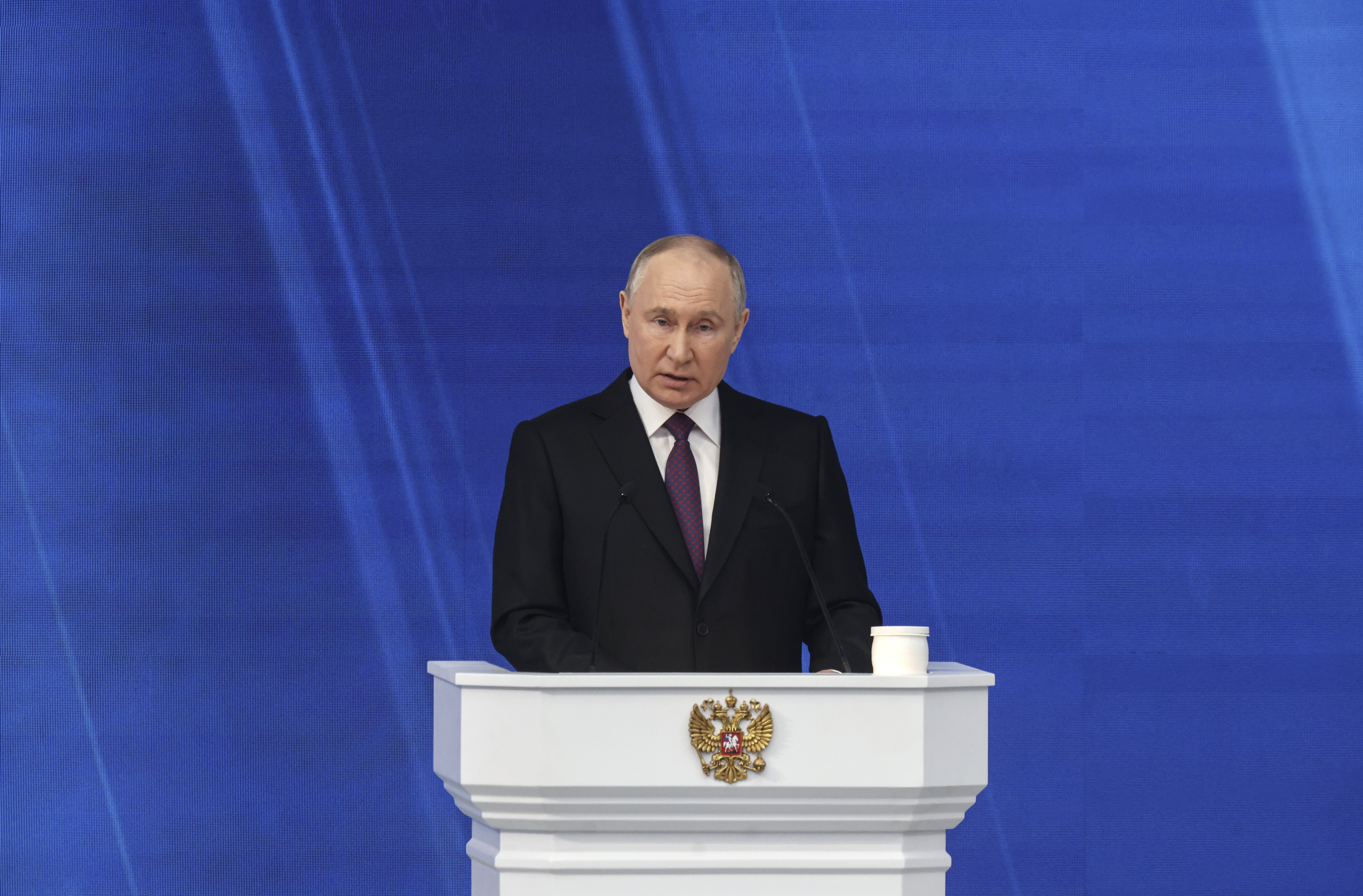
 Russian President Vladimir Putin delivers his annual address to the Federal Assembly at the Gostiny Dvor conference center in Moscow, Russia, 29 February 2024. About 1,200 people, including lawmakers of Russias two-chamber parliament, Government members, heads of the Constitutional and Supreme court, and regional governors, were invited to attend the event. EPA-EFE/SERGEI ILNITSKY
The US and Europe “must understand that we also have weapons that can hit targets on their territory and that all this really threatens a conflict with the use of nuclear weapons, and therefore the destruction of civilization,” Putin said. He listed new Russian strategic weapons that are entering military service including Sarmat intercontinental ballistic missiles capable of carrying nuclear warheads.
The threat came after French President Emmanuel Macron this week refused to rule out sending troops to Ukraine, an idea rebuffed by the White House and German Chancellor Olaf Scholz. That’s as Russian troops are advancing in Ukraine, which is struggling to supply its forces with ammunition while more than $60 billion in US military aid is held up in Congress amid political disputes.
Europe is boosting defense production in response to Russia’s aggression. Still, Ukrainian officials are concerned Russia could gain momentum to break through defenses by the summer unless allies increase the flow of ammunition, according to a person familiar with their analysis. Assessments in Kyiv of the battlefield situation are growing increasingly bleak.
Much of Putin’s flagship speech, which lasted a record two hours and six minutes, amounted to his manifesto for the March 15-17 presidential election that will prolong his almost quarter-century rule by another six years.
How Putin Engineers Longest Russia Rule Since Stalin: QuickTake
In language reminiscent of World War II, which is known in Russia as the “Great Patriotic War,” he began his address by praising the contribution of citizens working around the clock at factories producing munitions and weapons for the army fighting in Ukraine.
“Everyone is playing their part for us to achieve victory,” said Putin, who reiterated that Russia remains committed to the goals of its February 2022 invasion.
The US and its allies imposed fresh sanctions on Russia last week to mark two years since the war began. With defense spending helping to spur growth, Russia is gradually adapting to years of unprecedented measures that failed to collapse its economy.
Still, Putin has lost a big part of Russia’s monetary defenses. Some $300 billion of the central bank’s assets remain frozen abroad as the US and Europe weigh measures to use the funds to help Ukraine.
Russia imposed capital controls to bolster the ruble, which has weakened nearly 18% against the dollar in the past year. The National Wellbeing Fund’s liquid assets have declined by almost half since the war began as the government taps reserves to try to shield the economy.
Inside Russia, the Kremlin has crushed dissent with the harshest crackdown in decades. The Feb. 16 death of Alexey Navalny, Putin’s most outspoken foe, in an Arctic prison camp dealt a severe blow to Russia’s opposition movement, whose leaders are mostly in exile or in prison.
Navalny’s funeral in Moscow announced for Friday offers potentially the most significant gauge of opposition support in the country since the war began.
Putin set out plans to boost spending on government support to mothers and on health care to help reverse Russia’s population decline and improve life expectancy in his next term. He pledged to raise salaries for teachers by 5,000 rubles ($55) per month from September, and to repair thousands of schools and kindergartens by 2030.
Putin, 71, is already the longest-serving Russian ruler since Josef Stalin. Under constitutional changes adopted in 2020, he’s eligible to run for two more terms lasting to 2036, when he’ll be 83.
Comments
Scroll down to load comments...