 Stocks wavers after big rally
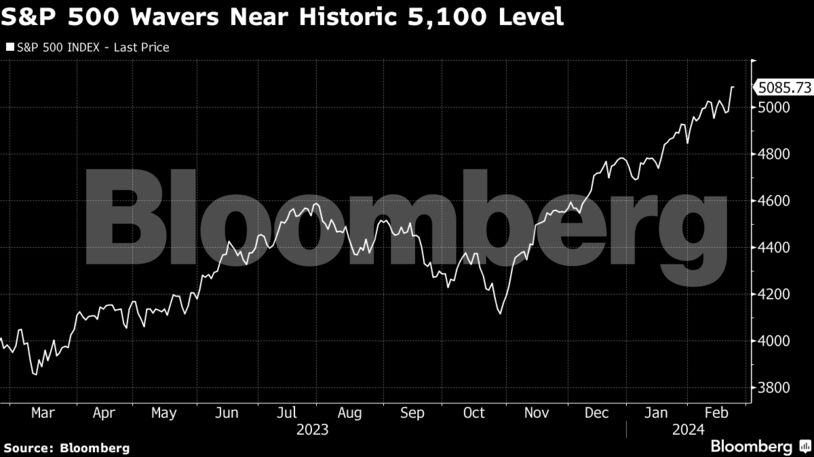
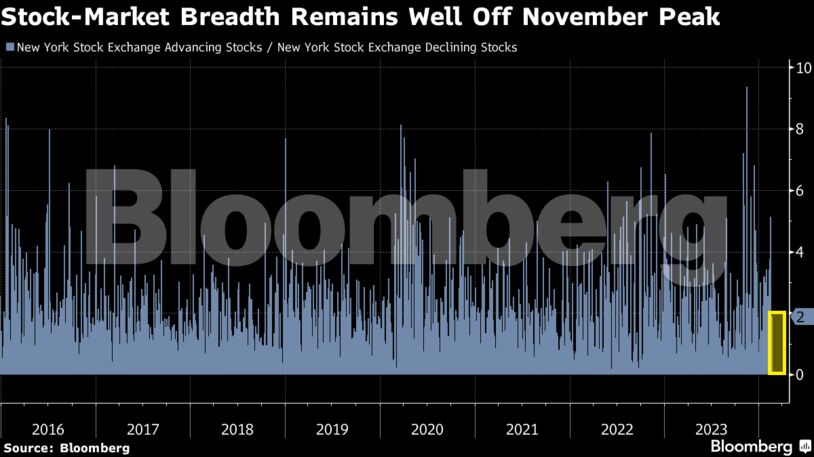
 “The speed of the tech rally has left investors wondering whether to take profits,” said Mark Haefele, chief investment officer at UBS Global Wealth Management. “While we see merit in re-balancing portfolios, we believe that retaining strategic exposure to US large-cap technology is important, and the rise in tech stocks could go further still.” A rally in artificial intelligence stocks and optimism about economic growth at a time of easing monetary policy are the ingredients of a “magic sauce” to drive more gains in equity markets, according to Bank of America Corp.’s Michael Hartnett. The strategist — who has taken a more neutral tone on stocks this year after remaining bearish through 2023 — said that a “baby bubble” in AI was “growing up.” A pickup in US business activity just as the Federal Reserve could start cutting interest rates also bodes well for the S&P 500 to continue to mark new highs, Hartnett said. The S&P 500 was little changed, while still heading for a weekly gain. The tech-heavy Nasdaq 100 underperformed. Treasury 10-year yields declined six basis points to 4.26%. The surge in Nvidia’s shares on Thursday left short sellers with about $3 billion in paper losses, according to an analysis by S3 Partners LLC — which called it an “AI generated nightmare” for bearish traders. The mark-to-market losses are another blow for contrarians who argued that Nvidia’s sky-high valuations and speculative fever had all the makings of a market bubble about to pop. The chipmaker is the third-largest US short with $18.3 billion of shares that have been borrowed and sold, according to S3. While the rally in US tech behemoths has sparked some concern about a potential bubble, the price action is aligned with earnings fundamentals, according to Barclays Plc strategists. As long as stocks move in tandem with profit outlook, the “fear of missing out” will continue to prevail for the tech/AI space and investors will give the benefit of the doubt to lofty valuations, the team led by Emmanuel Cau wrote. “There will likely be pullbacks and volatility over the next few months and we are supportive of the buy-the-dip mentality when it comes to big tech,” said Greg Marcus at UBS Private Wealth Management. Now as hard as the S&P 500 rallied a day after Nvidia’s blowout results, the advance lacked an important component — strong participation of its constituents. As investors cheered blowout results from Nvidia on Thursday — only 73% of the S&P 500’s members advanced. That’s the lowest participation for an up day of this magnitude since the immediate aftermath of the 2020 election, when the index gained 2.2% while only 47% of its members went up. Since then, 2% up days have been accompanied by an upward move in 92% of its stocks, on average, data compiled by Bloomberg show. “Even though market breadth is still narrow, it’s wider than it was last year, with more and more stocks this year outperforming the S&P 500,” Marcus added. To Matt Maley at Miller Tabak + Co., while earnings out of Nvidia sparked another strong advance, it was disappointing to see a “very narrow” rally — which hasn’t hurt the market yet. However, Maley points to a significant “valuation divergence” between Nvidia and the other AI-related stocks that has been developing for some time now. “This should have important implications for how these stocks should be weighted in one’s portfolio — even when an inevitable correction takes place at some point in the future,” he noted. Marcus at UBS says that if the Federal Reserve starts cutting interest rates, that will likely help spark wider breadth in the market. “While we expect a continued resilience in tech stocks, we also expect a less dramatic — albeit still heavy — focus on the ‘Magnificent 7’,” Marcus added. “Rate cuts are also likely to help support the broader market.” Goldman Sachs Group Inc. economists have pushed back their view on when the Fed will begin cutting interest rates to June after parsing recent comments from the central bank and minutes of its January meeting. The US investment bank has dropped its forecast for a May cut and now expects four reductions this year, versus five previously, with moves in June, July, September and December. It now sees four more cuts next year, versus a prior three, leaving the same terminal rate of 3.25%-3.5%, economists including Jan Hatzius wrote. And interest-rate strategists at JPMorgan Chase & Co. raised their year-end forecasts for Treasury yields “to reflect greater risk premium and a longer QT runway than previously expected,” a team led by Jay Barry said. The 10-year yield forecast rose to 3.80% from 3.65%. While “yields have room to decline from their current levels in the coming months” based on “markets pricing in a less dovish path than our forecast” for Fed policy — which is for 25bp rate cuts at every meeting this year beginning in June — uncertainty over the Fed’s path is likely to persist, they noted. “And Treasury yields will likely stay more elevated with a higher risk premium to reflect higher probability of fewer cuts over time.” Some of the main moves in markets:Corporate Highlights:
Stocks
Currencies
Cryptocurrencies
Bonds
Commodities
This article is more than a year old
Newsdeck
Stock Rally Wanes After S&P 500 Touches 5,100 Mark: Markets Wrap
The stock market struggled for direction on Friday, with big tech losing steam after a powerful rally driven by the artificial-intelligence euphoria.
A feat of multiple records in the world’s biggest equity market drove the S&P 500 briefly above the historic 5,100 mark. Most members of the “Magnificent Seven” group of megacaps came under pressure — with Nvidia Corp.’s gains moderating after the giant chipmaker topped $2 trillion in value earlier in the session.