




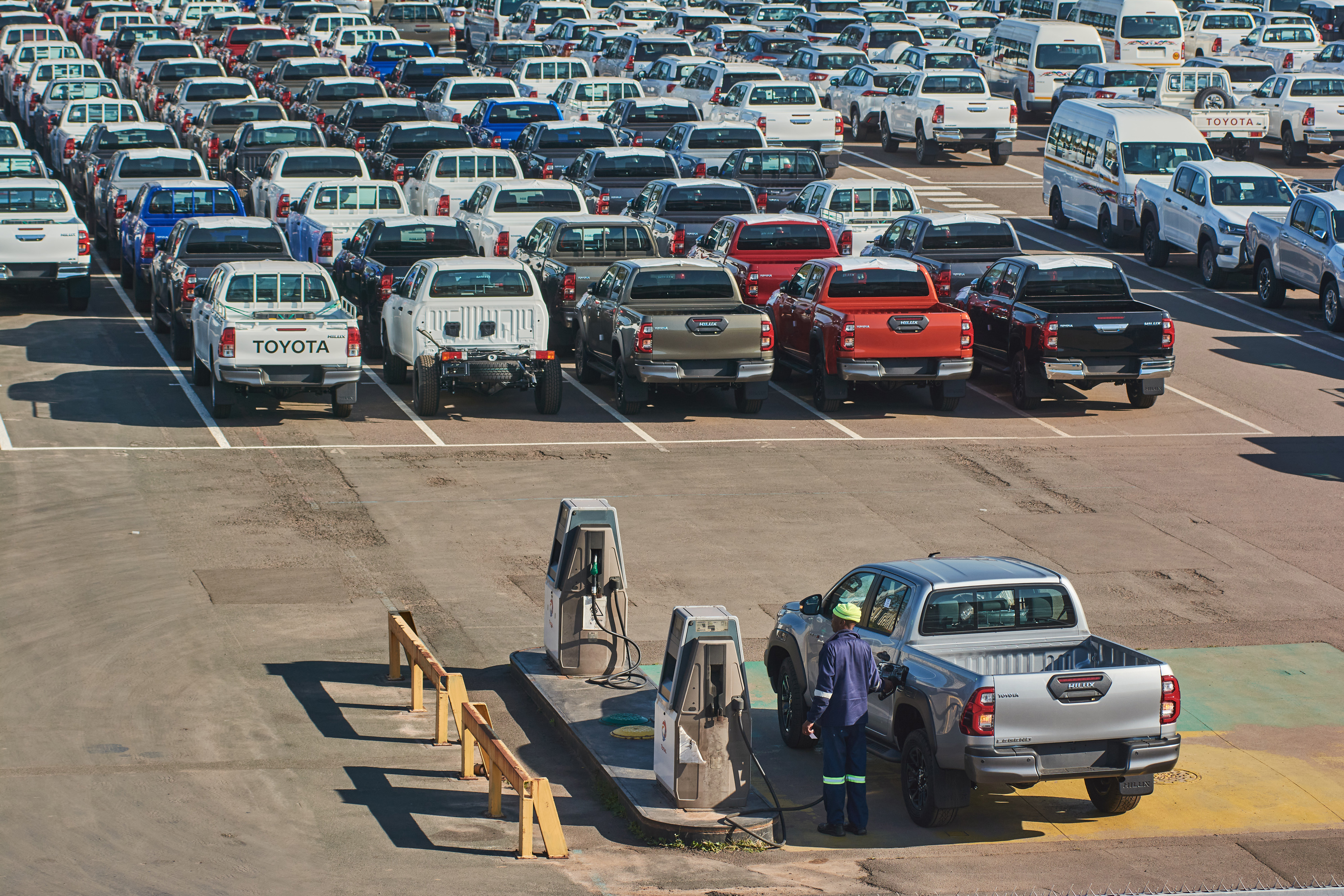
 A worker fuels a Hilux vehicle at a petrol pump at Toyota Motor manufacturing plant in Durban on Tuesday, 16 August 2022. (Photo: Waldo Swiegers/Bloomberg via Getty Images)
 Global sales, including those of subsidiaries Daihatsu Motor Co. and Hino Motors Ltd., rose 7.2% from the previous year to a record 11.2 million cars in 2023, the company said on Tuesday.
Output, which refers to cars off the production line, grew 8.6% to 11.5 million units. VW’s deliveries increased 12% to 9.24 million units in 2023.
“Toyota has gone from struggling with supply chains last summer to selling whatever it makes,” Bloomberg Intelligence senior auto analyst Tatsuo Yoshida said.
Despite falling further behind in the global shift toward electric vehicles, recovering supply chains and steady demand in North America and Europe last year helped Toyota boost production and rake in profits from abroad. Demand for hybrids at home meanwhile remains high and steady across most of the world.
While 2023’s full-year figures cement Toyota’s dominance, it was China’s BYD Co. that arguably generated the most buzz last year when it surpassed Elon Musk’s Tesla Inc. as the world’s top manufacturer of electric cars. Shenzhen-based BYD, which only sells EVs and plug-in hybrids, sold around 3.02 million units in 2023.
Toyota, by comparison, sold 104,018 battery EVs. Initially the Japanese carmaker aimed to sell 202,000 units during the fiscal year that ends in March, but lowered that goal to 123,000 in November, citing issues of demand and supply.
Tesla delivered 1.81 million vehicles last year.
Toyota CEO Koji Sato has promised the company will be able to sell 1.5 million battery EVs annually by 2026, and 3.5 million by 2030.
On Monday, Toyota suspended shipments of 10 models after an internal investigation revealed that one of its suppliers, Toyota Industries Corp., had been manipulating test results to gain certification for its vehicles.
The revelations piled onto a scandal that emerged in December, after unit Daihatsu, which sells and supplies popular lightweight trucks, was found to have manipulated collision safety test results dating back as far as 1989.
Read more: Toyota Vows Reform After Affiliate Caught in Safety Scandal
While the impact and financial burden of the fraudulent conduct is only just beginning to take shape, Toyota has said it will step in should Daihatsu struggle to compensate its suppliers and business partners while production is partially suspended and vehicles are recalled.
Toyota chairman Akio Toyoda — who said this month EVs will at most reach a 30% market share — is scheduled to speak with reporters on Tuesday afternoon in Nagoya prefecture on his vision for the future of the group.
Daihatsu was ordered by Japan’s transport ministry to put forward countermeasures by mid-February to prevent a repeat of such a thing happening again. Toyota has also said it will announce a new structure, though it didn’t clarify what that meant.