




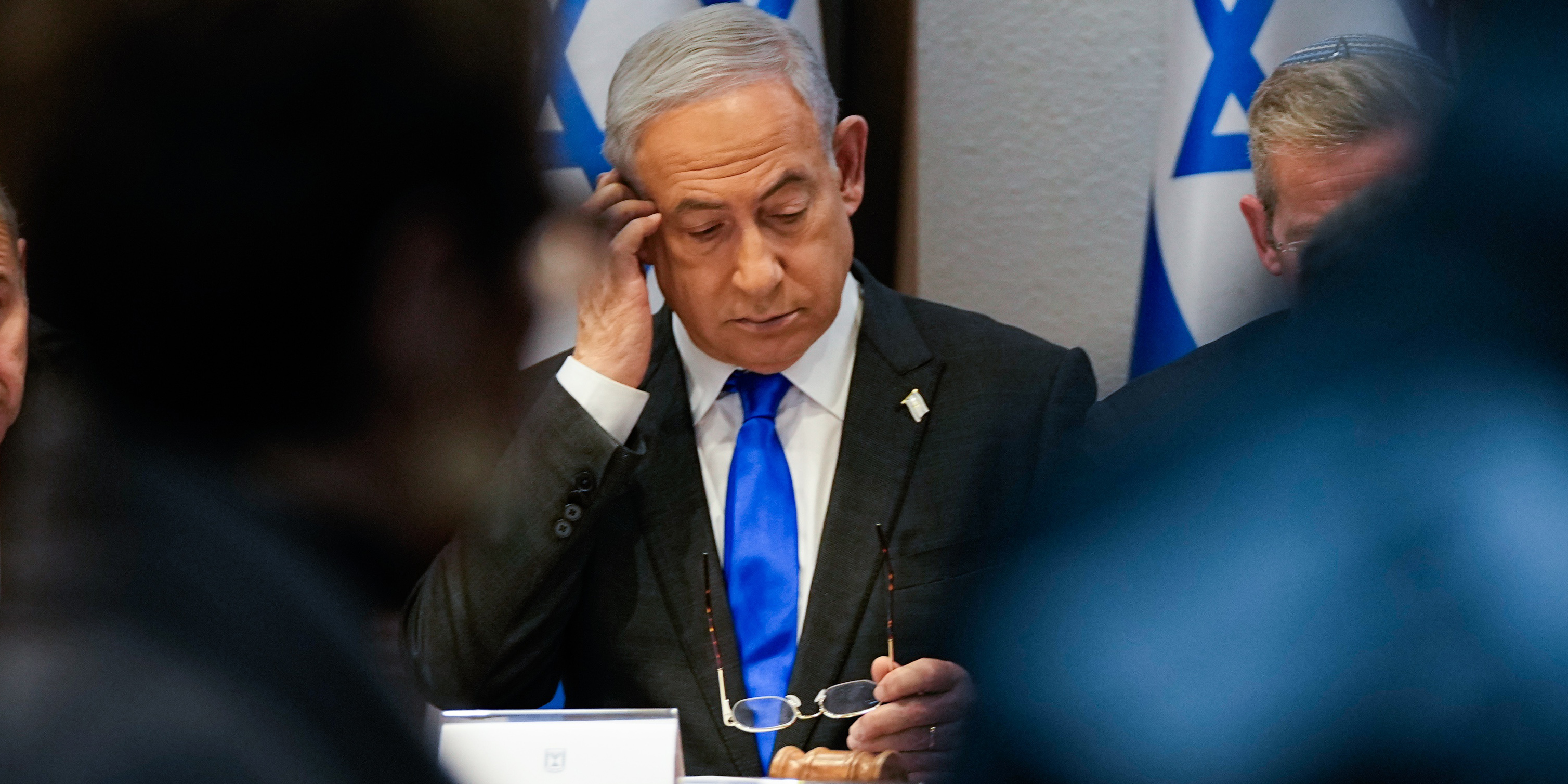
 Prime Minister of Israel Benjamin Netanyahu chairs a Cabinet meeting at The Kirya military base in Tel Aviv, Israel, 24 December 2023. (Photo: EPA-EFE / Ohad Zwigenberg)
Israel will need to increase defence spending by at least 30-billion shekels ($8.3-billion) next year, according to the finance ministry, as the war against Hamas rages on.
The US military launched strikes on three installations in Iraq, targeting what it said is a terrorist group backed by Iran that Washington has accused of a series of attacks on US personnel, including one on Monday that left three people injured.
Iran said an Israeli air strike in Damascus on Monday killed a senior commander of its Revolutionary Guard, Seyyed Razi Mousavi.
Netanyahu outlines three prerequisites to achieving peace
Israeli Prime Minister Benjamin Netanyahu outlined three prerequisites to achieving peace in its war with Hamas: the destruction of the group, the demilitarisation of Gaza and for Palestinian society to be “deradicalised”.
The comments, made in an op-ed in the Wall Street Journal published on Monday, come amid rising pressure on Israel to scale back the conflict in Gaza, which began following Hamas’ 7 October assault on southern Israeli communities that killed 1,200 people — with Hamas militants kidnapping scores of Israelis.
“In destroying Hamas, Israel will continue to act in full compliance with international law,” Netanyahu wrote, saying that eliminating Hamas “is the only proportional response to prevent the repeat of such horrific atrocities”.
More than 20,000 people have been killed in Gaza since the start of the war, according to the Hamas-run health ministry. Much of the Palestinian enclave has been flattened by Israeli airstrikes and the UN has said the humanitarian situation is dire.
The US has continued to back Israel’s right to defend itself, vetoing a United Nations Security Council resolution earlier this month that called for a ceasefire. But President Joe Biden and his top officials have increasingly pressed Israel to change its approach to the war against Hamas, designated a terrorist group by the US and European Union.
Netanyahu has repeatedly said the war will last for as long as it takes to destroy Hamas. He and his Cabinet have put no timeline on the intense period of fighting, or the wider war itself.
In the op-ed, the prime minister said his government must ensure Gaza is never again used as a base to attack Israel. This would require “establishing a temporary security zone on the perimeter of Gaza and an inspection mechanism on the border between Gaza and Egypt that meets Israel’s security needs and prevents smuggling of weapons into the territory”, he wrote.
Israel sees defence spending rising by $8bn as war rages
Israel will need to increase defence spending by at least 30-billion shekels ($8.3-billion) next year, according to the Finance Ministry, as the war against Hamas rages on.
The ministry, in a document presented to Parliament on Monday, said the overall 2024 budget would probably have to total 562-billion shekels, compared with 513-billion when the spending plan was first approved last May.
As well as the military spending, the ministry said an additional 10 billion shekels would be required to cover the evacuation of around 120,000 people from Israel’s northern and southern border areas, higher budgets for police and other security services, and the reconstruction of settlements destroyed during Hamas’ attack on 7 October.
The projections underscore the high financial cost of the war for Israel, which has mobilised hundreds of thousands of reservists for its ground operation against Hamas in the Gaza Strip in the south, and deployed more troops in the north to counter threats from Hezbollah militants based in Lebanon. It’s using huge numbers of costly missiles for its airstrikes in Gaza and to intercept rockets and drones fired into Israeli territory.
The Finance Ministry’s document assumes high-intensity fighting in Gaza will end in the first quarter of 2024, presumably allowing Israel to demobilise some reservists.
US strikes targets in Iraq after drone attack injures troops
The US military launched strikes on three installations in Iraq, targeting what it said is a terrorist group backed by Iran that Washington has accused of a series of attacks on US personnel, including one on Monday that left three people injured.
The back-and-forth underscores the risk of the Israel-Hamas war widening into a broader conflagration. Iran said an Israeli air strike in Damascus on Monday killed a senior commander of its Revolutionary Guard. Meanwhile, the US has assembled a coalition of militaries willing to help protect Red Sea shipping lanes after a number of vessels came under attack by Iran-backed Houthi rebels based in Yemen.
Iran backs Hamas and other regional groups. It has denied that it is helping militants to attack commercial ships.
“At President Biden’s direction, US military forces conducted necessary and proportionate strikes on three facilities used by Kataib Hezbollah and affiliated groups in Iraq,” Defense Secretary Lloyd Austin said in a statement late on Monday.
Directly addressing the threat of a wider war, Austin said that “while we do not seek to escalate conflict in the region, we are committed and fully prepared to take further necessary measures to protect our people and our facilities”.
In a separate statement, US Central Command said, “Early assessments indicate that these US airstrikes destroyed the targeted facilities and likely killed a number of Kataib Hezbollah militants.” Centcom added there were no indications civilian lives were affected.
Iraq condemned the US strikes, with a statement from the prime minister’s office saying the US had targeted “Iraqi military sites” and that a member of the country’s armed forces was killed.
The Christmas Day strikes followed what the White House described as a drone attack on US forces in northern Iraq that wounded three service members, including one critically. President Joe Biden was briefed on that attack on Christmas morning and, in an afternoon call with Austin and other national security officials, ordered the retaliatory response.
Iran says Israeli strike killed a top officer in Syria
Iran said an Israeli air strike in Damascus on Monday killed a senior commander of its Revolutionary Guard, Seyyed Razi Mousavi.
Iranian President Ebrahim Raisi said Israel would pay a price for the action, according to state-run Press TV, which said Mousavi was serving as a military adviser in Syria.
Israeli army spokesperson Rear Admiral Daniel Hagari, asked at a briefing on Monday if Israel had anything to do with the killing of the Iranian commander, declined to comment, adding, “The Israeli army’s duty is to maintain Israel’s security interests.”
Press TV said Mousavi previously worked with Lieutenant-General Qassem Soleimani, who was killed by a US drone strike in January 2020.
Hezbollah, the Lebanese militant group that is, to some extent, a proxy force for Iran’s Revolutionary Guards, said on its Al-Manar television station that Mousavi’s death was “a new crime” by the “Zionist enemy”. It added that it considered “this assassination a blatant and shameless assault and a transgression of borders”.
Hezbollah has joined the Israel-Hamas war, and its attacks on northern Israel have led to the evacuation of more than 100,000 Israelis from their homes. DM
Comments
Scroll down to load comments...