




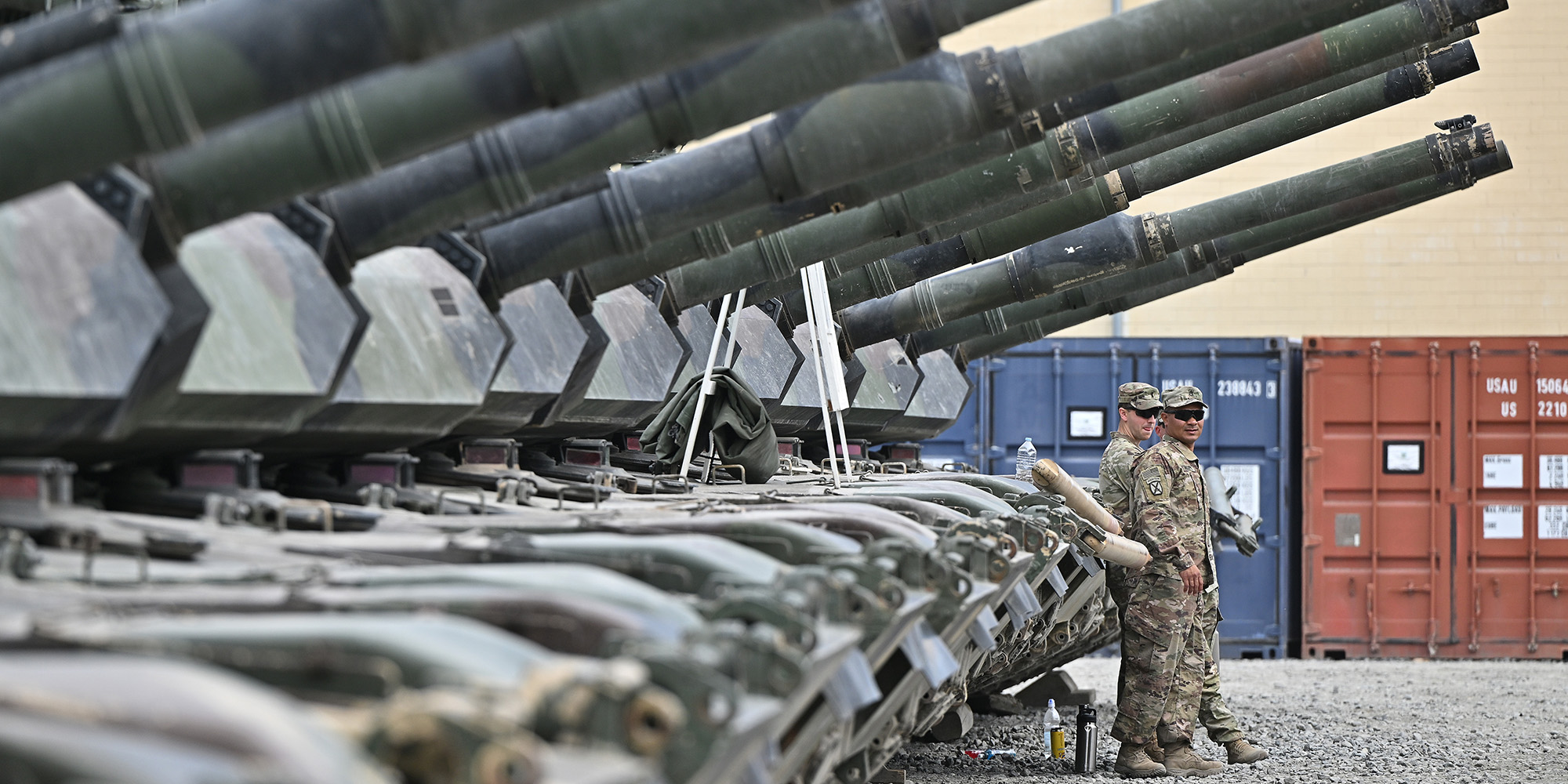
 Soldiers of the US-Army 1st Raider Brigade stand in front of tanks at the Grafenwoehr training grounds on 13 July 2022 near Grafenwoehr, Germany. The U.S. has increased its troop presence in Germany and in eastern Europe following Russia's military invasion of Ukraine in February. (Photo: Lennart Preiss / Getty Images)
 By Patricia Zengerle
Separate from the appropriations bills that set government spending levels, the National Defense Authorization Act, or NDAA, authorizes everything from pay raises for the troops - this year's will be 5.2% - to purchases of ships, ammunition and aircraft as well as policies such as measures to help Ukraine and pushback against China in the Indo-Pacific.
This year's bill is nearly 3,100 pages long, authorizing a record $886 billion, up 3% from last year.
The NDAA "will ensure America can hold the line against Russia, stand firm against the Chinese Communist Party, and ensures that America's military remains state-of-the-art at all times all around the world," Senate Majority Leader Chuck Schumer said before the vote.
But the final version of the NDAA left out provisions addressing divisive social issues, such as access to abortion and treatment of transgender service members, that had been included in the version passed by the House over the objections of Democrats, threatening to derail the legislation.
The 100-member Senate backed the NDAA by 87 to 13. The House is expected to pass it as soon as later this week, sending it to the White House where President Joe Biden is expected to sign it into law.
The fiscal 2024 NDAA also includes a four-month extension of a disputed domestic surveillance authority, giving lawmakers more time to either reform or keep the program, known as Section 702 of the Foreign Intelligence Surveillance Act (FISA).
The Senate defeated an attempt to remove the FISA extension from the NDAA on Wednesday before voting to pass the bill.
The Republican-majority House passed its version of the NDAA earlier this year, followed by the Senate, where Biden's fellow Democrats have a slim majority. Negotiators from both parties and both chambers unveiled their compromise version last week.
The bill extends one measure to help Ukraine, the Ukraine Security Assistance Initiative, through the end of 2026, authorizing $300 million for the program in the fiscal year ending Sept. 30, 2024, and the next one.
However, that figure is a tiny compared to the $61 billion in assistance for Ukraine that Biden has asked Congress to approve to help Kyiv as it battles a Russian invasion that began in February 2022.
That emergency spending request is bogged down in Congress, as Republicans have refused to approve assistance for Ukraine without Democrats agreeing to a significant toughening of immigration law.
Ukrainian President Volodymyr Zelenskiy met with lawmakers at the Capitol on Tuesday to make his case for the funding requested by Biden, but emerged from meetings with lawmakers without Republican commitments.
(Reporting by Patricia Zengerle; Editing by Leslie Adler, Sandra Maler and Grant McCool)