




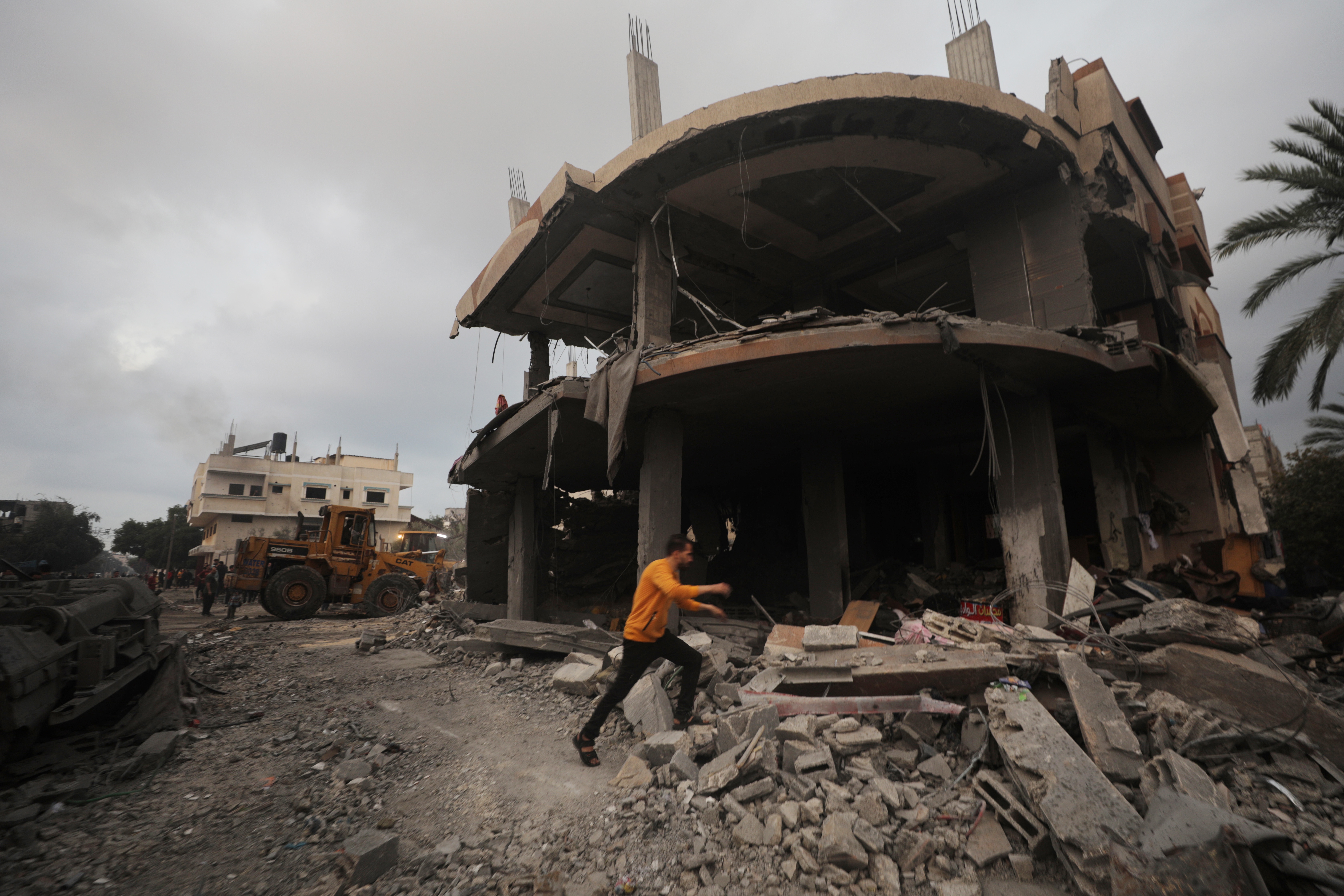
 Palestinians search for bodies and survivors in the rubble of a destroyed house following Israeli air strikes on Deir Al Balah in the southern Gaza Strip on 5 December 2023. (Photo: EPA-EFE / Mohammed Saber)
 The emotion is driven by the scale and brutality of the Hamas attack on 7 October and the existential questions it poses for Israel. It is heightened by stories of immense suffering in Gaza. And it is amplified by the vitriolic debate on social media where violent imagery, misinformation and hate speech are rife.
As AFP works around the clock to explain fast-moving events, we are exposed to accusations of both pro-Israel and pro-Palestinian bias. Every word we write is picked over for signs that we are leaning one way or the other. Our staff are subjected to unacceptable abuse. It is an extremely difficult environment in which to do quality journalism.
For the record, AFP is not biased. We are fiercely loyal to our statutes which oblige us to report independently to uncover the facts and to bear witness. And for the record, we are very proud of the AFP journalists who are working so hard on this story, some facing extreme dangers. They have produced some extraordinary journalism.
We are not perfect. Real-time newsgathering can be messy. We file hundreds of stories, photos and videos every day. Despite our best efforts, we will make honest mistakes and imperfect choices. But we will be transparent. We will always correct, adjust and update. We will always strive to get it right and to report this war on the ground in Israel and Gaza without fear or favour.
/file/dailymaverick/wp-content/uploads/2023/12/11464529%401x_1-1.jpg "A video tribute to slain AFP video journalist Arman Soldin plays during a minute's silence held for him at AFP headquarters in central Paris on 11 May 2023. Soldin was killed in a rocket strike as he reported with AFP colleagues from Ukrainian positions in Chasiv Yar on 9 May 2023. (Photo: EPA-EFE / Martin Bbureau)")
Every day we double down on the guiding principles of our editorial charter and our sourcing guidelines. We are a news agency, we do not editorialise. Every piece of information we send to our clients needs a clear source.
Our chief editor, working with our standards editors, produces regularly updated guidelines on the Israel-Hamas war aimed at ensuring all our content remains fair and balanced. This is a story that has mobilised a large part of our 1,700-strong team of journalists. We are reporting on ructions caused by the war in countries across the world. The same guidelines must be applied everywhere.
At AFP, we prioritise putting journalists on the ground to witness events directly. We have about 50 journalists working in Israel, the Gaza Strip and West Bank. The majority live there permanently – Israelis, Palestinians, foreigners. Joined by about 15 special correspondents, they have brought vital expertise, knowledge and sources to the story from day one.
The mainstream media is no longer the gatekeeper of information. It was already on social media. Our job is to verify and contextualise.
We have teams crisscrossing Israel reporting on the impact of 7 October, which left about 1,400 Israelis dead, mostly civilians. We have been telling the stories of ordinary Israelis and documenting the military build-up. We have reported on the horrific scenes in the communities attacked by Hamas, from the morgues where body parts have been collected and from the festival site where hundreds of young people were shot dead. We are telling the stories of Israeli hostages and their families. We have been present at many heart-rending funerals. And we are making a concerted effort to continue telling stories of the Israeli victims of 7 October even as events in Gaza take centre stage.
Read more in Daily Maverick: Israel-Palestine War
In Gaza, we have nine Palestinian staff working in very precarious conditions. They all fled their homes and evacuated our office in Gaza City when the Israeli military ordered the population to move further south on 13 October. All that remains is a rooftop video camera beaming live images to TV stations around the world.
/file/dailymaverick/wp-content/uploads/2023/11/Tamsin-Gaza-war-3.jpg "Media workers protest against the deaths of journalists in the Gaza Strip, calling for an immediate ceasefire. (Photo: Karine Pierre / Hans Lucas via AFP)")
/file/dailymaverick/wp-content/uploads/2023/11/GettyImages-1791679817.jpg "An Israeli flag flies on top of a destroyed building next to a mosque in northern Gaza on November 13, 2023, viewed from Sderot, Israel. (Photo by Christopher Furlong/Getty Images)")
Our team was crammed into shared apartments and tents with more than 60 family members near Khan Younis. There was little food and water, and air strikes continued to hit targets around them. Some have lost family members, all have lost friends or neighbours. Family homes have disappeared. There is an air of desperation.
They continue to show extraordinary courage and resilience as they document death and destruction around them. More than 50 Palestinian journalists are reported to have been killed. Their work takes them into hospitals and morgues. They have seen hundreds of dead and injured people, including women and children. The human stories of suffering they report can be overwhelming. The Hamas-controlled authorities say more than 15,900 people, including thousands of children, have been killed.
AFP management is in regular touch with the Israeli military. We have been told media will not be deliberately targeted, but that our journalists’ safety cannot be guaranteed. We are lobbying governments for help.
/file/dailymaverick/wp-content/uploads/2023/11/GettyImages-1791615658.jpg "The silhouette of IDF soldiers walking through a cloud of sand and dust in an area near the Gaza border on November 13, 2023, in Southern Israel. (Photo by Alexi J. Rosenfeld/Getty Images)")
Hospital strike
The complexity of this coverage is illustrated by the explosion at the Al-Ahli Hospital in Gaza City on 17 October.
AFP, and many credible global media, reported claims by Hamas health officials that 200 to 300 people had been killed in an Israeli air strike. We immediately contacted the Israeli military for a response and had a first comment in our stories within 15 minutes. Israel’s denial and accusation that an Islamic Jihad missile was responsible came nearly three hours later, leading us to totally rewrite our stories. But in the battle for narrative, the Hamas claim had a long head start.
There has been much criticism of media coverage of this incident for giving too much prominence to the Hamas claims.
Could we have handled this story differently? Yes. We should have been more circumspect in our language and we should have made it clear that AFP could not independently confirm such a major claim by Hamas. We have updated our coverage guidelines as a result.
In the digital world, the battle for narrative is often fought through wrenching and violent images. There is also an information war.
Could AFP have ignored this Hamas ministry statement? No. The mainstream media is no longer the gatekeeper of information. It was already on social media. Our job is to verify and contextualise. Analysts and weapons experts we interviewed for our investigation into the strike seemed to lean towards a Palestinian missile, but they did not definitely rule out any scenario.
In our struggles to keep our Gaza staff safe, we are only too aware of the very real dangers of this war.
AFP photographer Christina Assi was seriously injured in an attack in south Lebanon on 13 October that killed Reuters colleague Issam Abdallah. Five other journalists including AFP’s Dylan Collins and staff from Reuters and Al Jazeera were injured. The journalists believe they were struck by fire from the Israeli side of the border. Investigations are still under way.
/file/dailymaverick/wp-content/uploads/2023/10/11762797.jpg "A rocket is launched from the coastal Gaza Strip towards Israel by militants of the Ezz Al-Din Al Qassam militia, the military wing of Hamas, on 7 October 2023. (Photo: EPA-EFE / Mohammed Saber)")
We are also working every day to protect the mental health of our journalists. In the digital world, the battle for narrative is often fought through wrenching and violent images. There is also an information war.
Our journalists were among the first independent witnesses to the horrific scenes in southern Israel on 7 October. The images we filed of ordinary people gunned down at a bus stop or shot dead in their cars in the town of Sderot were used around the world. They are very hard to watch. We were also among the first group of journalists to gain access to the kibbutzim near the Gaza border which witnessed some of the worst Hamas violence.
From day one, we verified and sent to clients images given to us by Israeli rescuers from CCTV cameras, car dashcams and bodycams taken from dead attackers. While editors sifted through images of the atrocities, our digital verification journalists interacted with a tide of fake videos showing violent and decontextualised scenes from events unlinked to the war.
These images came on top of the thousands of very difficult pictures and videos produced by AFP journalists over the previous three weeks. The images of dead and injured children in Gaza are particularly challenging.
We do this work to try to build a clear picture of events and to provide our global client base with verified facts. But we are only too aware of the psychological impact. It is brutal, and we are always looking at ways to protect and support our staff.
Despite the many pressures, we feel a great sense of responsibility and purpose. We are heartened by the support of clients and by the solidarity we feel with other media. Our work has never felt more important nor more relevant. AFP/DM
Phil Chetwynd is AFP Global News Director.