




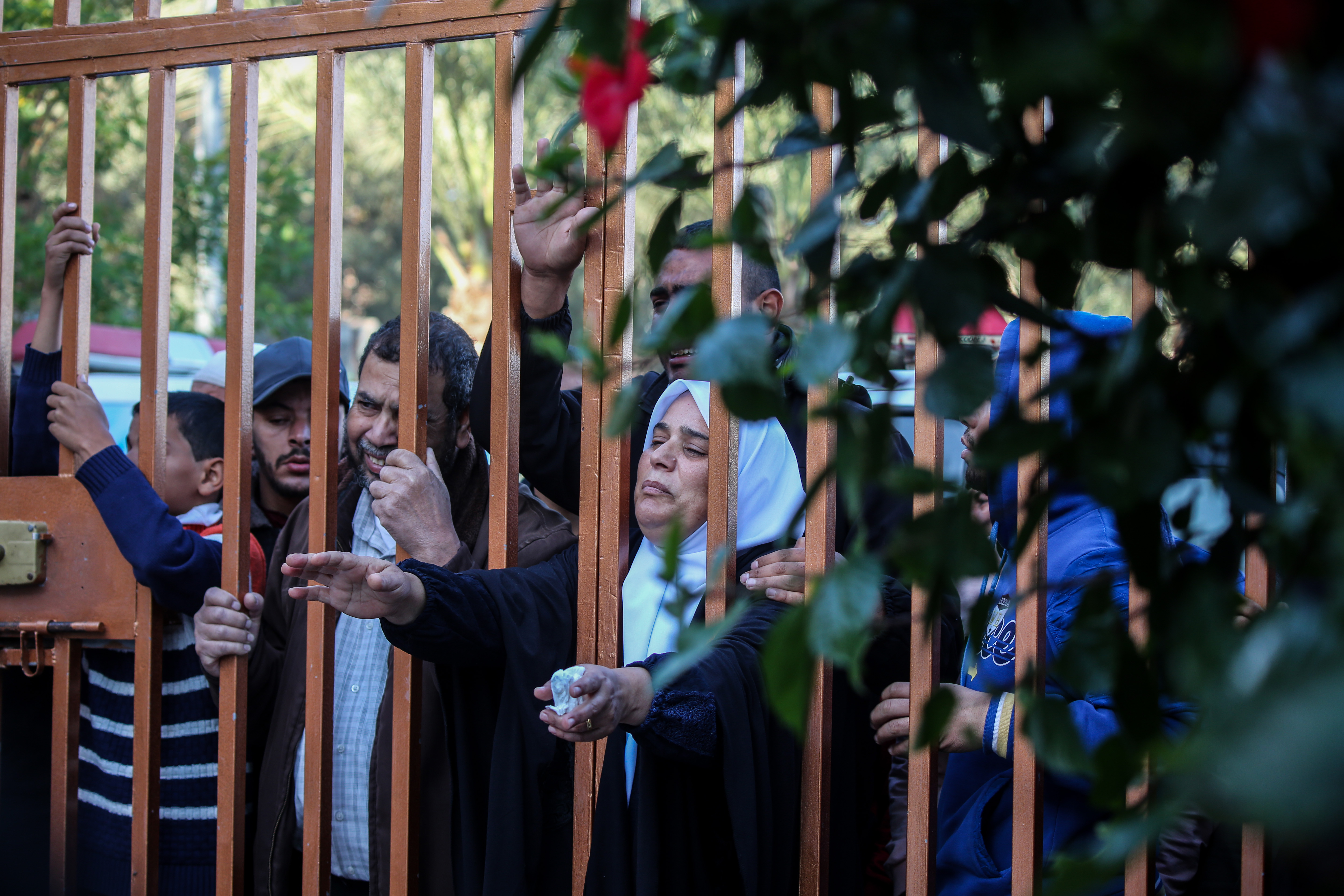
 Palestinians mourn as they collect the bodies of loved ones killed in an airstrike on 3 December 2023 in Khan Yunis, Gaza. (Photo: Ahmad Hasaballah / Getty Images)
 More than 100 hostages are free. At least 5,000 Hamas fighters are dead. About 500 tunnel shafts have been destroyed. The Israeli military controls two-thirds of northern Gaza. It’s a third of the way to its goal — destroying Hamas — and has launched the next phase of bombing the south.
Eight weeks into its war on Hamas and days since a weeklong ceasefire ended, that’s the Israeli government’s assessment of where things stand in its longest war since the 1948 War of Independence.
It’s bearing down on the city of Khan Younis where it says the Hamas leadership is entrenched deep inside tunnels, telling Palestinian civilians to move to a set of nearby “no-target” zones.
To much of the world, all of that sounds too tidy when more than 15,000 Gazans — according to the Hamas-run health ministry — have been killed, large sections of Gaza City have been reduced to rubble and 80% of the 2.2 million inhabitants, most of them poor, are displaced.
Numerous governments want Israel to end the war — which began on 7 October when several thousand Hamas operatives killed and kidnapped hundreds of Israelis — by declaring a permanent ceasefire.
Even Israel’s biggest backer, the US, says that far too many civilians have died in Gaza from Israel’s 10,000 strikes over almost two months.
The US hasn’t, however, joined the call for a permanent ceasefire.
Instead, it’s used its influence with the government of Prime Minister Benjamin Netanyahu to increase humanitarian aid into Gaza and create a system of “safe zones” to reduce civilian casualties as the next phase of the war begins.
It’s trying to create diplomatic space for Israel to eliminate Hamas, which it designates — as does the European Union — a terrorist group.
“As far as toppling the Hamas regime is concerned, Israel has completed about 30% of the task,” said Amos Yadlin, a retired general and former director of military intelligence.
“We still have a long way to go to achieve the goal of destroying Hamas, but sometimes there is a breaking point for the enemy, where the stopwatch starts to advance at a faster pace.”
This is also the view of a senior official who said that the ground operation in the north had gone better than Israel expected. The rest of the war should take somewhere between weeks and months — and Khan Younis will be key.
Another official said the assault on Khan Younis, already begun and set to intensify this week, will be difficult and bloody.
Israel also has to overcome Hamas’ strategy in which survival is itself a victory. They’ve prepared for years for this kind of invasion on their own turf, and are waging a complicated defence both on the ground — as well as under it — and for world opinion.
Many abroad are highly sceptical of Israel’s strategy.
French President Emmanuel Macron said in Dubai at the weekend that Israel’s aim of eliminating Hamas would require a decade of war.
“So this objective must be clarified,” he added.
Within Israel, there is deep support for the war but also plenty of worry.
Ben-Dror Yemini, a conservative author and columnist, said by phone that thus far it’s been “a failed policy” because Israeli forces don’t fully control Gaza City or the tunnel network.
As soon as the ceasefire ended on Friday, Hamas fired off some 250 rockets from northern Gaza, the most since the first day of the war. On Saturday night, a dozen missiles were fired at Tel Aviv, sending hundreds of thousands into shelters.
The senior official said the rockets were a result of Hamas replenishing and reloading its launchers during the ceasefire.
Yemini, who embraces the goal of destroying Hamas, worries that Israel is using too blunt a set of instruments — what he called a “hammer strategy” involving huge bombs from the air, causing many abroad to assail Israel.
“We need to think more about commando operations,” he said.
The fate of the rest of the hostages remains a concern, both politically in Israel and as a goal of the war.
A deal in which Hamas freed women and children in exchange for many Palestinian women and minor prisoners in Israel, along with a pause in fighting and more aid for civilians, lasted a week. It ended when, according to Israeli and US officials, Hamas declined to free the remaining women it holds.
Hamas blamed Israel for the breakdown and said the women were of military age and in a different category. Israeli officials denied that and speculated that the women may have been abused in captivity, hence the hesitation to free them.
Hamas now holds mostly men of various ages, and whether they’ll be freed remains a topic of intense concern in Israel.
Officially, freeing the hostages is co-equal as a goal of the war to destroying Hamas, but now that about half of them have been freed, the focus is turning again to combat, which may endanger the hostages.
The government has argued that pressuring Hamas militarily actually leads to hostage releases, something that many abroad, including in the US government, doubted before the last deal.
Now that scores of hostages have been freed following intense military action, the approach has fewer critics, though families in Israel remain worried about their loved ones still in Gaza, and street demonstrations have begun seeking to push the hostage issue back to the top of the agenda.
Some of those released have offered valuable information on the location and well-being of those still held. They confirmed, for example, that at least half a dozen hostages were dead, their bodies in Gaza. This has played a role in shifting attention from hostage negotiations to military operations.
In Gaza, all this talk of strategy — along with a map Israel has published with numerous zones — is a matter of life and death. Residents say missiles are raining down on Khan Younis and evacuation orders suggest the entire city has to move south, to Rafah, where bombings are also reported.
The map is vague, the warnings unclear and the danger overwhelming, they say.
Myasser Zaher fled her home in Jabaliya, a crowded area in northern Gaza, last month, for her daughter’s house in Deir Al-Balah, in the south. The house is in a numbered area she said wasn’t under evacuation orders.
Nonetheless, bombs fell on an adjacent house.
“We don’t know what to do or where to go,” she said by phone. “They divided Gaza into blocks and they still struck everywhere the same way.”
She fled to a nearby hospital.
“They are pushing us into one tight place,” she added. “This is not a life. A tent on the ruins of my house would be better than this displacement.”
US says warship attacked, Houthis target two Israeli ships
Yemen’s Houthis claimed they carried out targeted operations against “two Israeli ships” in the Red Sea on Sunday, the latest in a series of actions by the rebel group linked to Israel’s war on Hamas.
The Houthi posting on X, formerly Twitter, followed a statement from the Pentagon, reported by the Associated Press, that a US warship, the USS Carney, had come under attack.
The Yemen-based, Iranian-backed rebels said the Bahamian-flagged bulk carrier Unity Explorer was struck by a missile, while the Panama-flagged container ship Number 9 was hit by a naval drone.
The attacks came after the ships “ignored warning messages from the Yemeni naval forces,” according to the statement.
The statement didn’t mention a US Navy vessel. The extent of any damage was unclear.
The incidents are the latest in a string of attacks on vessels in the region since rebels in Yemen last month issued a threat against ships with ties to Israel, calling them “legitimate targets.”
The Pentagon didn’t identify where the fire on the USS Carney, an Arleigh Burke-class destroyer, originated from, the AP said.
The United Explorer, which was on its way to Singapore from the US, issued “distress calls related to piracy/missile attack,” Al Arabiya reported earlier citing the maritime security firm Ambrey.
United Kingdom Maritime Trade Operations, an arm of Britain’s Royal Navy, earlier said it received a report of a drone attack in the vicinity of the Bab el Mandeb Strait near Yemen.
Separately, on Saturday, US Central Command said on X that a US military plane had intercepted an Iranian drone “operating in an unsafe and unprofessional manner during aircraft carrier flight operations in the Arabian Gulf.”
Israel calls for Gaza evacuations after US urges restraint
Southern parts of the Gaza Strip were hit by airstrikes on Sunday hours after Israel called for the evacuation of areas of the Palestinian enclave it believes Hamas leaders are located.
Al Jazeera reported 10 people dead and more than 100 wounded in an airstrike in the Al-Geneina neighbourhood of the border city of Rafah in southern Gaza, citing eyewitness reports. The information can’t be verified, and the Israeli Defence Force hasn’t commented on its latest operations.
Israel on Sunday instructed Palestinians to abandon areas near Khan Younis, the southern city where Israel believes top Hamas militants are ensconced.
The US, concerned about high civilian casualty rates in Gaza, has been urging Israel to come up with safe zones for fleeing civilians.
Israel on Saturday pulled its officials from Qatar, where negotiations had earlier resulted in a seven-day truce accompanied by exchanges of hostages for Palestinian prisoners.
In ordering its team to come home, Israel said Hamas had reneged on a pledge to release women and children held since the 7 October attacks on southern Israel.
Qatar said Sunday it will continue efforts to revive the truce, and Eylon Levy, a spokesman for the Israeli government, said Israel is prepared to entertain further offers from Hamas
In the past day, the IDF said it continued to strike suspected Hamas targets from fighter jets, helicopters and from the sea. Hamas has responded with heavy rocket fire toward southern and central Israel. Exchanges of fire resumed across the Israel-Lebanon border, with an Israeli military vehicle hit by an anti-tank missile.
Levy said that 398 Israeli soldiers and 59 police personnel have been killed since the war began and that 11,000 rockets have been fired toward Israel, with 2,000 falling short and landing in Gaza. He added that 800 tunnels used by Hamas have been found and 500 destroyed.
IDF troops eliminated 500 of the 800+ exposed shafts to Hamas’ underground tunnels located near or inside kindergartens, schools, playgrounds and mosques.
After the exchanges of the past week, 137 hostages remain in Gaza with 117 of those being male, including two children, he said. All but 11 are Israeli, he said, adding that three bodies of hostages have been located by the ministry and six people are still missing.
Despite warnings from multiple US officials, including Defence Secretary Lloyd Austin and Vice President Kamala Harris, for Israel to heed warnings about civilian casualties, Levy said, “Israel and the US see eye-to-eye about the goals of this war.”
“I have personally pushed Israeli leaders to avoid civilian casualties, and to shun irresponsible rhetoric,” Austin said on Saturday.
Many nations have warned Israel not to use the overwhelming force in the south as it did in the north, where it levelled much of Gaza City.
“We are trying to be as surgical as we can be in a very difficult combat situation,” Mark Regev, a senior adviser to Netanyahu, told the BBC on Sunday. He added that casualty estimates from Gaza health authorities “need to be taken with a grain of salt.”
John Kirby, spokesman for the US National Security Council, said Israel has taken “a step in the right direction” in being mindful of civilian casualties.
“They have actually given civilians in Gaza a list, a map online, a list of areas where they can go to be more safe,” Kirby said Sunday on NBC.
“There are not too many modern militaries in advance of conducting operations that would actually do that.”
Netanyahu nonetheless suggested that a significant escalation is underway in the south as Israel seeks to destroy Hamas, the stated objective of the war.
Combat in the south is more difficult now because of the displacement of some 1.8 million people, many of whom fled there to avoid the earlier fighting in the north, according to figures by the United Nations.
“Clearly the first phase of the operation, before the ceasefire, exacted such an enormous cost,” said Brian Katulis, vice president of policy at the Middle East Institute in Washington.
“A lot of those people were told to move south. Now the campaign’s moving south. And that’s the real worry that a lot of people in the administration have.”
US Defence Secretary’s Israel warning is naive - GOP senator
Republican Senator Lindsey Graham said he has lost confidence in US Defence Secretary Lloyd Austin after his “naive” comment that Israel risks strategic defeat in its war with Hamas if it fails to protect civilians in Gaza.
“Strategic failure is letting Hamas stand,” Graham, a foreign-policy hawk who backs Israel’s goal of eradicating Hamas, said on CNN’s State of the Union on Sunday.
He was responding to a question about the remark by Austin, who said Saturday he has pushed Israeli leaders to avoid mounting civilian casualties in the densely populated Gaza Strip as it conducts its war to rid the area of Hamas.
“I’ve just lost all confidence in this guy,” Graham said of Austin, a retired four-star Army general with experience in urban warfare in Iraq.
“Strategic defeat would be inflaming the Palestinians? They’re already inflamed. They’re taught from the time they’re born to hate the Jews and to kill them.”
Authorities in Hamas-ruled Gaza say more than 15,200 people, mostly women and children, have been killed there in Israel’s military response to the 7 October attack
“In this kind of a fight, the centre of gravity is the civilian population,” Austin said in a speech to the Reagan National Defense Forum in Simi Valley, California.
“And if you drive them into the arms of the enemy, you replace a tactical victory with a strategic defeat.”
Israel, threatened by Hezbollah, seeks solution for empty north
A winding road in northern Israel lined with vineyards leads to Kibbutz Menara atop the Ramim Ridge in the Naftali mountains where pomegranate and avocado trees grow.
It should be an idyllic scene.
Instead, gaping holes have been blown through the blackened walls of the community’s double-storey houses. A roof has collapsed and a twisted lump of melted metal denotes what was once a car.
For the last few weeks, Islamist militant group Hezbollah has been firing anti-tank missiles into the kibbutz from the Lebanese village of Meiss El Jabal in the valley a few hundred yards below. Other villages in the region have also come under attack and the Israeli military has responded with strikes of its own.
While the world’s attention focuses on a resumption of fighting between Israel and Hamas militants in the Gaza Strip in the south, this largely abandoned cooperative highlights an upcoming problem for the embattled Middle Eastern state: How to get the tens of thousands of people who have fled the region to return when an existential threat is in eyesight just across the border.
“Anyone who moves here will get injured. They have no actual security and no sense of security to come back,” Yoshiau, a bearded 27-year-old mechanical engineering student, who’s also a tank captain in the Israeli military and limited his identification to his first name in line with its rules, said in an interview at the kibbutz.
“In order to allow the citizens to come back, we have to have a clear indication from our enemies in Lebanon, Hezbollah, that they have no intention of attacking people.”
The issue has bedevilled Israel since it fought Hezbollah in a 34-day war in 2006. Yet the sense of precarity that farmers and other inhabitants of Israeli villages that line the Lebanese border live with has reached unprecedented levels since Hamas militants poured out of Gaza into Israel on 7 October.
The Israeli military hit back with air raids that reduced much of northern Gaza to rubble and a ground invasion that Hamas authorities in the Mediterranean strip say has killed more than 15,000 people.
The US considers Hamas and Hezbollah terrorist organisations. Hezbollah is bigger and better armed than Hamas, and they are both backed by Iran and share the aim of eradicating the Jewish state.
United Nations Security Council Resolution 1701, adopted after the 2006 war ended, required the establishment of a demilitarized zone between the Israeli border and the Litani River, about 29km to the north. It has been widely flouted and so far the international community has done little to enforce it, Eyal Hulata, a former national security adviser in the Israeli government, said in a press briefing on Thursday.
“Hezbollah has planned to do something very similar in the north for years” to the incursion carried out by Hamas, said Yoshiau, the tank captain, who left his wife and 18-month-old son at his home near the border with Gaza a few weeks ago to help guard the northern frontier.
There was “an informal cease-fire” with Hezbollah during the temporary truce in the south, he said.
Hezbollah began firing volleys of mortars, rockets and anti-tank missiles at Israel on 7 October, the heaviest attacks it has staged since 2006. The military was placed on high alert and fully deployed along the 48-mile-long border.
The ongoing tension was evident on Thursday morning, the day that Bloomberg spoke to Yoshiau, with the military shooting down what it said was “a suspicious aerial target” that crossed from Lebanon into Israel. Cross-border hostilities resumed after the fighting in Gaza restarted.
For now, many of the 250 people who usually live in Kibbutz Menara have decamped to the town of Tiberias, an hour’s drive south on the western shores of the Sea of Galilee, where the government is paying for their accommodation.
While the stronger military presence may deter Hezbollah from crossing the border or stepping up its attacks, it’s unlikely to convince Israelis who live in the region to come home. Nor will it diminish the threat of Hezbollah’s more advanced weaponry, which includes missiles that could strike as far afield as Eilat on Israel’s southeastern tip.
The conundrum in the north has been put on the back burner while the military and the government mainly focus on the war in the south, but the problem isn’t going away and is of major concern to some of Israel’s most prominent business leaders.
“People will not continue to be on the border with Hezbollah breathing over them and shooting at the fence or the houses with anti-tank missiles,” said Erel Margalit, founder and chief executive officer of Jerusalem Capital Partners, one of Israel’s biggest venture capital firms.
“Something is going to need to be done about that either diplomatically or militarily.”
The government has begun paying incentives to workers to return to their jobs in the north, topping up their salaries, according to Ron Tomer, president of the Manufacturers’ Association of Israel, who says 70 of the group’s member companies operate there.
That doesn’t address the security question, or provide long-term clarity to those who live along the northern border as to whether they should return.
While Israel, concerned about the reaction of the international community, held back from preemptive ground invasions of both Gaza and Lebanon for years, the Hamas attack “changes that calculus” and once it achieves its aims in Gaza of eliminating Hamas and freeing the remaining hostages that may change, Hulata said.
A stronger military presence is unlikely to convince Israelis who live in the region to return home.
“Doing what we need in Gaza is difficult enough. We don’t need to find ourselves entangled on two fronts,” he said.
“I would not propose to any Israeli government to wait again. I think we need to act before it happens to us and prevent another massacre of civilians in any part of Israel.”
Yoshiau, who passed corpses and cars riddled with bullet holes close to his home when driving north to join his unit on 7 October, sees no immediate alternative to Israel maintaining an enhanced military presence along the Lebanon border.
“There’s no other option,” he said, even as he bemoaned missing key moments in his son’s childhood. “We need to be here until we can bring back the sense of security.”
Israel risks ‘strategic defeat’ if it doesn’t protect civilians - Austin
US Defence Secretary Lloyd Austin said Israel risked “strategic defeat” in its war with Hamas if it fails to heed warnings about the mounting civilian death toll.
“I have personally pushed Israeli leaders to avoid civilian casualties, and to shun irresponsible rhetoric, and to prevent violence by settlers in the West Bank,” Austin said in a speech to the Reagan National Defence Forum in Simi Valley, California, on Saturday.
Austin’s comments come as top US officials have grown increasingly vocal in their warnings to Israel about the death toll in the Gaza Strip. Those warnings, previously confined to closed-door meetings, have been thrust into the open by mounting pressure from Israel’s Arab neighbours, human-rights activists and opinion at home — including the left of President Joe Biden’s Democratic Party.
While Austin and other US leaders have vowed to continue supporting Israel, they worry that American support could become untenable if civilian casualties continue to mount.
During a trip to Israel this week, Secretary of State Antony Blinken said that the punishing campaign unleashed on northern Gaza shouldn’t be repeated as Israeli forces move south after the end of a multiday ceasefire with Hamas.
In California, Austin turned to personal combat experience to make his case.
“I learned a thing or two about urban warfare from my time fighting in Iraq,” he said. “Like Hamas, ISIS was deeply embedded in urban areas. And the international coalition against ISIS worked hard to protect civilians and create humanitarian corridors.”
“The lesson is not that you can win in urban warfare by protecting civilians. The lesson is that you can only win in urban warfare by protecting civilians,” he said. “In this kind of a fight, the centre of gravity is the civilian population. And if you drive them into the arms of the enemy, you replace a tactical victory with a strategic defeat.”
Austin also reiterated US advocacy for a two-state solution to the Israel-Palestine question.
“We believe that Israelis and Palestinians must find a way to share the land that they both call home,” he said. “It would compound this tragedy if all that awaited Israelis and Palestinians at the end of this awful war was more insecurity, more rage, and more despair.”
“I wouldn’t have said that,” Senator Roger Wicker, a Mississippi Republican, said of Austin’s comments on civilian casualties. “Israel and its Western allies have been very careful to minimise civilian casualties, unlike Hamas, which does it deliberately.”
In the years before the Hamas assault, successive US administrations maintained a rhetorical commitment to a two-state solution, while putting a priority on normalisation of relations between Israel and its Arab neighbours, most recently Saudi Arabia.
Austin also repeated warnings to Iran over attacks against US personnel in Iraq and Syria by militias supported by Tehran. “We will not tolerate attacks on American personnel,” he said. “These attacks must stop.”
The US defence chief cast the war in the Middle East as part of a growing constellation of national security concerns stretching from the Middle East to Eastern Europe and Asia.
“We’re living through challenging times,” Austin said.
“That includes the major conflicts facing our fellow democracies, Israel and Ukraine; bullying and coercion from an increasingly assertive China; and a worldwide battle between democracy and autocracy.”
He also warned that US adversaries are increasingly finding common purpose in their desire to blunt US power.
“From Russia to China, from Hamas to Iran, our rivals and foes want to divide and weaken the United States — and to split us off from our allies and partners,” he said.
Austin’s warnings about rising global threats were accompanied by a mention of the political challenges in Washington that risk stymieing the US response.
“While I’ve got you here, let me urge you to pass a full-year appropriation,” Austin told the multiple members of Congress assembled in Simi Valley, a reference to continued congressional clashes over funding for the federal government.
“You know, our competitors don’t have to operate under continuing resolutions,” he said. “Doing so erodes both our security and our ability to compete.” DM
Read more in Daily Maverick: Israel-Palestine War