



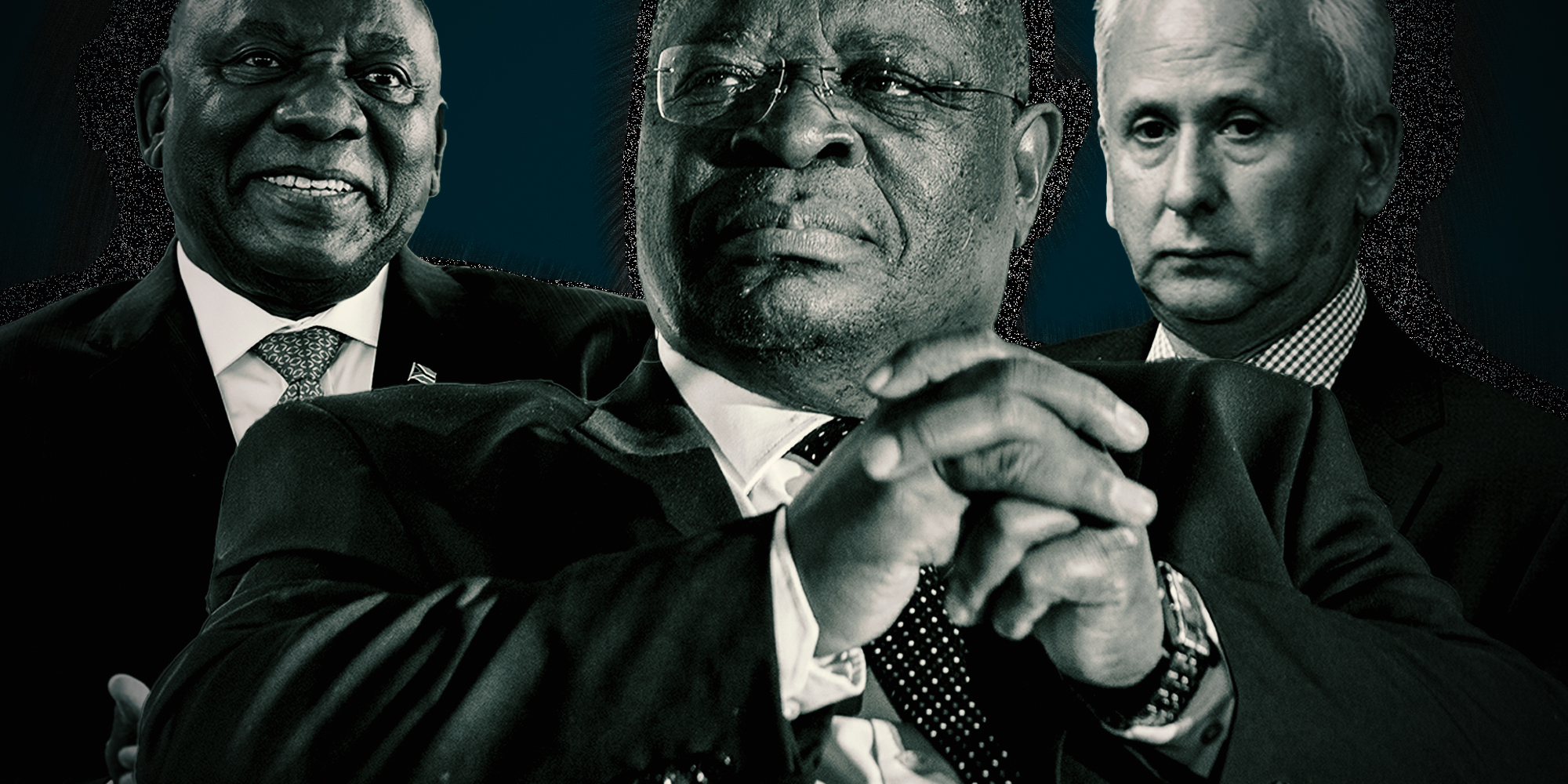
 Illustrative image, from left: President Cyril Ramaphosa (Photo: Gallo Images/Alet Pretorius) | Chief Justice Raymond Zondo (Photo: Gallo Images/OJ Koloti) | National Anti-Corruption Advisory Council chair Firoz Cachalia (Photo: Gallo Images / Papi Morake)
 The work done by the State Capture Commission, chaired by now Chief Justice Raymond Zondo at a cost of just over R1-billion, has been lauded internationally as extraordinary, despite the snail’s pace in implementing key findings at home.
Professor Christopher Stone, from Oxford University’s School of Government in the UK, said although graft was prevalent in governments worldwide, the commission’s 5,500-page report had done an exceptional job in highlighting corrupt acts and had had a global impact.
“There’s a degree of public accountability that the commission has achieved in its observations and recommendations… The Chief Justice went out of his way to highlight not just the corrupt acts, but people who stood up to corruption,” Stone said.
He was speaking at the two-day National Anti-Corruption Advisory Council’s (Nacac’s) dialogue in Boksburg this week on building a corruption-free South Africa.
The council, chaired by Firoz Cachalia, was established by President Cyril Ramaphosa in August 2022 to advise on SA’s anti-corruption institutional architecture, among other functions.
‘Long road ahead’
Speaking at the event, Ramaphosa said that after 1994, there were hopes that democratic SA would herald a “new era of integrity, honesty and ethical conduct by all in positions of responsibility”, but this had not been the case.
“Corruption has wounded our democracy and shaken people’s faith in our institutions. If corruption is not arrested, the greatest damage will not be in the funds stolen, the jobs lost or the services not delivered. The greatest damage will be to the belief in democracy itself.
“Our Constitution, which embeds the values of social justice, human dignity, accountability, transparency and the rule of law, is the most powerful instrument we have to fight crime and corruption,” Ramaphosa said.
The completion of the work of the State Capture Commission and subsequent voluminous report, which laid bare the extent of State Capture, was a watershed moment in the country’s history, the President said.
The report went beyond identifying the extent and depth of this criminality, but also presented means to remedy the harm and created the conditions that would prevent its recurrence, he said.
Last month, Zondo decried the slow pace of the government in the establishment of new institutions to safeguard the state against capture 16 months after he handed in the final instalment of the report.
Read more in Daily Maverick: Zondo concerned by no sign of public procurement anti-corruption agency 16 months after State Capture report
He highlighted several areas of concern, including the need for protection of whistle-blowers, the establishment of a portfolio committee in the Presidency and the establishment of an independent, public procurement anti-corruption agency.
Ramaphosa said in his address that these recommendations and other proposals to safeguard the state against capture were being explored through intensive research processes and consultations by Nacac and the Department of Justice and Constitutional Development.
Speaking about strides made in State Capture-related crimes, Ramaphosa listed several successes, which Daily Maverick has been unable to confirm at the time of publishing, including:
- Nine separate court cases, involving 47 individuals and 21 companies, have been brought to court.
- Freezing orders amounting to R14-billion have been authorised by the Asset Forfeiture Unit and a total of R5.4-billion has been recovered and returned to the state.
- The South African Revenue Service has collected R4.9-billion in unpaid taxes as a result of evidence brought before the State Capture Commission.
“While there is a long road ahead, the fight against corruption is gaining momentum,” Ramaphosa said.
Insufficient progress
Zondo did not appear to share the President’s sentiments, warning that if drastic measures were not taken urgently, South Africans would have no place to call home.
“Most of the corruption we get in SA is in the area of public procurement. If we can close the taps in public procurement, we will make a big difference in our fight against corruption. We recommended the establishment of a public anti-corruption agency. We see that the Public Procurement Bill of 2023 doesn’t have an institution like that.
“The levels of corruption in our country have reached completely unacceptable proportions, and unless something very drastic and effective is done soon, we will have no country worth calling our home,” Zondo said at the Nacac dialogue.
The Chief Justice further suggested that had the Scorpions, an independent and multidisciplinary unit, not been disbanded, corruption would not have skyrocketed to its current levels.
“I have a sense that if the Scorpions were not disbanded, we would not have the level of corruption that we have now in our country,” he said.
Read more in Daily Maverick: ‘Reimagining of Parliament’ thwarted by patchy application of State Capture report proposals
Nacac chair Cachalia stressed the need for a multipronged approach in the fight against corruption. This would include setting up of new institutions in line with Zondo’s recommendations.
“This is a complex task. You need skills, you need budgets, you need to get it right because you can set up institutions that fail and anti-corruption institutions that are captured by the corrupt. You can set up institutions in a way that they disrupt other institutions, for instance.
“We can’t think about setting up a new institution without thinking about how they affect the SIU [Special Investigating Unit] or the impact it will have on the Directorate of Priority Crime Investigations (DPCI).”
This comes after the National Prosecuting Authority (NPA) faced widespread criticism for its failure to produce evidence that the Gupta family’s network was implicated in the Nulane fraud and money-laundering case.
The Investigating Directorate (ID), tasked with delivering critical State Capture prosecutions, has said it would not be able to prosecute all State Capture cases because of a lack of resources, an inadequate budget and a skewed criminal justice system.
Instead, it will assess and prioritise cases that deliver the most impact and those that have been most damaging to SA’s constitutional democracy.
Whistle-blowers
Zondo also reiterated the need for the incentivisation of whistle-blowers in cases where money was recovered, saying that they should be entitled to a percentage of recovered money. He urged the council to explore the format in which this would take place.
“Whistle-blowers helped to stop State Capture. Everybody talks about the protection of whistle-blowers, but all of you would be aware the commission went beyond that, recommending we incentivise them to blow the whistle…”
“Incentivisation applies to somebody who makes a disclosure and then money is recovered, but perhaps this council can look at how do we incentivise whistle-blowers to come forward before the money is stolen,” Zondo said. DM