




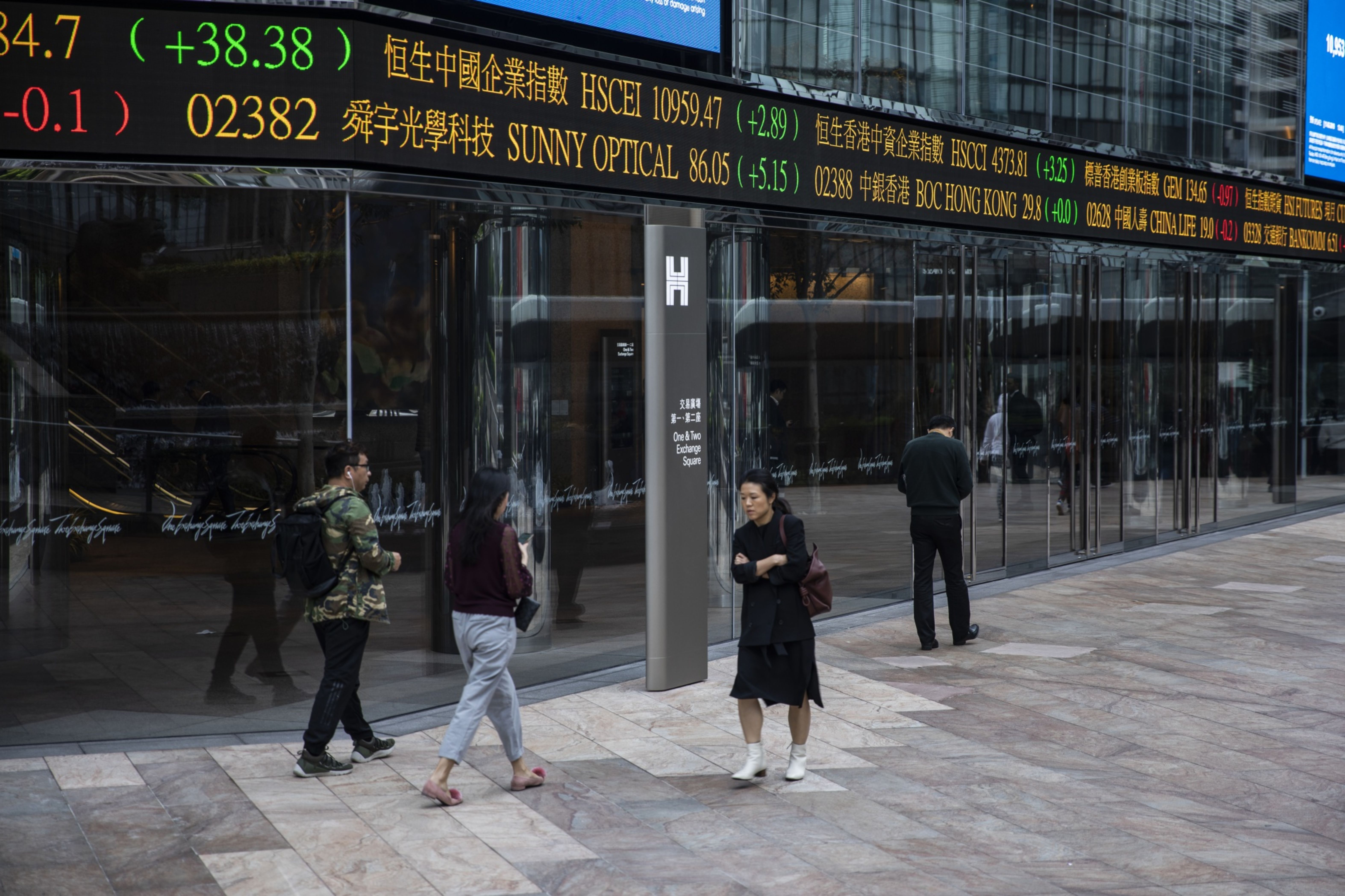
 Pedestrians walk past an electronic ticker board displaying stock figures outside the Exchange Square complex, which houses the Hong Kong Stock Exchange, in Hong Kong, China. (Photo: Justin Chin/Bloomberg)
 Asian shares were mixed after the lowest S&P 500 close since May, with equities paring declines of more than 1% in Japan, South Korea and Hong Kong. Oil eked out a gain as the next stage of the Israel-Hamas war remained unclear.
The rebound in Chinese equities “shows that while it may still be too early to call a bottom, the authorities are making it a rule to step on the brakes whenever there looks like there’s overwhelming downward momentum”, said Raymond Chen, fund manager at Zizhou Investment Asset Management. “This does help somewhat ease the panic, assuring investors that the nation will continue offering support if it drops further.”
The CSI 300 Index was little changed, while gauges in Shanghai and Shenzhen rose.
Treasury 10-year yields were little changed, as some of the market’s most prominent bond bears said the historic rout in US government bonds had gone too far. Yields slumped on Monday after hitting 5%, amid volatility fueled by expectations the Federal Reserve will keep rates elevated and the government will boost bond sales to cover widening deficits.
A gauge of the dollar retreated, giving a boost to emerging Asian currencies such as the Thai baht, South Korea’s won and Indonesian rupiah.
“USD seems to be softening alongside the pullback in UST yields, stretched long positions as well as potential for US preliminary PMI numbers to signal further slowdown in the economy,” said Fiona Lim, a senior analyst at Malayan Banking Berhad in Singapore.
Oil edged higher in Asia trading after dropping the most since Hamas’ attack on Israel as Tel Aviv was seen holding off on an invasion of Gaza amid hostage negotiations, containing the conflict for the time being. There are growing calls inside the country to rethink the scope of a ground invasion of Gaza. China reiterated that Israel must protect civilians even as it has the right to defend itself in a conflict.
In Japan, the central bank announced an unscheduled bond-purchase operation on Tuesday, underscoring its desire to curb the speed of increases in sovereign yields. The Topix benchmark dropped to the lowest since June after Nidec, a key supplier to the tech and electric vehicle industries, plunged over 10% on disappointing quarterly earnings.
Elsewhere, billionaire investor Bill Ackman wrote in a social media post that he unwound his bet against US government bonds amid rising global risks. Bill Gross, co-founder of Pacific Investment Management Co., wrote that he’s buying short-dated interest-rate futures in anticipation of a recession by year-end.
Bitcoin extended a rally fueled by expectations of fresh demand from exchange-traded funds, reaching the highest price since May last year.
High bar
US equity futures rose after the S&P 500 fell for a fifth straight session — its longest slide this year. The Nasdaq 100 outperformed with Microsoft Corp. gaining ahead of its results while Nvidia Corp. rose along with peers. Investors looking to the earnings season for a dose of good news are hanging their hopes on big tech.
The five biggest companies in the S&P 500 — Apple Inc., Microsoft, Alphabet Inc., Amazon.com Inc. and Nvidia Corp. — account for about a quarter of the benchmark’s market capitalization. Their earnings are projected to jump 34% from a year earlier on average, according to analyst estimates compiled by Bloomberg Intelligence.
Morgan Stanley’s Michael Wilson — among the most bearish voices on US stocks — said he “would not be surprised” to see further declines in the S&P 500 with “earnings expectations likely too high for the fourth quarter and 2024, and policy tightening likely to be felt from both a monetary and fiscal standpoint.”