



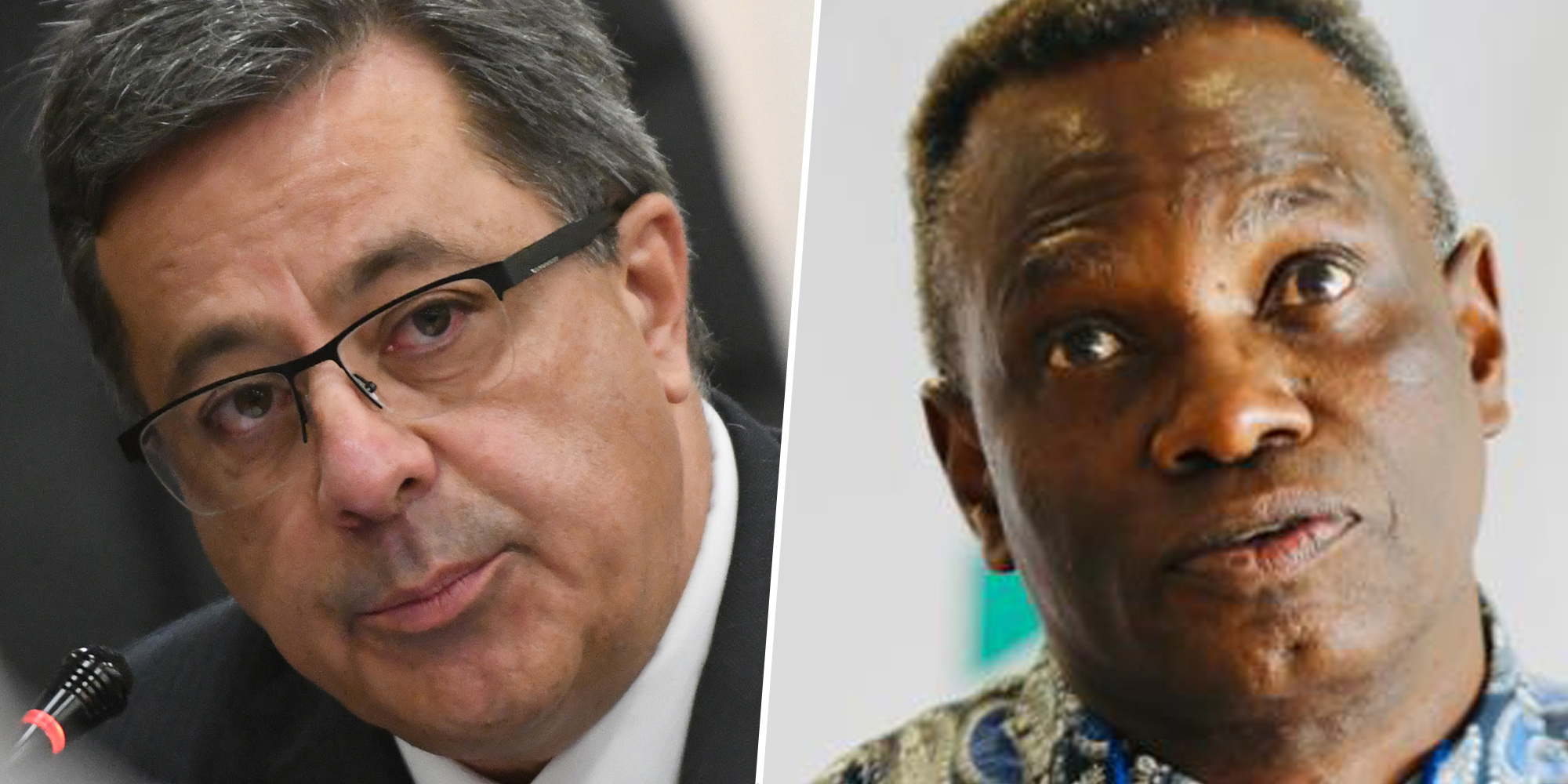
 Former Steinhoff CEO Markus Jooste. (Photo: Gallo Images / Brenton Geach) | Chairperson of the Sanral Board Themba Mhambi. (Photo: X / @Dotransport)
Here is an irony: Two senior executives at two very different organisations have made precisely opposite declarations about the disasters in their organisations. I, on account of being of a deeply suspicious nature and generally uncouth demeanour, don’t believe either of them. In fact, I believe precisely the opposite of what they claim. I do have reasons.
What on earth am I talking about here?
First, former Steinhoff CEO Markus Jooste claimed on Tuesday in a hearing before the Financial Services Tribunal to appeal two R7.5-million fines imposed by the JSE, that if there were accounting irregularities at Steinhoff, he wasn’t aware of them.
If this were Twitter, or X, as we are now forced to call it, you could well imagine a whole bunch of people using the “bwahaha” emoji, which looks like this if you are interested. 😂
If one were being uncharitable – a charge to which I would readily plead guilty – you might call this the “I am incompetent” defence.
Jooste’s lawyers claimed there was no evidence that he knew of the accounting irregularities behind SA’s biggest corporate scandal. He doesn’t claim there weren't irregularities; he simply claims he was entitled to rely on information provided to him by his underlings – and did so.
Lawyers for the JSE claim a) he could not not have known about them, because obvs, and more pertinently, b) that even if he didn’t, the JSE listing requirements clearly state that directors who delegate their duties are not absolved of their responsibilities. In other words, the “I was incompetent” defence is not an excuse.
The other example concerns national roads SOE, Sanral, where the situation is, as mentioned, precisely the opposite: the board chair claims the enormous additional expenses incurred by the organisation after it nullified tenders worth around R17-billion were not because of incompetence, but because the board under chair Themba Mhambi were, again, the opposite: they were ultra diligent. 😂
In reply to my questions about this, Sanral said, “In keeping with the obligations under the Public Finance Management Act, the Board decided to act after it discovered in January 2020 that the construction contractor bid evaluation process in the organisation had a major, and potentially corruptive, flaw.
“The process allowed the same service provider to do design drawings for an infrastructure project; develop the technical specifications for the tender for that project; and determine the technical bid to be recommended for award by the Bid Evaluation Committee if it meets other criteria.”
Thus, five contracts, already signed off by management, were summarily cancelled, including Africa’s largest bridge project, the R4-billion Mtentu Bridge, and Sanral’s largest project ever, the R5-billion N2/N3/EB Cloete interchange upgrade.
But is this ultradiligence or just, how should we put this, kinda dubious? The inclusion of project designers in the project award process is an industry norm, for the very obvious reason that when it comes to the technical evaluation of bids, it helps to have the expertise of the bid designers on board. Consulting engineers are not contracting engineers. Far from being a “major and potentially corruptive flaw”, it is actually financially effective, apart from being just commonsensical.
The board claims this decision was subsequently ratified by the Treasury and that senior counsel’s legal opinion confirms its view. Well, not to be overly cynical, but if you shop around, it’s not impossible to get a legal opinion that suits your own, particularly if you are forking out the boodle.
But the fact remains that nowhere in the world is this considered a conflict, unless of course the consulting engineers are also contracting engineers in the bid, which almost never happens, and was certainly not the case here.
But it goes further. The board, in its wisdom, insisted the rule be applied retrospectively. When it discovered that Sanral management didn’t, in fact, do that, it decided – brandishing more of that wisdom – to suspend two of its senior managers who outrageously didn’t think the board were nuts enough to want this absurd rule applied retrospectively, particularly since the board didn’t make that absolutely clear this is what they wanted.
This process cost around three years in construction time and billions of rands, and a whole new bidding process had to be initiated. However, this did give the board the opportunity to fiddle with the BEE rules and the SMME rules. The net result is that three of the contracts have been won by Chinese construction companies.
Personally, I welcome foreign companies winning construction contracts. But how, you may ask, does that help BEE? Local construction companies – those that are left, anyway – have an overwhelmingly black employee core. They have big BEE investment schemes, they train, they buy locally, and their profits go to local shareholders.
But the main point is that we have seen this whole playbook before at Eskom and Transnet and the Post Office and elsewhere. The pattern is instantly recognisable: Contracts cancelled, crushing new BEE rules imposed, expertise departs in droves, new contracts handed to obliging clients. This is precisely the modus operandi that dooms these organisations.
But perhaps I’m being too harsh.
Perhaps we should defer to the board’s caution, innate expertise and knowledge. Because, after all, the board chairman’s previous job was as an English lecturer. I am not making this up. He may even be distantly related to the engineering expert politician who appointed him, Blade Nzimande. That obviously qualifies him to upend long-established engineering processes.
Sometimes you can’t help thinking the ANC actually wants SA to fail. BM
- Article corrected to reflect that Sanral board chair Themba Mhambi was appointed by Nzimande not ANC Secretary General Fikile Mbalula, although the main events described here happened during Mbalula's term of office as Transport Minister between 2019–2023.
.
Comments
Scroll down to load comments...