




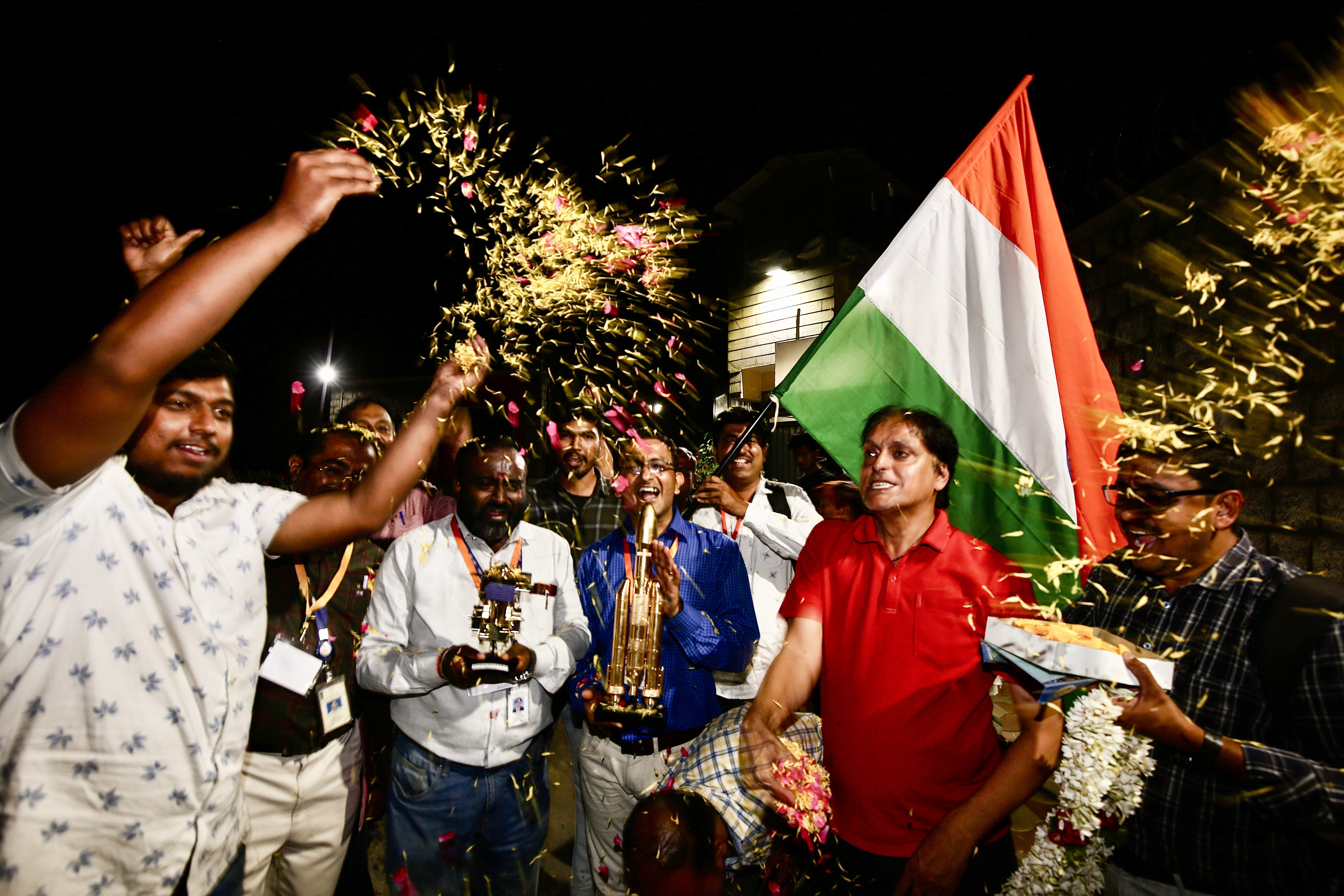
 Indian Space Research Organisation (ISRO) scientists, employees and staff members celebrate after the ISRO's mission Chandrayaan-3 soft landing on Moon's South Pole, at the ISRO Telemetry, Tracking and Command Network (ISTRAC) in Bangalore, India, 23 August 2023. Chandrayaan-3 is the third and most recent Indian lunar exploration mission under the Chandrayaan program of the Indian Space Research Organisation (ISRO). India became the first nation to land on the Moon's south pole and only the fourth nation ever to accomplish this, ISRO confirmed it on X (formerly Twitter) by saying 'I reached my destination and you too!' Chandrayaan-3 has successfully soft-landed on the moon. EPA-EFE/JAGADEESH NV
 The spacecraft landed on the unexplored south pole of the moon on Wednesday evening, days after Russia's Luna-25 failed, making India the first country to achieve this feat.
The soft, textbook touchdown by the lander after a failed attempt in 2019 sparked widespread jubilation and celebration in the world's most populous country.
"The Ch-3 Rover ramped down from the Lander and India took a walk on the moon!" the Indian Space Research Organisation (ISRO) said in a post on X, formerly Twitter.
ISRO chief S. Somanath said the "Pragyan" rover had two instruments to conduct element and chemical composition experiments.
"More than that it will do the roving on the surface, we will also do a robotic path planning exercise which is very important for us for future exploration," Somanath told Indian news agency ANI, in which Reuters has a minority stake.
Accomplished with a budget of about 6.15 billion rupees ($75 million), this was India's second attempt to touch down on the moon. A previous mission in 2019, Chandrayaan-2, successfully deployed an orbiter but its lander crashed.
Chandrayaan means "moon vehicle" in Hindi and Sanskrit. Chandrayaan-3 is expected to remain functional for two weeks which equals one lunar day when its solar-powered equipment is built to last.
The moon's rugged south pole is coveted because of its water ice, which is believed to be capable of providing fuel, oxygen, and drinking water for future missions, but its rough terrain makes landing challenging.
INDIA EUPHORIC
People across the country tuned in to watch the landing on Wednesday, with nearly 7 million people viewing the YouTube live stream alone.
Prayers were also held at places of worship, and schools organised live screenings of the spectacle for students.
Besides boosting India's standing as a space power and its reputation for cost-competitive space engineering, the landing is also seen as a major moment of national pride.
Prime Minister Narendra Modi said he was being congratulated by everyone since Wednesday evening and the world saw the successful landing not as one country's achievement but that of all of humanity.
"It is a matter of pride and a pat on the back for Indian scientists," Modi said at the BRICS summit in Johannesburg on Thursday.
Indian newspapers had banner headlines screaming "The moon is Indian", "India goes where no nation's gone before", and "India lights up the dark side of the moon", among others.
"Lunar landing is the most significant Indian scientific achievement," the Times of India said in an editorial.
"If India is now in a position to harvest the benefit of a spurt in interest in basic sciences there's one reason: ISRO," it said.
By YP Rajesh, Sakshi Dayal
(Reporting by YP Rajesh and Sakshi Dayal; Editing by Gerry Doyle and Toby Chopra)