




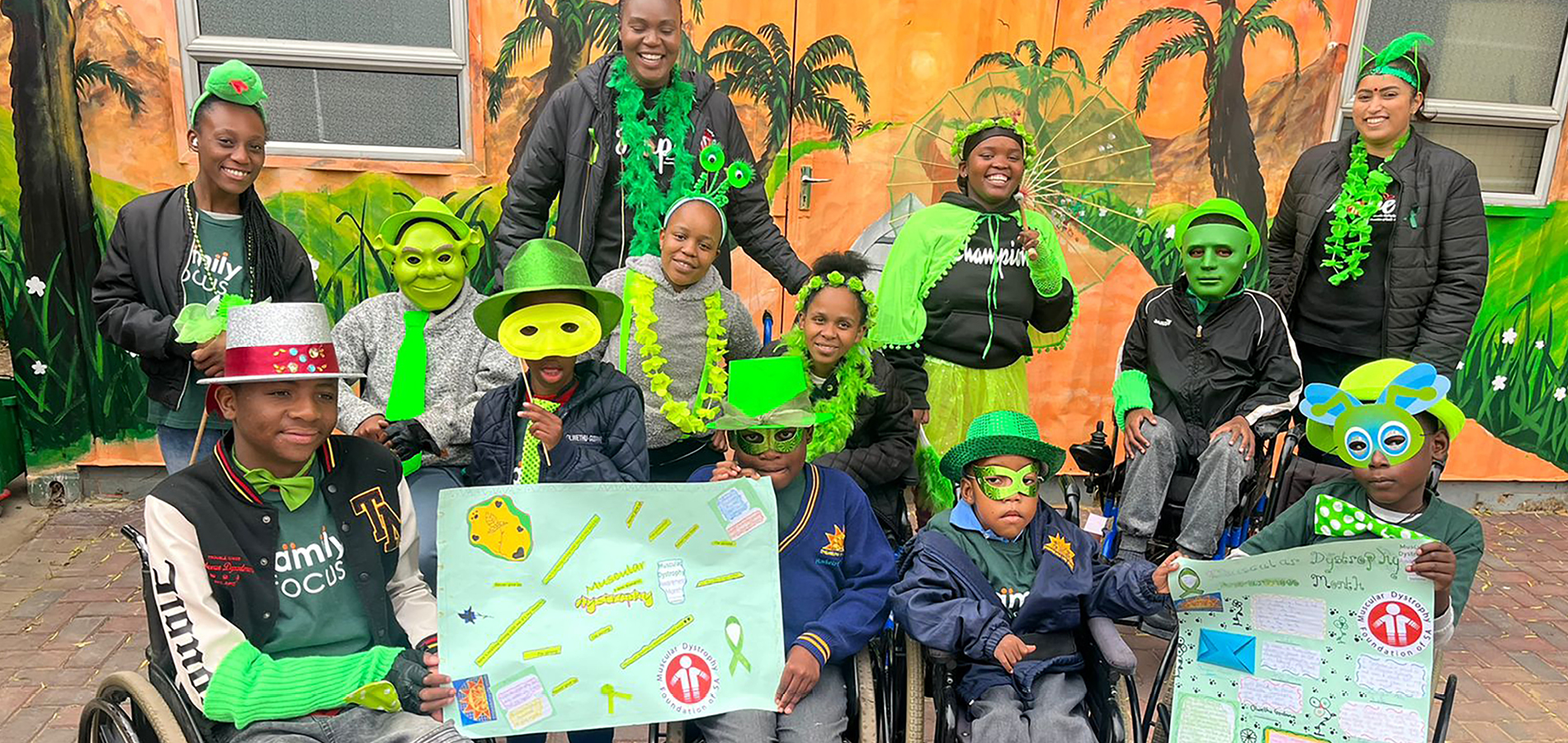
The Muscular Dystrophy Foundation of South Africa (MDFSA) is a 49 year old organization with a proud track record of providing psychosocial support to South Africans living with muscle wasting conditions. The foundation is a registered non-profit organisation consisting of a national office and three branches (Roodepoort, Cape Town and Durban), which operate in the nine provinces of South Africa.
Statistically, Muscular Dystrophy affects 1 in 1 200 people, which means South Africa should have roughly 49 492 registered Muscular Dystrophy patients. And yet, MDFSA, the country’s only support body for the condition, only has 1 228 registered members.
‘These numbers illustrate the country’s struggle with diagnosing patients and offering the access to medical care that is enshrined in the country’s constitution,’ says Gerda Brown, General Manager of the MDFSA National Office.
‘Because conditions like Muscular Dystrophy have always been viewed as untreatable, patients have been left to fend for themselves for decades. But things are changing fast, and increasingly the way South Africa as a whole thinks about Muscular Dystrophy casts light on critical areas of weakness in the country’s medical system.’
Providing psychosocial support to members is the MDFSA’s core focus, but the organisation also faces new challenges that have led it to push for improved general awareness of the many obstacles South Africans living with muscle wasting conditions face.
One key challenge for the organisation is improving access for members to crucial medical support services, from expensive mobility equipment such as electric wheelchairs, ventilators and Bipap machines through to regular physical therapy.
Unfortunately, while Muscular Dystrophy is listed as a Prescribed Minimum Benefit (PMB) condition, many private health care patients have claims for the cost of medical care rejected by medical aids, while at the national health level thousands of affected citizens go undiagnosed, or receive little medical support.
‘The trouble our community members face in securing basic levels of care is worrying in general, and also says a lot about the gaps in our system,’ says Brown. ‘The PMB list is supposed to ensure some level of equitable health care for all South Africans, regardless of whether they are members of a medical aid or not, or what level of medical aid membership they have. But in this case the theory doesn’t really translate in reality, and care is simply not provided. The spirit of PMB legislation is clearly not being upheld.’
Improving diagnosis and medical care involves rewriting the country’s PMB codes to provide a much clearer description of the various conditions that fall under the Muscular Dystrophy umbrella, and the treatments that should be provided for by funders. This, in turn, requires far greater awareness across the country of the plight of people living with muscle wasting conditions, including the need for South Africa to dramatically improve its diagnostic capability.
In addition, in recent years new genetic treatments have emerged globally that are able to address some muscle wasting conditions. Unfortunately, these treatments are extremely expensive, and some have at times been classified as the most expensive pharmaceutical drugs in the world. And while western countries have the budgets and strong healthcare systems to pay for new genetic treatments, in countries like South Africa most patients are left out in the cold, with private and national health funders stating that they cannot cover the cost.
‘South Africa needs a policy framework to address this really urgently,’ says Brown. ‘Not only for patients living with muscle wasting conditions, but for all patients living with rare diseases, many of which are now treatable through new genetic therapies. A process – The Rare Diseases Access Initiative (RDAI) – is underway, but our hope at the MDFSA is that it will start to move much faster than it has been, and that the different role players will start to reach the point of making agreements and decisions. Until then, the outlook for South African rare disease patients when it comes to accessing genetic treatments is very uncertain.’
Taking up an advocacy position and pushing forward with a national awareness campaign is new territory for the MDFSA. Nonetheless, the organization believes that, as one of the largest constituency groups for rare diseases in the country, it has a crucial role to play in changing South Africa's attitude to these important challenges.
The MDFSA also faces huge day-to-day challenges in its quest to offer care for its members. In its severe forms, Muscular Dystrophy can be fatal, and often restricts basic functions like the ability to breathe, and sit upright. The MDFSA receives regular requests for help with mobility aids and crucial equipment like batteries, wheelchairs and ventilators, which it fundraises for on an individual basis.
‘Some people living with Muscular Dystrophy face pretty extreme, life or death challenges every day,’ says Brown. ‘Many require ventilators to breathe, while a lot of members also need electric wheelchairs to participate in society. And then there’s loadshedding, which increases the need for batteries and generators a lot. We really need all the help we can get to help them cope.’
But, even with all these challenges, Brown sees a lot of reasons to stay positive. ‘Hopefully the country can start taking steps to deal with the gaps in the health system that allow these things to happen, but in the meanwhile it’s up to individuals and local communities to step in and help,’ she concludes. "We're always amazed at MDFSA just how many people approach us with different kinds of support, from donations to batteries. There’s plenty of evidence around of just how committed and caring ordinary South Africans are, which bodes well for our future.’ DM/MC
Comments
Scroll down to load comments...