




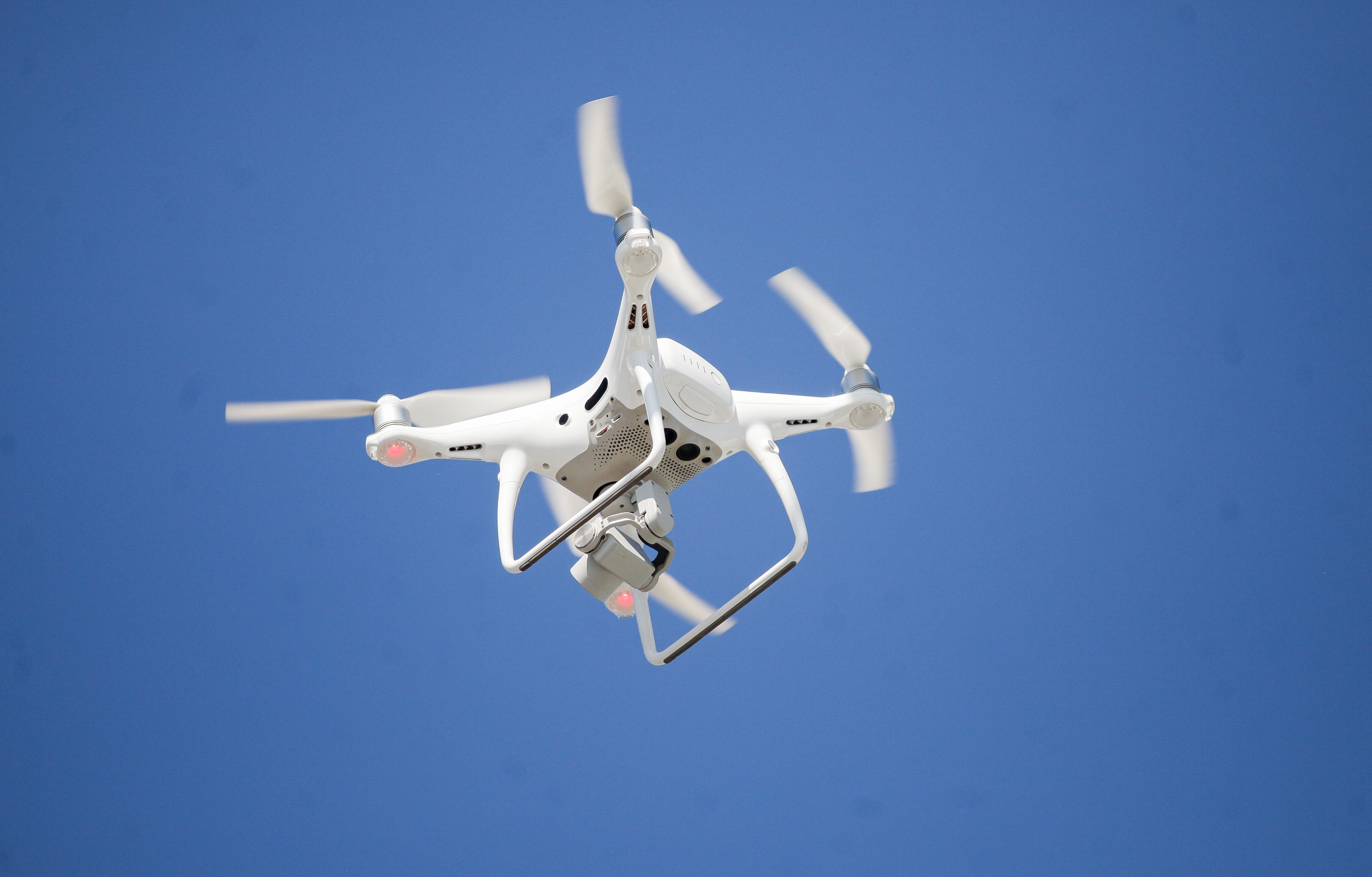
 A drone in Johannesburg on 21 February 2022. According to research firm Industry ARC, South Africa's growing small drones market is estimated to reach R2.4-billion by 2025. (Photo: Gallo Images / Sharon Seretlo)
Drone surveillance is becoming popular among security companies – camera-mounted drones can be more swift and effective, giving aerial views of a residence in case of a potential security threat. But, while experts say there are regulations around their use, organisations such as the Private Security Industry Regulatory Authority (PSiRA) only locked down some of these for companies as recently as 2022.
According to a drone merchant: “Drone surveillance is the use of unmanned aerial vehicles (UAVs), which are piloted from a remote pilot station known as remotely piloted aircraft system, to capture still images and video from a distance or at a high altitude to gather information about specific targets, which may be individuals, groups or the environment.”
Drones’ small size and ability to withstand harsh environments mean they can often surveil objects that may be out of reach and get a first-person view that photographers don’t usually get. Nowadays, security drones equipped with live video cameras, infrared cameras, thermal sensors and LiDAR (light detection and ranging) are used in large numbers by law enforcement. These are no longer fuzzy stationary cameras but high-definition gear that can feed information into the “all-seeing” video management systems.
The regulations are vague on how people’s privacy in their homes will be protected while security companies serve their clients. One of the main rules is that drones may not be flown within 50m of people or private property (without permission from the property owner).
/file/dailymaverick/wp-content/uploads/2023/07/ED_364914.jpg "One of the main rules is that drones may not be flown within 50m of people or private property (without permission from the property owner). (Photo: Gallo Images / Sharon Seretlo)")
This begs the question: when was the last time you were approached for permission to have a security camera flown over your house, apartment complex or flat?
One of the major security companies, Fidelity-ADT has been at the forefront of using this technology, having partnered with VumaCam which has a wide network of surveillance cameras in Johannesburg, intending to reach 15,000 and expanding into provinces such as KwaZulu-Natal, at the request of the eThekwini Municipality. Activists have raised the alarm about the use of a central nerve centre that can recognise personal data such as number plates, as well as other artificial intelligence that can watch for certain security threats. Fidelity and VumaCam have insisted that privacy laws will be adhered to.
Eyes in the sky
The South African Police Service has used drone surveillance as part of its operations – 13 drone pilots were given their licences last month in Midrand, to combat crime and increase police presence in areas that are hard to access owing to environmental design, according to Gauteng’s police commissioner, Lieutenant-General Elias Mawela, who thanked the Fidelity Special Service and UDS Drone Solutions for helping to train the pilots, adding that this will usher in “e-policing”.
This initiative will be expanded as more pilots are trained.
The police minister has in the past few years outlined the push for drone surveillance, and his department has been buying drones in phases for a national roll-out of drone use.
Read more in Daily Maverick: Up in the air — drone fishing spins a tangled nest of legal, ethical and conservation dilemmas
This surveillance will target townships and rural areas, Gauteng community and safety MEC Faith Mazibuko told eNCA, saying Diepsloot already has two drones with face-recognition technology surveilling the township:
“These drones will make it easier for police to see what’s happening on the ground, in places like Diepsloot there are places where you can’t even walk; if you are a bigger person like me you have to squeeze into those passages. It actually helps to monitor and give information to those on the ground, to say there is this crime taking place, a person is in distress or something is happening… as soon as we can zoom in on all these challenges, Diepsloot will be a normal place like all others.
“What is impressive is the two cameras we have deployed there – there are CCTV cameras with facial recognition. Where they were deployed it was a hotspot but nowadays it’s no longer a hotspot because they know there is an eye in the sky, those cameras are linked to the station, the station can observe or monitor what is happening in that area.”
Draft regulations published by the police minister in the Government Gazette in July 2022 require drone service providers to the security industry in South Africa to register as a security service provider according to the requirements of the Private Security Industry Regulation Act, or face prosecution.
This gives the regulating authority power to:
- Determine the information that must be submitted to the authority by security service providers, including any person rendering a security service, operating or involved in operating a remotely piloted aircraft system (RPAS);
- Determine the condition under which service providers may operate or advertise services relating to the use or operation of an RPAS following the applicable laws;
- Determine guidelines for conducting assessments for security service providers operating an RPAS for purposes of ensuring it is legally operated;
- Monitor security service providers operating an RPAS to ensure that such operation follows all applicable laws;
- Keep a register of security service providers and employers of in-house security officers who are licensed to use, or are involved in operating an RPAS for rendering security services;
- Enter into agreements with or obtain the assistance of any relevant person, institution or organ of state to conduct or assist it in conducting any investigation or performing any function in terms of these regulations.
In a discussion paper the South African Law Reform Commission spelt out that: “Privacy is a valuable aspect of personality. Data or information protection forms an element of safeguarding a person’s right to privacy. It provides for the legal protection of a person in instances where his or her personal information is being collected, stored, used or communicated by another person or institution. In South Africa, the right to privacy is protected in terms of both our common law and in section 14 of the Constitution.
“In protecting a person’s personal information consideration should, therefore, also be given to competing interests such as the administering of national social programmes, maintaining law and order and protecting the rights, freedoms and interests of others.”
‘Future-facing industries such as drones’
Although the thought of Big Brother getting more wings might be ominous as a threat to civilians, especially activists, and journalists, drone piloting offers opportunities for unemployed young people.
Youth Employment Service (YES) chief executive Ravi Naidoo noted that the drone surveillance industry is booming and can offer opportunities in a declining jobs market.
“Jobs are being created in future-facing industries such as drones, tech/ICT, creative, coding, renewables and finance, simply adding to the multiplier effect,” said Naidoo. “These are industries that piggyback on the world’s inexorable move towards digitization and technology: people working in business process outsourcing (BPO) centres, for example, or becoming drone pilots, in green energy and developers,” he said.
Drone pilot Mawanda Faniso, who entered the industry through the YES training programmes, comes from a previously disadvantaged background in the Western Cape and notes that the industry can be hard to navigate because of constricted finances.
Faniso does surveillance over railways, power stations and mines, and has noted a growth in surveillance over oceans to detect and deter abalone theft in the Western Cape.
Read more in Daily Maverick: Weaponised drones — the latest tech threat to be employed by criminal and extremist groups in Africa
“I would say there is a lot of red tape, especially if you are trying to open your own business in drone piloting and surveillance. It is a technical industry so the red tape can be appropriate and expensive. That’s why well-off businesses use permissions from the South African Civil Aviation Association, so from a work point of view it is expensive and can be inaccessible, trying to get your licence to fly, licence to fly different kinds of drones, and buying the equipment.
Nevertheless, “the drone industry is expanding, people are finding more need to use the drone, especially in surveillance, especially security, people are doing new things every day, even drone racing and so forth”.
Mawanda believes you need clarity of mind, the intention to work and the right environment. “You need to make sure you have your flight pack, which is where you would have your permissions – you can’t fly over land where the owner doesn’t know, so you have to attain that even if it means physically going into the space and getting that permission [although] if you have a team, other members secure those permissions for you.”
/file/dailymaverick/wp-content/uploads/2023/07/Fidelity-Security-drones.jpeg "Fidelity Security drones. (Photo: Supplied)")
He notes too that communication is important since other drone pilots need to know you are flying as well, while different tiers have different regulations.
According to DroneNews.Africa: “Other companies to employ drone technology of late include Hassar Security and Defence Solutions and Thorburn Security Solutions; the latter of which has been working with rising security drone services provider Drone Guards to buttress security missions and patrols by its ground personnel. As a security implement, unmanned aerial systems can be applied for search-and-rescue missions, perimeter security, aerial surveillance and border control, among many other use cases.”
The validity of wanting privacy in the Information Age is questioned daily in southern Africa and globally. In ebook, The Social, Cultural, and Environmental Costs of Hyper-Connectivity: Sleeping Through the Revolution, author Mike Hynes describes how it’s becoming easier to have mass surveillance tools that are interconnected, making it harder to secure fundamental rights to privacy and protect personal information.
“The shift in communications to the digital realm effectively solves many of the problems that plagued surveillance in the analogue age. It is cheaper, storage space is almost infinite, equipment reasonably cheap and such digital technology allows for doing more with fewer resources,” he writes. DM
Naledi Sikhakhane is a journalist researching digital surveillance, with support from the Media Policy and Democracy Project run by the University of Johannesburg’s Department of Communication and Media.
Comments
Scroll down to load comments...