




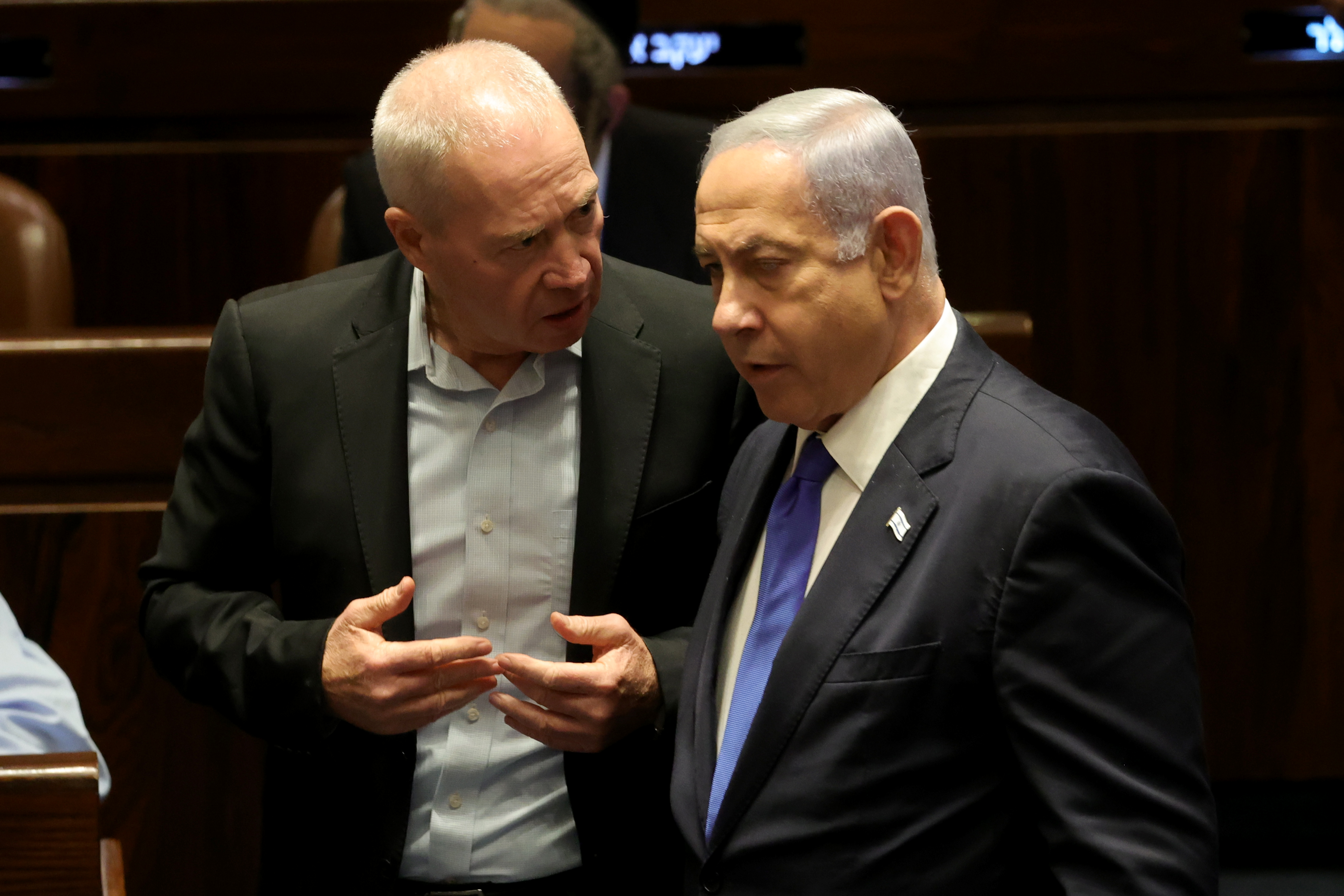
 Israeli Prime Minister Benjamin Netanyahu (R) and Minister of Defense Yoav Gallant at a Knesset session to vote on law on justice system reform, Israel, 24 July 2023. Mass protests continue across the country as the Israeli parliament, or Knesset, is set to hold a final vote on the bill that would limit the Supreme Court's powers. EPA-EFE/ABIR SULTAN
 Surveys by two main Israeli news broadcasters showed that if an election was held now, the number of seats held by Netanyahu's hard-right governing coalition in the 120-seat Knesset parliament would fall from 64 to 52 or 53.
Seats held by the 73-year-old premier's Likud party would fall from 32 to 28, according to N12 News, and to as low as 25, according to Reshet 13 in the polls published late on Tuesday.
The nationalist-religious coalition, formed after an election last November, passed legislation on Monday to limit some of the Supreme Court's powers, despite street protests and disapproval from Israel's strongest ally the United States.
It was the first ratification of a bill that is part of changes to the judiciary that Netanyahu casts as necessary to balance powers and stop the Supreme Court over-reaching.
Critics say he is threatening Israel's democratic principles and independence of the courts, possibly with an eye to a corruption case he himself is facing. Netanyahu denies that.
The Supreme Court is to hear an appeal against the new law in September, according to its website.
The domestic crisis comes during a surge of violence in the West Bank. On Wednesday, the official Palestinian news agency WAFA said that a 23-year-old man was shot dead by Israeli forces during confrontations in the West Bank city of Nablus.
The Israeli military did not immediately comment.
With the shekel falling around 10% since the government announced its judicial overhaul in January and pressure mounting on Netanyahu, his opponents are looking to the more moderate camp in Likud to dissuade him from pushing more legislation.
"There is a hardcore over there that will follow Netanyahu blindly into any abyss. However there is a critical mass among Likud voters who are displeased with what is happening right now," said political analyst Amotz Asa-El, research fellow at the Shalom Hartman research institute.
CONSENSUS POSSIBLE?
Defence Minister Yoav Gallant, Economy Minister Nir Barkat and the Knesset's foreign affairs and defence committee head Yuli Edelstein are widely seen as among those who could push for consensus with the opposition.
The United States has lamented the Knesset vote and urged consensus but offered no hint that Netanyahu’s government could face practical consequences, exposing the limits of President Joe Biden’s influence over the long-serving right-wing leader.
A day-long doctors' strike ended and street protests largely subsided by Wednesday as the Knesset parliament approached a long summer recess from July 30. Lawmakers reconvene in mid-October and Netanyahu has set November as a target for consensus with opposition parties.
Israel's largest labour union the Histadrut, which had tried to mediate a compromise between Netanyahu's coalition and opposition parties, has threatened strike action if the government pursues further legislation without agreement.
Amid concerns that the crisis may distract Israel from security issues, the military has acknowledged an uptick in requests by reservists to halt service and said that could gradually affect its readiness if the trend persists.
Protest leaders say growing numbers of reservists may abstain from duty.
Israel's enemies have convened top-level meetings to consider the turmoil and how they might capitalise on it, sources familiar with the discussions told Reuters.
As well as violence between Israel and the Palestinians, the domestic furore has coincided with rising friction with Lebanese Shi'ite group Hezbollah, backed by Israel's arch-foe Iran.
It has also hit the economy by drawing warnings from credit agencies, triggering foreign investor flight and risking strikes.
Moody's sees negative economic consequences of Israel's judicial upheaval Read full story
Israel's enemies see opportunity in its crisis Read full story
(Reporting by Maayan Lubell in Jerusalem; additional reporting by Ali Sawafta in Tamallah; writing by Michael Georgy; editing by Robert Birsel and Andrew Cawthorne)