



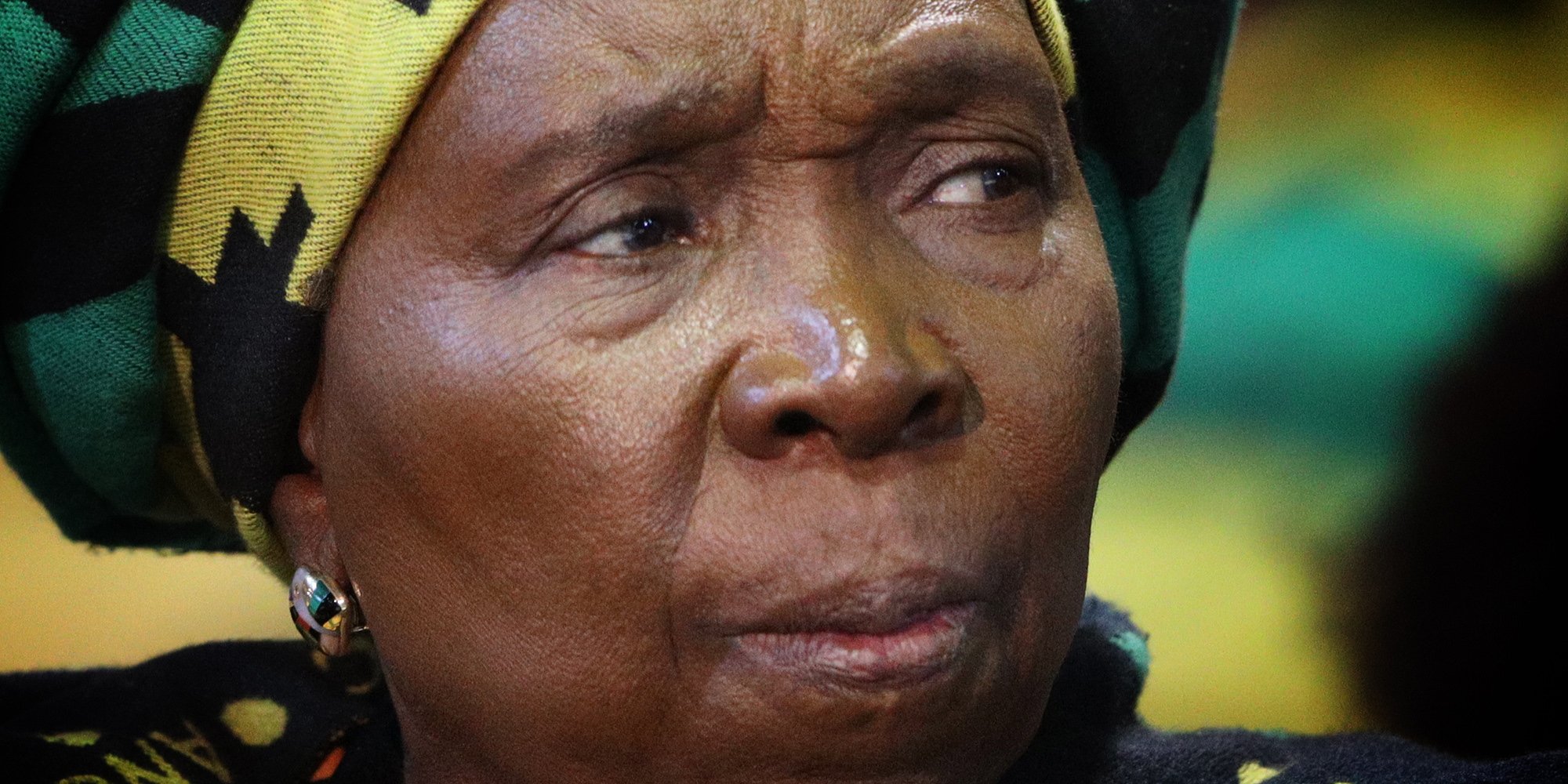
 Nkosazana-Dlamini Zuma. (Photo: Felix Dlangamandla)
 If I had to choose the South African minister who has been the most destructive force in government in the post-liberation era, it may seem obvious that the winner would be, hands down, former president Jacob Zuma. He, after all, presided over State Capture, a mushroom cloud of corruption, cadre deployment and a lost economic decade in which SA’s national debt exploded, SOEs went bankrupt and unemployment increased. Pretty crappy list.
But, you know, he had help. You don’t achieve this level of economic disaster all by yourself. Next in the queue, I would place his former wife Dr Nkosazana Dlamini Zuma.
Dlamini Zuma, famous for such grand spectacles as Sarafina 2, Virodene and banning tobacco during Covid, has now issued a diatribe against SA’s banks (again).
Speaking at the BRICS Youth Summit in Durban, Dlamini Zuma said SA was “forced to kneel before five banks”.
Actually, 63 banks operate in SA – 17 of which are local.
“This represents some of the most concentrated banking systems in the world,” she said. I mean – do I need to write this? SA isn’t close to being the most concentrated banking country in the world. The UK has five banks that represent around 90% of deposits. Switzerland has five banks that represent 95% of deposits. For a country the size of SA to have five major banks operating intensely competitively is routinely mentioned in international reports as one of the country’s most valuable assets!
She goes on: “The greater concentration of banking to the big five has clearly undermined accountability, hindered development, stifled competition and passed on the cost burden to citizens.”
This is simply horse manure.
SA’s big five operate on margins that are absolutely within the ballpark of countries with the same risk profile.
SA’s bank price-to-book ratios are richer than those of developed country banks: they have to be, because – and this is something you hope Dlamini Zuma would have noticed after 25 years in government – SA’s government is so dysfunctional that our country risk has been rising and economic growth is stagnant, forcing banks to make larger provisions for bad debts.
But, you know, this is not what really bugged me most about this speech.
We have heard this bunkum so many times before that most people in business and government just smile and wave. What got me was the heart of the speech, where she spoke about the desperate need to fight with all our might against the “unipolar” world, and how the BRICS grouping is our best shot at achieving this noble aim.
Well, you know, there is a global rebalancing taking place; it’s inevitable and welcome because it rests on the mass enrichment of some of the poorest people in the world.
But what Dlamini Zuma sees coming out of this is not global solidarity, but “multipolarity”. Multipolarity, she says, is a departure from the dominant reality of a unipolar world order in which there is only one dominant power. (You have to ask, what world does she think she is living in?)
“In a multipolar world, power is dispersed, and no one country has the ability to dictate the international agenda. The rationale behind multipolarity is that it promotes stability and reduces the likelihood of conflicts.
“When there is no single dominant power, each great power must negotiate and cooperate with others to achieve its national interests. The presence of multiple centres of power also means that no single power has the ability to impose its will on others, which can help prevent conflicts and promote peaceful resolution of disputes,” she says.
Oddly enough, we have seen how a multipolar world works. It was pretty horrible.
Because if your philosophy is rooted in the notion of national power dynamics only, rather than, say, global cooperation, powers are going to coalesce and all of a sudden you have two opposing power blocs with guns pointed at each other.
What follows are all the joys of nuclear standoffs, proxy wars and third-world despots clinging to authority by playing one power off another, as we had during the Soviet era.
“Multipolarity” would only work if there were, say, five equally balanced powers competing with each other. Odd, that.
But that is not what BRICS is about. BRICS, in the world-view of Dlamini Zuma, is about uniting to create a bipolar world of them – “the West” – against us, the glorious rest.
And what BRICS will do is fight the dastardly symbols of oppression and neocolonialism, the horrors of this terrible new world order, the World Bank and the IMF (in which, by the way, all BRICS members including SA are currently represented. Apparently the inherent evilness of an organisation is not a sufficient reason to, you know, leave).
I hope the Bretton Woods institutions forget this speech when SA finally ends up with no choice but to try to hit them up for a much-needed bailout, which is the direction we are seemingly inexorably headed. DM