




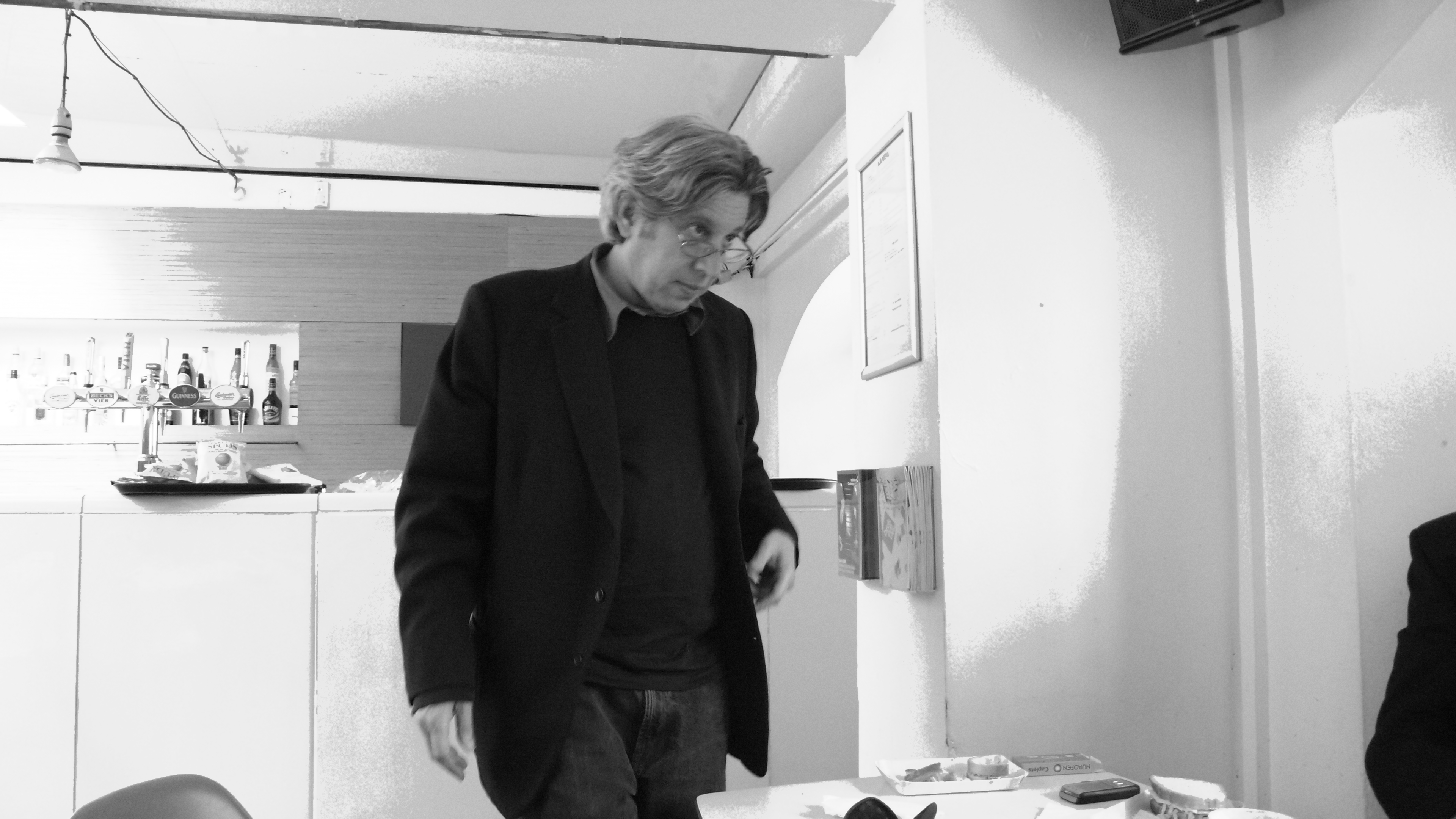
 Eric Liknaitzky. (Photo: Supplied by the author)
 Born in Johannesburg on 13 September 1951, he migrated to Cape Town after a stint in the army and a job with a mainstream film distributor in 1975. Already a film enthusiast with a prodigious knowledge, he was employed by a 16mm film library specialising in offbeat cinema owned by Cape Town entrepreneur Tony Velkes.
Tony had seen, on a tour of Europe, how a taste was emerging among younger filmgoers for challenging, artistic cinema outside of the Hollywood vein. Taking a leap of faith, he made a deal with the owner of the Labia Theatre in Gardens to hire the theatre on an ongoing basis.
The theatre, owned by a Polish émigré, Wolf Miknowski, was going through a bad period. The Nico Malan Theatre (now Artscape) had opened and productions which would have gone to the Labia were decamping to the new venue. The Labia was fairly run down, with ancient carbon arc projectors and an alcoholic projectionist, so, romantically speaking, it was a perfect venue for offbeat cinema.
/file/dailymaverick/wp-content/uploads/2023/06/Eric_Liknaitzky_Obit_2023Eric-Liknaitzky-photo-by-Charles-Rubenstein.jpg "Eric Liknaitzky. (Photo: Charles Rubenstein; Supplied by the author)")
Eric was the man with film knowledge and Velkes could not have gone forward without him. Under the advertising banner of “Five good reasons why the face of cinema is changing” (the five reasons being Tony Velkes, Eric Liknaitzky, myself, Gordon Nichol (technical) and Mario C Veo – who became the Labia proprietor from 1979 to 1989), the tentative first week of programming drew a rapturous response and the Labia was reborn as an independent cinema, as it still is.
Eric programmed the Labia until 1978 when he emigrated to London and those years, 1975 to 1978, became legendary for iconoclastic programming and an anarchic contempt for mainstream cinema. The Labia operated more like a commune than a bioscope and frequently barefooted patrons mingled with arty cognoscenti. Apartheid laws were ignored and those who sold the tickets became colour blind and the telltale whiff of cannabis often permeated the auditorium.
The weekly programme written by Eric (EL), myself (TST) and a polyglot of others eschewed all the advertising rules of middle-class society. If we didn’t like a film, we said so. We still showed the film though to allow audiences to make up their own minds. The Dope section at the bottom of the programme page was the anarchic crème de la crème and it became a regular section.
In London, Eric worked for some of the emerging art film distributors such as Gate Cinemas (run by New Yorkers David and Barbara Stone who had produced several left-wing films in America) and Artificial Eye whose director, German film critic Andi Engel, had been a close associate of the New German Cinema.
Eric, outside of the cinema world, was an ardent Bob Dylan specialist and would attend every concert when Dylan played the UK. When he finally left Artificial Eye, his goodbye present was a pristine copy of the four-and-a-half-hour cut of Dylan’s only directorial venture, Renaldo and Clara.
Eric then joined one of the UK’s oldest distributors of artistic cinema, Contemporary Films, run by Charles and Kitty Cooper who, apart from an enormous library of films, ran two of London’s premier art houses, the Paris Pullman in South Kensington and the Phoenix in East Finchley. The Coopers were ageing and Eric brought new life into the firm, acquiring rights on classics such as Bernardo Bertolucci’s The Conformist and Michelangelo Antonioni’s The Passenger.
The back catalogue at Contemporary included many South African anti-apartheid films – such as Last Grave at Dimbaza, Let My People Go, World of Strangers (adapted from a Nadine Gordimer novel starring Zhakes Mokae) and End of the Dialogue. Because they were the only prints of the films in existence, Eric oversaw programmes of South African resistance cinema in New York and elsewhere. Contemporary also held prints of films related to the Spanish Civil War, the Campaign for Nuclear Disarmament (such as Carry Greenham Home) and documentaries focusing on civil rights and urban protest.
/file/dailymaverick/wp-content/uploads/2023/06/Eric_Liknaitzky_Obit_2023Eric-Liknaitzky-and-Wolf-Miknowski-1975-in-the-Labia-foyer.jpg "Eric Liknaitzky and Wolf Miknowski in the Labia foyer in 1975. (Photo: Supplied by the author)")
The Coopers, having been committed socialists, also had a comprehensive library of Soviet cinema, cinema from China (especially the work of Felix Green) and Indian cinema (especially the work of Satyajit Ray).
When Charles Cooper died and Kitty Cooper was finding the business difficult to maintain, Eric took over the reins and ran Contemporary as director. From offices in Kentish Town and later in Crouch End, he managed the work of independent filmmakers such as Peter Whitehead and Joseph Strick. The relationship with Whitehead was particularly fruitful as Whitehead’s work, which had been largely forgotten, was reanimated with a full retrospective at the Vienna Film Festival. Eric continued to represent Whitehead as the filmmaker’s visibility once again took off.
As the climate of film distribution changed from celluloid to digital and the whole landscape of exhibition became complicated by changing tastes and the closing of many iconic independent cinemas, Eric undertook the task of distributing documentary films of specific-interest potential to limited venues.
His own film tastes were varied and he had a special affection for the work of Robert Altman, Sam Peckinpah, Howard Hawks and Woody Allen. Like so many film buffs of his generation, Eric enjoyed making Best 10 Film Lists at the end of each year.
/file/dailymaverick/wp-content/uploads/2023/06/Eric_Liknaitzky_Obit_2023The-Labia-5-Good-Reasons-1975.jpg "The Labia, 1975. (Photo: Supplied by the author)")
Always a moveable feast, films would be rated highly, only to disappear as each new year came around. In December 2022, Eric faithfully compiled his list which included Kubrick’s 2001: A Space Odyssey, Peckinpah’s The Getaway, Polanski’s Chinatown and Fellini’s Toby Dammit.
In May 2023, Eric was diagnosed with a particularly virulent cancer, which spread unabated.
He passed away just before midnight at his daughter’s home surrounded by his family. He leaves his wife Shen, his daughter Jude, son-in-law Dick, his grandchildren Milly and Vincent, and brothers David and Barry.
Although he spent most of his working life in England, Eric’s contribution to cinema appreciation in South Africa is immense and his memory will always be attached to the Labia in Cape Town and for being one of the five good reasons the face of cinema changed. DM