
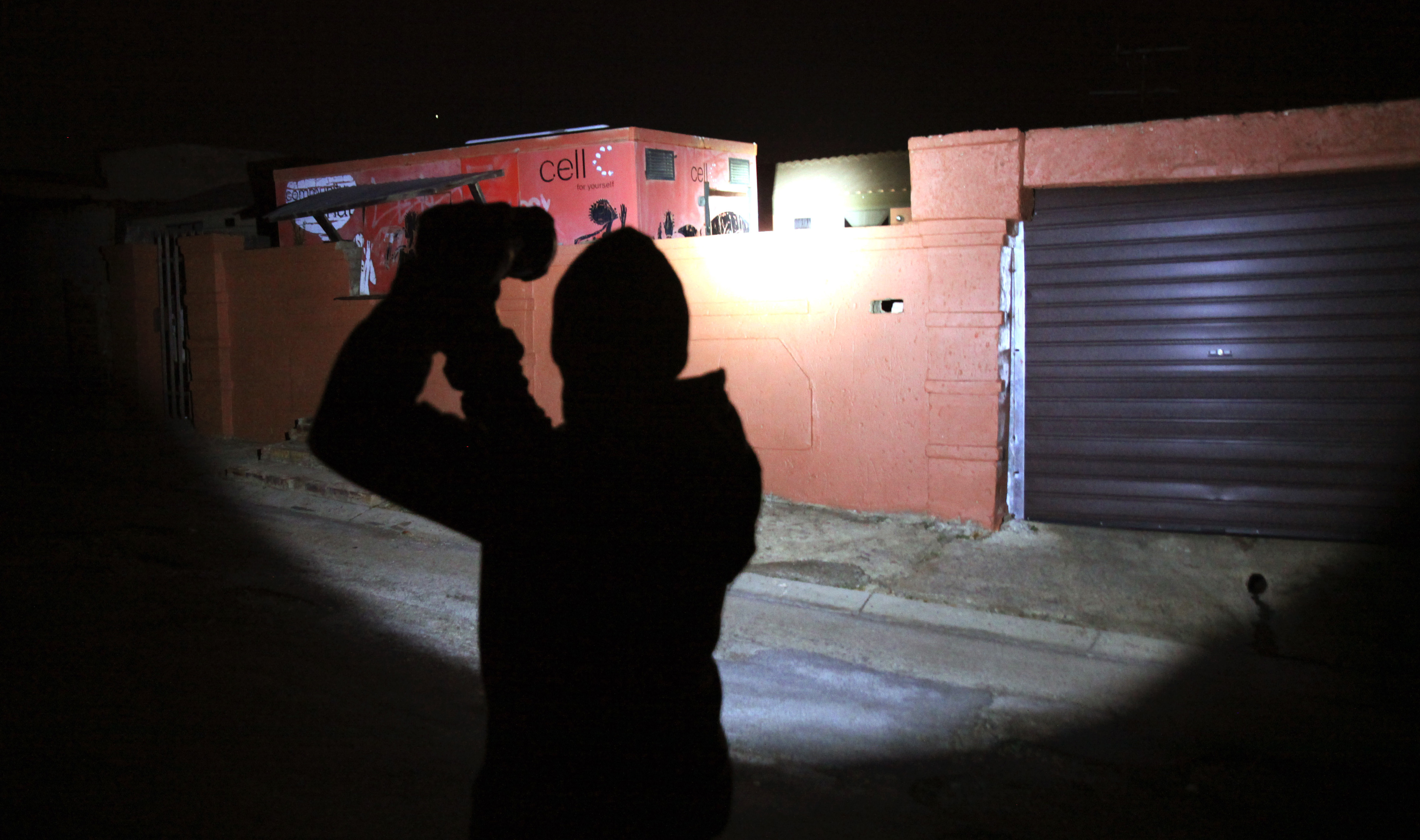
 A patroller shines a torch on a house to alert the occupant that it is safe for her to come out. (Photo: Kabelo Mokoena)
 In a population of about 60 million only 16.2 million are employed. Just 51% of black women have a job and there was an increase in youth unemployment – up to 62.1% – in the first quarter of 2023.
South Africa has had a high crime rate for a long time, but there has been an increase of 3.4% in the 2022/23 financial year on the same period the previous year.
Constant rolling blackouts have played a pivotal role in the increase in crime in South African communities and have left citizens in fear as they make their way to and from work in darkness.
In Soweto, most people use public transport to get to work, which means they usually have to walk some distance from their homes to get to taxi ranks or bus and train stations.
/file/dailymaverick/wp-content/uploads/2023/06/Kabelo-Protecting-people9.jpg "Tebogo Molata (21) checks in with one of her fellow patrollers over a walkie-talkie. Tebogo is part of the Ekhayalami Neighbourhood Watch in Soweto. (Photo: Kabelo Mokoena)")
Large numbers of jobless young people have resorted to crime, often carrying weapons to intimidate and rob people making their way to work in the early hours.
All this was just too much for a group of individuals in Soweto, who decided to take a stand and try to reduce crime in their neighbourhoods – particularly violent attacks, robberies and killings.
Pensioner Ntate Legwale said he feels at ease when he hears the sound of vuvuzelas in the morning… he knows the patrollers are operational.
Bafana Nkosi is a member of the Ekhayalami Neighbourhood Watch and lives in Meadowlands. He and his team of patrollers do not have jobs but have dedicated themselves to serving their community
“I grew up in Meadowlands; this place is home to me,” says Nkosi.
/file/dailymaverick/wp-content/uploads/2023/06/Kabelo-Protecting-people3.jpg "In the early hours patrollers are out in Mzimhlope, Orlando West. (Photo: Kabelo Mokoena)")
/file/dailymaverick/wp-content/uploads/2023/06/Kabelo-Protecting-people6.jpg "A woman leaves her home as a patroller uses a touch to indicate he is outside and it is safe for her to come out so he can escort her to the bus station. (Photo: Kabelo Mokoena)")
“We need to protect one another so that we are all safe. Yes, I don’t have a job now, but that doesn’t mean I must sit and do nothing.”
Nkosi and his “fellow troops” wake up in the early hours every day and get together in a local passageway for a prayer session before locating themselves at various transport hubs.
Read more in Daily Maverick:
The devaluation of Youth Day in Soweto tells a story of despondency among young people
They all feel a calling to protect each other and build a safe environment.
A walkie-talkie is used for communication and pepper spray for defence in case of an attack.
Funds for the walkie-talkie come from residents, who contribute R20 for the night patrols.
“The R20 is used for the uniform and to maintain the equipment. We need to indicate that we are patrollers and make sure the gear we use is working properly,” says Nkosi.
/file/dailymaverick/wp-content/uploads/2023/06/Kabelo-Protecting-people8.jpg "Karabo Sithole braves the cold to protect residents. Sithole said he is unemployed but instead of doing nothing he prefers to serve and protect his community. (Photo: Kabelo Mokoena)")
/file/dailymaverick/wp-content/uploads/2023/06/Kabelo-Protecting-people4.jpg "With few resources, a vuvuzela is a very important tool to alert residents that the patrol team is on the ground and it is safe for them to make their way to work. (Photo: Kabelo Mokoena)")
Plea to help patrollers
Ntate Legwale, a pensioner who lives in the area, said he feels at ease when he hears the sound of vuvuzelas in the morning and goes outside to open the gate as he knows the patrollers are operational. The sound is comforting and not a disturbance, he notes.
“When I hear the vuvuzelas being blown outside, to me it’s like an alarm going off.
“I find it no distraction to my sleep. I then know that it is time to get up and open the gate for anyone who might come in to visit.”
The 70-year-old says the guards should be properly compensated. They should get a stipend as their vigilance in the streets is of real value to the area, he reasons.
“If these kids stop patrolling, the crime will infiltrate. Those who see the opportunity to steal while we are asleep and making our way to work will be back on the streets to continue doing criminal activities,” says Legwale.
/file/dailymaverick/wp-content/uploads/2023/06/Kabelo-Protecting-people10.jpg "Two young patrollers shine a light on a woman who is about to make her way through a passageway. She feels safe enough to put down her bag and tie her shoelace. (Photo: Kabelo Mokoena)")
/file/dailymaverick/wp-content/uploads/2023/06/Kabelo-Protecting-people5.jpg "Schoolchildren feel safe when they are met at home and escorted to school by the patrollers. (Photo: Kabelo Mokoena)")
Tebogo Molata is a female patroller who lives in Meadowlands.
Molata believes the local Johannesburg city councillor should engage with and support the patrollers.
They would also like the councillor to inform them of any job opportunities that come up in the area.
This is only fair as they are risking their lives for the community, she adds.
“All I want is for the councillor to come to the party. We had a meeting with him and he promised we will be first in line when job opportunities come up.
“Now I was shocked when people went as far as Tembisa to work on a tender that is allocated in our neighbourhood.
“Most of us here are unemployed; that’s why we are in this community neighbourhood watch.”
/file/dailymaverick/wp-content/uploads/2023/06/Kabelo-Protecting-people1.jpg "After escorting her from her home, a patroller helps Lindiwe Ndlovu catch a taxi to work. (Photo: Kabelo Mokoena)")
Molata recalls the last time they tried to arrange a meeting with the councillor.
He never pitched up, even though he had set the time and place for the meeting.
“I am deeply hurt. All we get is empty promises.
“They say we do nothing the whole day, all we know is how to drink alcohol and smoke. But when we come up with initiatives to improve ourselves we don’t get support from those who are on top.” DM
This story first appeared in our weekly Daily Maverick 168 newspaper, which is available countrywide for R29.