




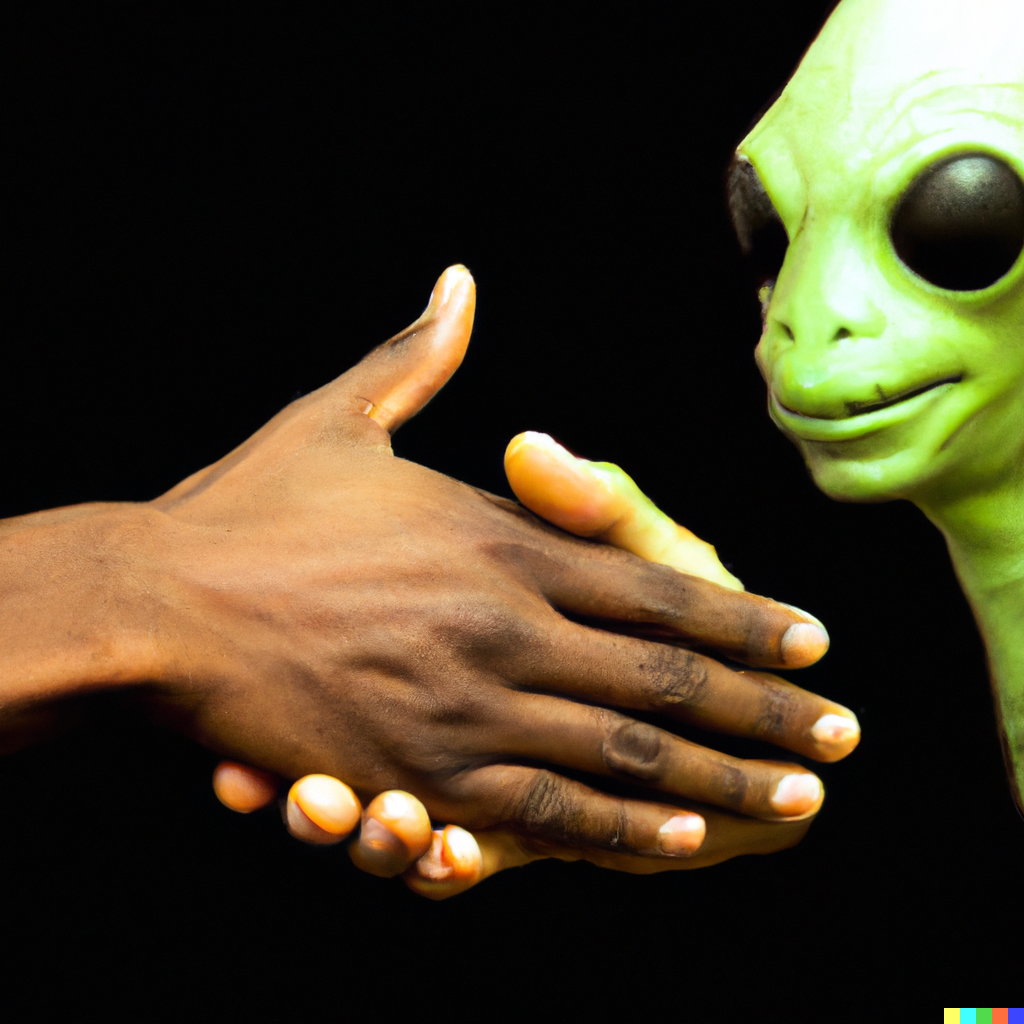
 Image created with DALL-E using the prompt: 'Alien creature shaking hands with a human'
 Every living thing on Earth is almost impossible, its beginning profoundly unlikely. Improbable encounters abounded in the context of mind-numbing vaults of time.
Could that be replicated around some other star? For there to be other life in the universe we would recognise as living, it would have followed a dissimilar (dictated by local conditions) but equally improbable journey as our own. Perhaps more astoundingly, in order to build a complex society capable of communicating with us, it would have to have become conscious, a state of being nobody is able to explain. It’s neurobiology’s biggest puzzle.
Consider the lifepath of life on Earth. It began more than four billion years ago, most likely beside hydrothermal black smokers of the deep ocean spewing all manner of chemicals. In that soup a possibly once-only chemical combination created a matrix that reproduced itself and created a membrane around itself for protection. As definitions go, that’s what life is. It would have been the first thing with an inside and an outside.
Life needs energy to survive. To leave the nurture of the smokers, the magical microscopic organisms had to get to the surface where sunlight provided energy for microbial mats. Lots of this is conjecture, of course, nobody was around to document it.
What we do know for sure, however, is that a few billion years later we had everything from hagfish to humans, with rather too many of the latter. We’ve come a long way from our smoky origins – our brains consist of about 86 billion neurons that buzz away being you. But it was always touch and go. Sabre-tooth cats, ice ages and droughts took their toll.
Could something out there in the depths of the galaxy be thinking similar thoughts? Let’s begin with 400 billion stars (a small number considering there are an estimated 1024 – a septillion with 24 noughts – in the observable universe).
Our sun is about 4.5 billion years old and is in its main sequence, meaning it’s remarkably stable, allowing us to exist in its benign neighbourhood. Life has evolved to operate within very precise parameters. If we evolved to see radio wavelengths rather than visible light we would need eyes 3,000m across to get the same spatial recognition as visible light.
Maybe, out there somewhere, are creatures with enormous eyes, or maybe they’re just mist beings, or an entire sentient planet. We’ll never know.
Read more in Daily Maverick: The power of what if? And why our curiosity has been worth it
The Italian physicist Enrico Fermi attempted to answer a question about the possibility of life in the universe which became known as the Fermi Paradox. He concluded that, given the vastness of the universe and the number of potentially habitable planets, it was likely that intelligent life existed elsewhere in the universe.
However, he also noted that there was a puzzling lack of any evidence for their existence or communication, which led him to ask: “Where is everybody?” If there were extraterrestrial civilisations, he concluded, they’re too far away, too advanced for us to detect, or have intentionally avoided detection. Maybe we’re in quarantine. His reasoning went like this:
- There are billions of stars in the Milky Way similar to the sun;
- There’s a high probability that some have Earth-like planets in a habitable zone;
- Many of these stars and their planets are much older than the sun. If Earth-like planets are typical, some may have developed conscious, intelligent life long ago;
- Some of these civilisations may have developed interstellar travel, a step humans are investigating now;
- Even at the slow pace of currently envisioned interstellar travel, the Milky Way could be completely traversed in a few million years;
- Since many of the sun-like stars are billions of years older than the sun, Earth should have already been visited by extraterrestrial civilisations, or at least their probes; and
- However, there is no convincing evidence that this has happened.
Then, of course, maybe there isn’t any other life out there at all. Professor Lucie Green of University College London, speaking on a podcast called The Infinite Monkey Cage, speculated about the odds of planets around consistent yellow white dwarfs like our sun being generators of life without going snowball or frying:
“Out of a billion such stars,” she said, “that number might be six, or two or one. Even if life started, there would be bottlenecks of near extinction again and again. When you multiply chance things by chance things, 1024 doesn’t seem enough stars to ensure life. There may not be enough star systems to arrive at sentient, conscious life. Mathematically we might be the only place where intelligent life has developed.”
It’s disturbing to think that the only intelligent beings in the entire universe include people like Vladimir Putin, Donald Trump and an American kid with a semi-automatic rifle with a desire to shoot his classmates.
We have to reboot. Humanity needs to take a deep collective breath, look around at the utterly amazing life forms and fragile, intricate systems that keep us and everything alive and cherish every bug, bird or beast, including ourselves. The universe is infinite and there’s a good chance we’re alone in it. It’s time to reappraise a notion ancient people took for granted: Earth and all life on it is a living being and sacred. Let’s stick together as Team Life and stop using the planet as free loot and our trash can. DM/ML/OBP