




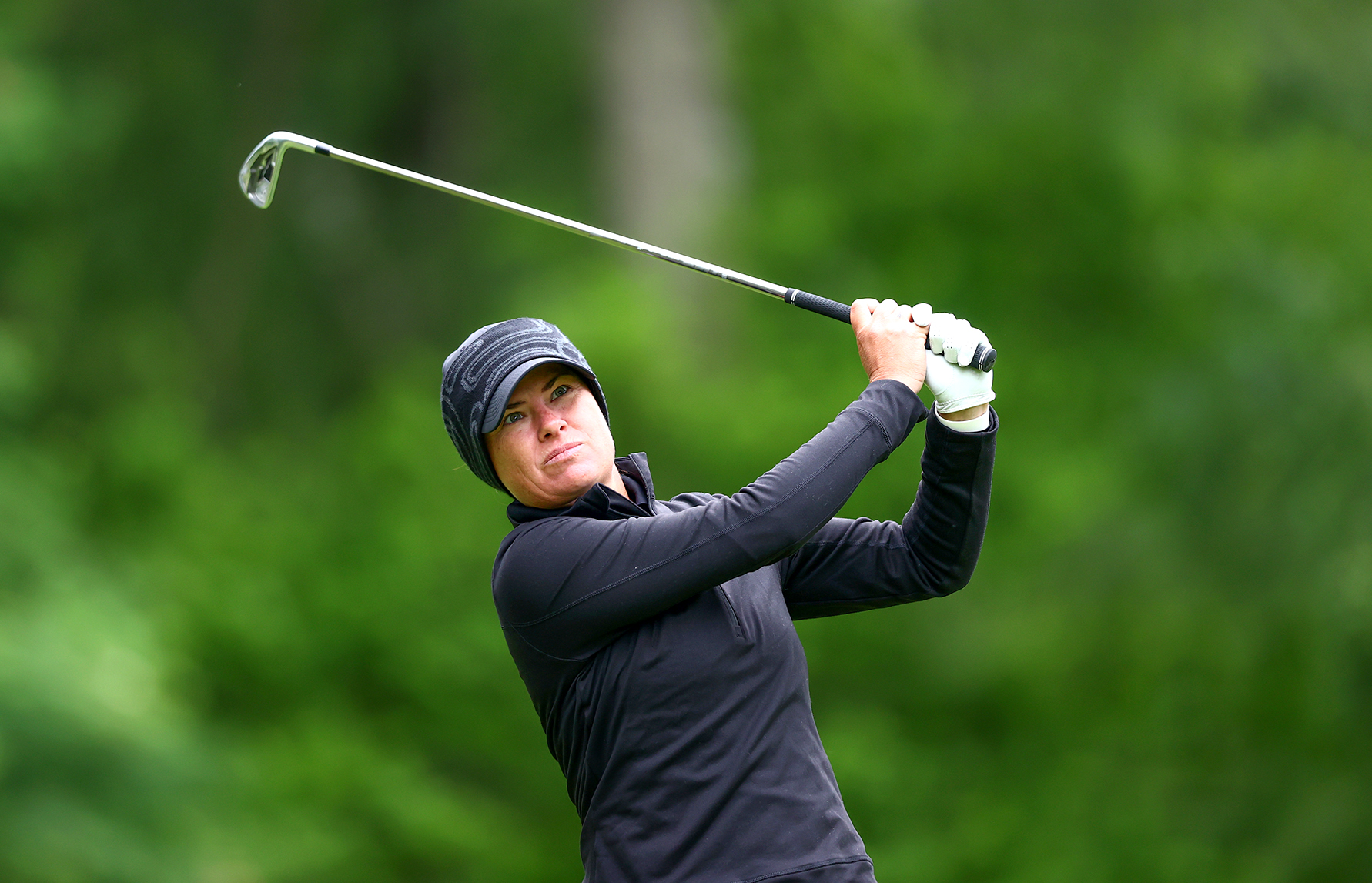
 Lee-Anne Pace of South Africa in action during a practice round prior to the Volvo Car Scandinavian Mixed Hosted by Henrik & in Halmstad, Sweden in June 2022. (Photo: Naomi Baker/Getty Images)
Lee-Anne Pace’s vast experience after 18 years as a professional golfer has left her a more relaxed and confident player. Pursuing more titles with a hungry group of young players trying to make a mark in the increasingly competitive top end of elite women’s golf, she is taking the challenges in her stride.
Pace, 42, won the 2022 SA Open at Steenberg Golf Estate in a dramatic six-hole play-off, which was the highlight of a season that only yielded four more top tens.
But the South African is one of the stars of the Ladies European Tour (LET) with 11 wins in 223 starts. She also has one win on the LPGA Tour. She’s been there and done almost all of it, in women’s golf.
As a Paarl native, playing at Steenberg Golf club in Cape Town from 8-11 March is a bonus for Pace.
“I feel completely relaxed actually. When I make a mistake now, I handle it and take it for what it is and move on,” Pace said before her first practice round at Steenberg on Tuesday, 7 March.
“I'm playing more like I did in the beginning of my career by just taking it one shot at a time and letting the end result take care of itself.
“And now when I’m in contention (to win) I really enjoy that feeling. Hopefully I can get that feeling this week.
“I think I have a bit more energy. My family and friends are here and they’re very motivating and very supportive. They actually give me a laugh on the course because most of them don't actually know anything about golf.
“Leading up to this event we’ve had five events in a row, So I’m in the zone, I’m trying to peak at the right time, like this week.”
Growing tour
This is the 30th staging of the SA Women’s Open and the tenth time it’s being held as part of the Sunshine Ladies Tour (SLT), which is a decade old. The SLT has grown from modest beginnings to a strong, albeit brief tour.
In 2014, the first season of the SLT, the total prize money for all the tournaments was a little more than R1-million. This year, the combined prize fund is R16-million, with the SA Open’s purse of €320,000 (R6.2-million) the largest on the six-leg swing through South Africa.
The global growth in women’s golf over the past decade is reflected in the expansion of the SLT, but female golfers outside of the elite top 30-50 in the world, still struggle to make a good living.
“When I started playing on the SLT, the prize fund was about R300,000 per tournament,” Pace said.
“That has grown to about R2.5-million per event, but eventually we’d like to see similar purses to the men and I think that will happen eventually with the tour becoming stronger.”
/file/dailymaverick/wp-content/uploads/2023/03/unnamed-4.jpg "Ashleigh Buhai on the range at Steenberg Golf Club, preparing for the Investec SA Open.(Photo: Credit Tristan Jones /LET)")
High price tags attached
This tour growth has also attracted more players to the sport, which in turn will drive standards up, but it’s a difficult life on the fringes.
Travelling to golf events, and all the associated costs, comes with a high price tag that is hard to sustain for the bulk of the tour. But as the SLT grows, it provides more opportunities for aspiring young South African women in the game.
South Africa’s Ashleigh Buhai, winner of the 2022 Open Championship, was one of the early pioneers of the SLT. She went from teenage golfing prodigy, winning the SA Open in 2004 at age 14, to struggling pro, to major winner.
She has won three SA Opens, and is not only South Africa’s leading women’s player but is ranked No 18 in the world.
“I don’t know how much part I played (in growing the tour), but hopefully a little bit,” Buhai said.
“Obviously it’s fantastic to see how it’s grown, how the sponsors are starting to support women’s golf in South Africa. And you can see it in women’s golf around the world. All prize purses are starting to increase. So, it’s great that they're following in the footsteps here.
“The reason I was able to have such a good amateur career was because we had four LET events every year, the girls would come down and I’d be able to test myself against some of the best, to see where my game needed to be.
“It’s so important to have these events for the local girls to be able to play on better courses, better set-ups and against stronger fields, so that they know what it takes for the next step.
“Because unfortunately you can’t play amateur tournaments here and they didn’t know what that next step was. And then unfortunately, they go to qualifying school and catch a bit of a shock and realise they’re a little bit behind.
“So, I think it’s helped a lot of the girls here tremendously, being able to see where they need to step their game up to.”
Different routes
Buhai has also supported South Africa’s women’s golf through providing mentorship and advice. Last year she was involved in a course with a group of promising amateurs, advising that they should consider going the US collegiate route before turning professional.
“For those who knew me really well, school was never really my forte.
And for me, unfortunately, if I went to college, I had to keep my grades up to play golf,” Buhai said. “That wasn’t for me. I wanted to play golf.
“And obviously (as an amateur), I had proven that I could test myself and I could win. So, turning pro at 18 was the best thing for me.
“But I also think, where college golf is good for you, is because it teaches you to be away from home. It teaches you to be an individual, but also to be part of a team, to have responsibility, about travel and it helps you grow up.”
Pace and Buhai have grown up to the point where they are not only the best women golfers in the country, but the best South African golfers, period. DM