




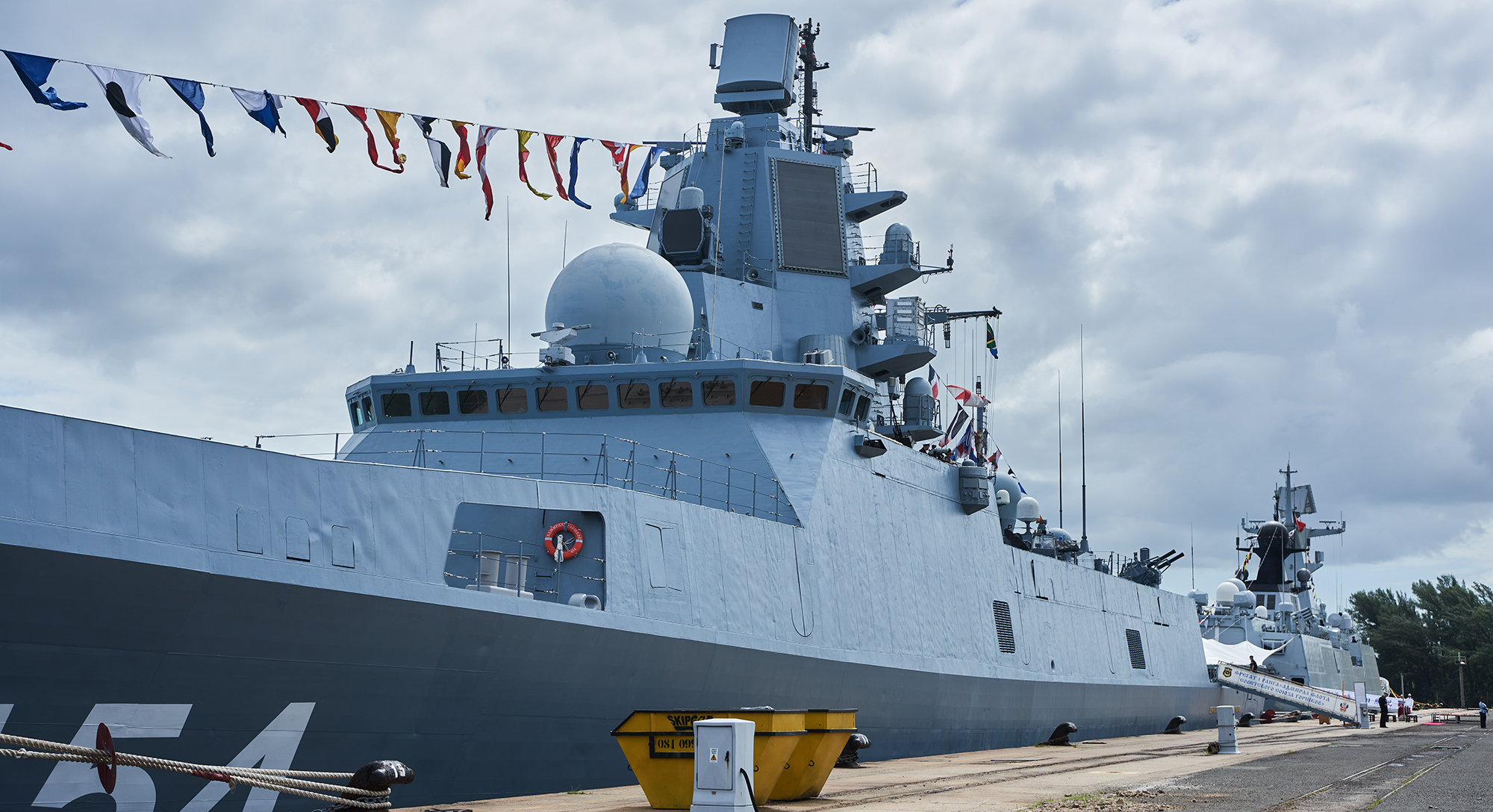
 The Russian frigate Admiral Gorshkov, left, and the Chinese frigate Rizhao 598, berthed in Richards Bay on 22 February 2023 ahead of naval drills between Russia, South Africa and China. (Photo: Waldo Swiegers / Bloomberg via Getty Images)
 A request by Lieutenant-General SG Hlongwa at the close of a media briefing — held aboard the SAS Mendi in Richards Bay — to “write positively about South Africa” resulted in laughs of disapproval from some of the media, leading Hlongwa to add: “Seriously, you know, that is very important… I am not saying don’t tell the facts. I am saying tell the facts and tell them positively.”
/file/dailymaverick/wp-content/uploads/2023/02/Mosi1.jpg "From left: Major-General SG Hlongwa, Russian Navy captain Oleg Gladkiy and Gladkiy’s translator. (Photo: Des Erasmus)")
Hlongwa later told Daily Maverick that Mosi II would cost South Africa R5.2-million and that each country was financing its own forces.
The South African Navy has been joined by Chinese and Russian vessels for the five-day at-sea exercise that coincides with SA Armed Forces Day — a commemoration of the sinking of the SS Mendi steamship in the English Channel in 1917, which itself has morphed into a week-long event.
/file/dailymaverick/wp-content/uploads/2023/02/GettyImages-1247381478.jpg "A soldier patrols onboard the Chinese frigate Rizhao 598 n Richards Bay on 22 February 2023 ahead of naval drills between Russia, South Africa and China. The exercises, known as Mosi II, have been criticised by some of South Africa's biggest trade partners, including the US and European Union, who have questioned the timing of the exercises, which take place a year after Russia launched its invasion of Ukraine. (Photo: Waldo Swiegers / Bloomberg via Getty Images)")
/file/dailymaverick/wp-content/uploads/2023/02/Mosi2.jpg "Chinese navy captain Sun Honglin with his translator, and Rear Admiral Bubele Mhlana. (Photo: Des Erasmus)")
Invasion anniversary
But the exercise also coincides with the first anniversary of Russia’s invasion of Ukraine following years of Russian aggression towards that country. The war has left Russia and its president, Vladimir Putin, increasingly isolated from the West and led to the imposition of thousands of sanctions on individuals, commodities and entities.
Read more in Daily Maverick: “Putin’s ally Wagner is poised to further expand militarily and politically across Africa — report”
The ANC-led South African government considers itself a friend of Russia based on ideological similarities stemming from the apartheid era. It purports to have taken a neutral stance on the war, and in October last year abstained from voting on a resolution at the UN General Assembly that demanded Russia “reverses course” on its “attempted illegal annexation” of Donetsk, Kherson, Luhansk and Zaporizhzhya.
South Africa’s posture has not garnered approval from the international community and some of its trade partners, and neither has Russia’s inclusion in Mosi II or the timing of the exercise.
Read more in Daily Maverick: “The wargames of Exercise Mosi II make an absolute nonsense of South Africa’s claim to neutrality”
Hypersonic missiles
The possibility of the Russian frigate Admiral Gorshkov testing its Zircon hypersonic missiles during Mosi II was first reported on by Russian state-affiliated news agency Tass earlier in February. Responding to a question about this at the briefing, South Africa’s chief of joint operations, Lieutenant-General Siphiwe Sangweni, said: “There is no plan for that to be utilised. You must all rest assured.”
/file/dailymaverick/wp-content/uploads/2023/02/GettyImages-1247381842.jpg "The Russian frigate Admiral Gorshkov in Richards Bay on 22 February 2023. (Photo: Waldo Swiegers / Bloomberg via Getty Images)")
He said the war games were “critically important” to ensure the South African navy was “competent”. The exercise was “purely for us to be empowered, and to get much more skills, and for our country to be able to have safety at sea”.
Responding to criticism of the war games from various sectors and diplomats, including the timing, Sangweni said Mosi II had been planned “some time ago”.
“At the level of government, the government of [South Africa] expressed itself on how South Africa has approached the situation in Ukraine. The government of South Africa has on many occasions indicated that South Africa’s approach, generally in other countries as well, prescribes to dialogue as well as negotiations for peaceful resolutions of conflict.”
There would be countries that “feel differently” about South Africa’s approach to the war, said Sangweni, “but all countries are sovereign nations and have a right to handle things the way they see fit”.
/file/dailymaverick/wp-content/uploads/2023/02/GettyImages-1247381405.jpg "A member of the Russian Navy disembarks from the Russian frigate Admiral Gorshkov in Richards Bay on 22 February 2023. (Photo: Waldo Swiegers / Bloomberg via Getty Images)")
Things were “different” in the military environment when compared to the political one, he said. Cooperation and coordination with other militaries were important, and South Africa had hosted naval exercises with various countries in the past.
The South African government had not indicated that Mosi II should be halted, said Sangweni. “We believe [the exercise] will also contribute to the approach of negotiated settlements and peaceful resolution to conflict,” when compared to “the other route” of cancelling the exercise.
‘No firing of Zircon missiles’
Responding via a translator, Russian navy captain Oleg Gladkiy said: “According to our planned schedule, there would be no firing of hypersonic missiles.” Russia is alleged to have used hypersonic missiles against Ukraine in March last year.
The Mosi II media briefing came a day after Putin delivered his annual presidential address to the Federal Assembly in Moscow, with the Ukraine war taking up much of his two-hour diatribe. Speaking of Nato and its allies, he said: “Let me reiterate that they were the ones who started this war, while we used force and are using it to stop the war.
“The West is using Ukraine as a battering ram against Russia and as a testing range,” said Putin. He also announced that he would be suspending the Russian Federation’s participation in the New Start nuclear arms reduction treaty with the US.
Neutral stance
Asked by Daily Maverick if South Africa hosting Russia for the military exercise was not a clear indication that it had forfeited its neutral stance on the war, President Cyril Ramaphosa’s spokesperson, Vincent Magwenya, said the “premise of the question was not accurate”.
“South Africa has remained consistent in asserting its position with respect to urging all parties involved in the conflict to seek a peaceful resolution. South Africa has called for a negotiations process under the auspices of the United Nations that will be mandated by the secretary-general of the UN.
“We will continue to advocate for this position in all bilateral and multilateral forums that we engage in. Furthermore, the South African National Defence Force has participated in war games with other countries including the United States military, that did not translate to our agreement or support with the US military actions in Iraq or Libya, for example.”
According to Rear Admiral Bubele Mhlana, the combat drills to be undertaken during Mosi II would include: “Joint actions to defeat air targets with implementation of simulated artillery firing at targets, while the South African Air Force would simulate various attacks on ships from various directions. Once the simulated attacks had been completed, air targets would be set and engaged by each ship, with firing only carried out in designated sectors.”
Ships would also practise manoeuvring in formation to detect and hit mock-ups of floating mines, said Mhlana. Drills would entail the freeing of civilian vessels captured by pirates and assistance to ships in distress, including people floating in the sea.
According to the UN Human Rights Office (OHCHR), between 24 February 2022, the start of the invasion of Ukraine, and 13 February 2023, it recorded 18,955 civilian casualties. Of these, 7,199 were killed and 11,756 were injured. The OHCHR said, however, that the numbers were likely to be much higher. DM