




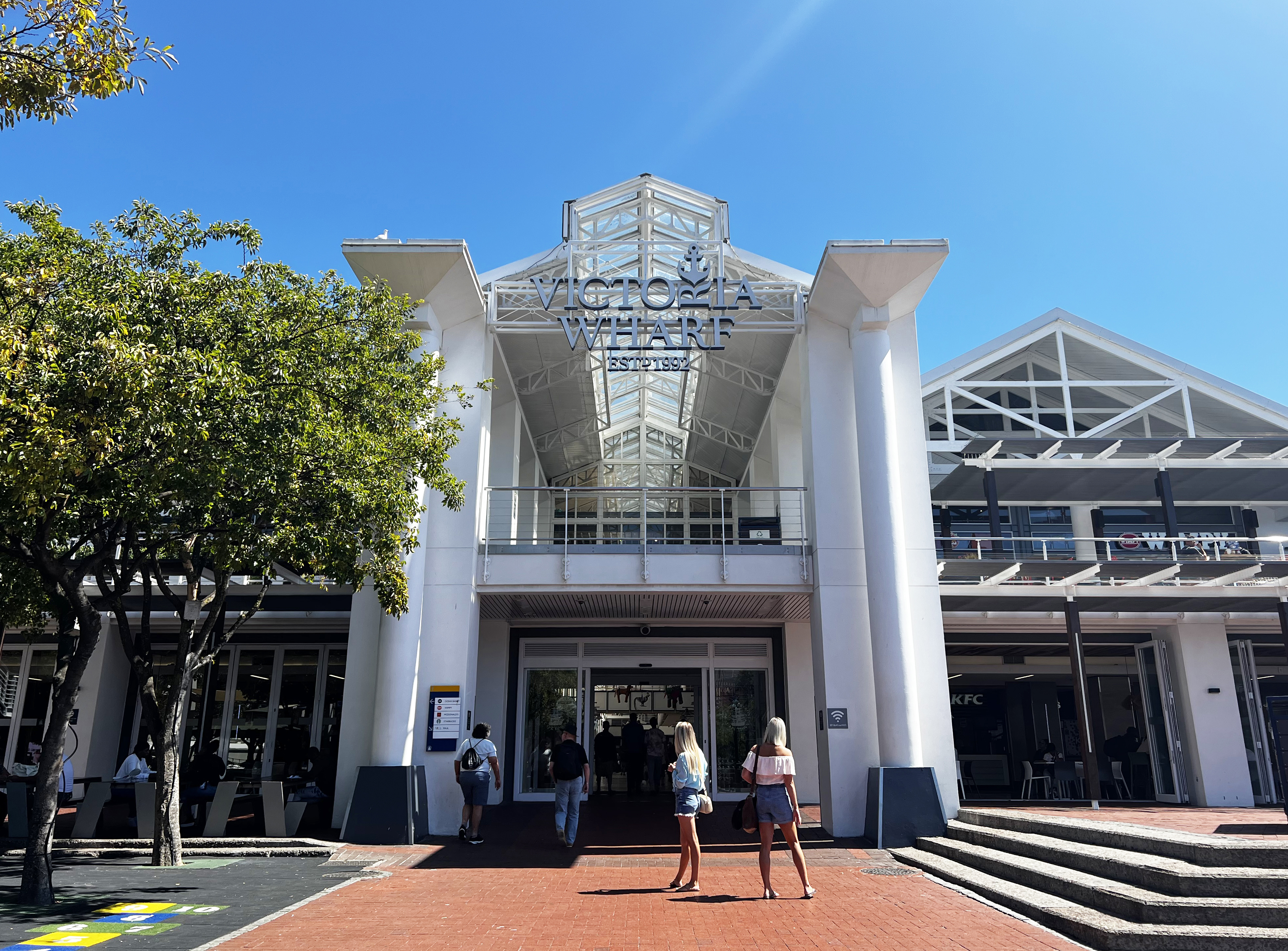
 Victoria Wharf, established in 1992. This then young reporter stood beneath its girders with its architect, the visionary David Jack, before the roof was put on. (Photo: Tony Jackman)
 Three decades on, and developments continue apace at Cape Town’s V&A Waterfront. Will its development ever end before there’s no space left for the ships? Before we all struggle to remember what anything ever looked like in its nascent days?
Revisiting the V&A Waterfront in Cape Town decades after you first stood under the steel girders of what was to become its flagship mall is a strange experience. How could there be so much of everything? How do you find your way any more? Any focus has long perished; in its place, a perplexing maze of brick, steel and glass, punctuated with bobbing boats with their skippers touting for your custom, almost everything designed to enthral and inspire. But collectively its effect is to overwhelm and confuse.
Everything is expensive. The clothes are expensive, the art, the appliances, the food, the coffee, even the Coke. Nothing here (unless you count the ever-obscure fast food section, which has always seemed like a reluctant sop to the rank and file) speaks to the ordinary person with a monthly budget to come out on and all the pressures most of us face. It is there for the fat-wallet tourist more than for the people of the city it is meant to serve. The Waterfront is not separated from the city it serves by design or artifice; it is separated from most of us by having done too much too fast, for too long, and it has lost its charm and character somewhere along the way.
Go away from the Waterfront for five minutes and when you return there’ll be another new development, another renovation, another innovation. Something will be gone, something new will be coming soon, all manner of other things will be pending.
And off it goes again...
The V&A Waterfront cannot stand still. It fidgets and shifts, eternally fretting about its future while slowly, irrevocably consuming itself. And off it goes again in 2023, in search of yet more reinvention of the copiously reinvented. The Union Castle building precinct, where Vaughan Johnson et al plied their wares, is undergoing a massive revamp with all sorts of wonderful things promised soon. The Cape Wheel is moving, making way for a piazza to accommodate public transport. A rooftop restaurant and bar is promised in that “new” precinct, along with all manner of delights (as if there aren’t already too many in the Mother City, let alone the Waterfront).
The mysteries within are all hidden behind giant bunting.
/file/dailymaverick/wp-content/uploads/2023/02/tony-underwraps.jpg "Under wraps: Newer, bigger, better things await the intrepid V&A Waterfront customer. (Photo: Tony Jackman)")
The “old” Alfred Mall and hotel reopened recently after a thorough refit. The NSRI building and quay are in the throes of a necessary upgrade. New shops shine and preen alongside. Before long, this entire precinct, but for the original Victoria Wharf Mall (faux as it is), will be unrecognisable to anyone who remembers it when it all started. Quay Four, miraculously, seems to defy everything – developers, the fates, God, the universe, the writing on the wall, time itself – and yet it goes on, a stubborn reminder that Not Everything Has To Change. And does anyone, anywhere, even remember Bertie’s Landing, or try, now, to pinpoint quite where it was? Case, rested. (Mind you, even Quay Four cannot last forever; at some point, some or other Bright Young Thing with cash to burn will get them out.) And there is of course Ferrymans, whose regular clientele would be likely to see off any interference swiftly.
Also read: "Mother City megalopolis — Cape Town prepares for a massive growth spurt"
The Cape Grace Hotel, once one of the prized Waterfront locations, now seems an outlier, a relic, amid the ever-burgeoning developments in every direction. The Clock Tower precinct seems more remote than ever, if you can even find it anymore, unless you’re arriving from Robben Island. Makers Landing is still there, somewhere, in its panhandle obscurity, out of sight to almost everything else, and you have to wonder why these “makers” who deserved a leg-up weren’t offered a more visible, accessible venue. Like, say, the premises of the V&A Food Market which, as we know, has been shut in the name of change and advancement.
A wasteland separating city from sea
But let’s go back a while. To 1976, when this then very young reporter was the assistant to the Cape Times Shipping Editor, George Young, and even then I was returning to my old haunt, because when I was a teenager at Sea Point Boys High, I was an infamous and inveterate truant who spent his mornings wandering around the docks when he should have been at school. I boarded every passenger liner and knew the layout of Duncan Dock and the adjacent Alfred Basin better than my own home. Now, I’d be lost.
When I look at the Victoria Wharf with its faux Victorian features, I see it without its roof, a mass of sturdy girders buttressing the sky, bright blue above; long, sleek shadows cast by the spokes of steel, and a younger me in a yellow hard hat, being shown through the new building under construction by its architect, David Jack, once dubbed the man who reconnected the harbour with the city. And that he did. Might we ask him to reattach it?
The Alfred Basin precinct was something of a wasteland that separated the city from the sea. But it contained a number of desirable buildings, many of them Victorian, which were deemed worth repurposing as part of a new development. Alongside them, new buildings in the Victorian style were built, commencing with what soon became the Victoria Wharf mall which, I’m relieved to be able to say, is still intact, although there have been sensible upgrades without losing its substance. In fact, it is improved, with wide passageways having been carved out to allow access between what were two very long corridors; it was an obvious design fault in the original mall.
/file/dailymaverick/wp-content/uploads/2023/02/tony-collective.jpg "The Harbour View premises at the far end of the V&A Mall is one of the better renovations, a smart collective of smaller food operators who banded together to share rental costs and space. (Photo: Tony Jackman)")
Thirty and more years later, having watched every shift and shuffle as the Waterfront management has endeavoured to remain vital and young, to keep the punters interested and aware, you can’t but admire their tenacity and resilience. They’ve led the way for the Mother City every year, month, week and hour since that day when the architect and visionary impressed the young journalist with what was happening. It has never ceased since that moment.
Change and renew, refresh and reassess
Now the older journalist has returned to find change again, and more, and more again, with nothing ever being left alone to be there and be used and, one day, to be remembered with affection. But nothing can be left alone any more. Nothing is allowed to become old and interesting. Everything must change and renew, refresh and reassess. Got to stay ahead of the game, don’t get left behind, if you rest on your laurels you’ll disintegrate, vapourise, become invisible and be forgotten. If this mindset were applied to our species, old people would be put down lest they offend the eyes and sensibilities of the young. Only the shiny and fresh are permitted.
One day, will I return again and find nothing at all that I remember from the Seventies or even the Nineties? Bearing in mind that everything there, at the end of the Eighties, was much as it had been in 1973.
The TimeOut market
I went back to the Waterfront with a mission to find out what another change was all about: the V&A Food Market was in the process of being replaced by a big “global” market called TimeOut, and if that name is instantly familiar, it’s because it is a venture begun by the Portuguese editorial crew of the famous magazine, and it has become a phenomenon in the world of food markets. Therefore, it makes perfect sense that there should be one at our V&A Market; let me be clear that I do not for a moment oppose the notion that we should have one.
/file/dailymaverick/wp-content/uploads/2023/02/tony-foodmarketentrance.jpg "The former V&A Food Market premises are to house Cape Town’s TimeOut Market. (Photo: Tony Jackman)")
The original TimeOut Market in Lisbon now has cousins in Chicago, New York, Miami, Boston, Dubai, Montreal, London and Prague. Now there is to be one in Cape Town, BUT… does it have to be on this site?
All the traders in the old Food Market near the (now revamped and upgraded) Alfred Mall, having endured and survived lockdown and managed to stay afloat, were rewarded by not having their contracts renewed. How’s that for a thank you? They might have expected a pat on the back. They got booted out. The place is bare. I went back earlier this month while visiting the city. This is what it looked like…
/file/dailymaverick/wp-content/uploads/2023/02/tony-order.jpg "The interior of the former V&A Food Market once the vendors had moved out. (Photo: Tony Jackman)")
My questions are these: did it have to be this venue? Was there not another venue that would have sufficed? If the venue had become tired could it not have been given a facelift and relaunched using the same traders? Bring us a TimeOut Cape Town but not at the expense of these traders. Don’t change only because there is a culture of change, change and change again that has permeated the Waterfront since the first brick was laid in 1992.
The website for the original in Lisbon encapsulates the concept as follows: “A place that previously housed the city's best vendors now houses its best restaurants and artists. While the wares on offer may differ, the principle is the same: bringing the best of the city under one roof.”
The TimeOut Lisbon website paints this picture:
“Why is a famous publishing name hanging from the roof of a historic market hall? And why is a team of journalists running one of the world’s largest gourmet food spaces? The answers to these questions are in the project’s name: TimeOut Market.
“A concept created from scratch in 2014 by the team at TimeOut Portugal, with only the best ideas and business projects in Lisbon – according to the editorial team – which can stay in the market from one week to three years. If it’s good, it goes in the magazine, if it’s great, it goes into the market.
“On the one hand, 26 restaurants, eight bars, a dozen shops and a high-end music venue, all with the very best in Lisbon (the best steak, the best hamburger, the best sushi and the best live performances, amongst others); on the other hand, home to some of the city’s best-known (and longest-running) market vendors of meat, fish, fruit and flowers.
“Today, together, both sides are proud of having turned the building, its immediate surroundings and the whole Cais do Sodré neighbourhood into a huge attraction for visitors, day and night.”
There’s a video on the TimeOut Lisbon website that shows us exactly what we can expect from any of their markets:
And the next video shows why the model is the success it has been, and why it makes sense that a TimeOut Cape Town would be a marvellous thing (yes, I do think so):
Here’s the full text of the first video:
“The one thing you need to know about TimeOut Market is that it isn’t just a food hall. You see, it didn’t start with a business plan, as food halls often do, it started with a magazine, TimeOut, the world’s #1 brand when it comes to inspire people to make the most of a city. A brand known for tasting, testing and choosing the best things to do. And that one day decided to put all that knowledge to good use and make the magazine come to life. And so the TimeOut Market concept was born, the first food and culture experience, fully curated, under one roof.
“We start by looking at all the 4 and 5 stars restaurants and then we double-check of course, one by one, name by name, until we have the perfect, genuine mix.
“To that, we add a relevant building, with soul and essence, and an upcoming location; it doesn’t need to be the coolest, we’ll bring the hype along.
“Once inside, the recipe is easy: two slices of restaurants and one big slice of clients. Forget about corners and niches, here we say ‘Hello!’, ‘Hello!, ‘Hello’ in big communal tables. A complex operation made simple, perfectly designed, so that fine dining is made casual and casual is made extraordinary. Finally, a dash of culture, retail and knowledge. Because in the end a TimeOut Market is not just a place where you go to eat, it’s a place where you get to know the city it all started with. TimeOut Markets, the best of the city under one roof.”
But.
‘An upcoming location?’
The V&A Waterfront is in its 31st year and is galaxies away from anything that could be described as “an upcoming location”. All around the venue are restaurants vying for our footfall and our bucks. Any feet that walk into this market and any bums on its seats will not be in any other restaurant in the entire development. Undoubtedly, this will have a ripple effect and see to the closure of at least some of its competitors over time. This contradicts the ethos behind the Lisbon original and its chosen site.
And they must be “4 and 5 stars” restaurants. Anyone who followed the recent Eat Out Awards will know that, in the first place, we have only recently got a star rating system and it goes from one to three. And most of our best restaurants aren’t even on the list. They are presumably referring to TimeOut’s in-house grading system.
And can a TimeOut Cape Town not rather aim for stalls with the best vetkoek, best roti, best samoosa, best Gatsby, best blêrrie Kaapse kerrie? Is it all going to be the usual “top” Cape Town restaurant brands and famous chefs with their ‘Gramworthy food? High-end, fêncy-schmêncy “bowls” and ramen and bao and nothing whatsoever to do with Cape Town Food? As per TimeOut’s stated ethos for its markets?
Meanwhile, I approached Donald Kau, head of comms and PR for the Waterfront, for comment on the shutdown of the Food Market. He said: “Under the management agreement, just as has been the case with the outgoing management of the V&A Food Market, TimeOut Market will be responsible for the curation and selection of the chefs and restaurateurs going into the new space, all of whom will be local. The Waterfront does not influence this process.”
Asked how many other Waterfront facilities were considered for the TimeOut market, i.e. other than the Food Market premises, he replied: “With the current lease for the V&A Food Market having come to an end in October last year, the decision was taken to bring something new to the V&A Waterfront to ensure we stay fresh and establish an international attraction that draws an audience of food and cultural lovers — TimeOut Market has a proven track record of achieving this. The space requirement was for a food hall space to accommodate the concept they offer.”
‘Vendors were offered alternative spaces’
Asked if it was not possible for TimeOut to occupy a different space that did not require these vendors to have to vacate the premises, Kau said: “Vendors from the Food Market were offered alternative spaces which many did not take up in time. Others such as Knysna Oyster Co, 7 Colours Eatery, Royal Tea took up offers and are successfully trading at our Union Square, Battery Park and upper level of the shopping centre respectively. We have put others on our waiting list should something appropriate come up for them to consider.”
Asked when the decisions would be made as to who the new vendors would be, and which of the old ones would be given space, Kau said: “TimeOut Market are (sic) looking to start operating at the end of 2023 from around September. Their process to identify and select their restaurateurs and chefs will be communicated in due course. New vendors have to be independent operators, no chain restaurants.”
Asked why the new vendors at the TimeOut market have to be “top” chefs and seemingly other high-end operators, and if there is a percentage of the space that would be available to people other than those already well known and famous, he said: “TimeOut will offer both established and local up-and-coming chefs the opportunity to showcase their talent to their audience in a great location without them having to invest money themselves.”
Asked, “How much warning were the old traders given that they had to vacate the premises? How many months or weeks?” he replied: “The current lease agreement came to an end in October 2022 and was extended into the end of January to allow the Food Market to benefit from the festive season. The management of the Food Market would have been aware of the end of the lease agreement and expected to communicate with their tenants.”
Was it taken into account that at least some of the old vendors had managed to survive through lockdown and yet now, not very long after having emerged from that massive difficulty, they have had to vacate and lose the advantage of all that they had worked towards?
Kau: “The Waterfront has supported its tenants, including those in the Food Market, with financial relief through the lockdown. The decision to extend the end of the current lease agreement into the end of January was mindful to allowing the vendors to not miss the peak visitor season of December/January ahead of closing the space to prepare it for its new tenants.”
Give us a true flavour of Cape Town
So, it’s TimeOut for the V&A Food Market traders who survived lockdown. It’s wonderful that Cape Town is getting a TimeOut Market. But it’s a pity that, to accommodate it, traders who endured and survived lockdown, managing to stay afloat, had to be shoved overboard.
Will the owners of the TimeOut Market franchise remember that they are journalists who, at the other end of their pens, might be writing about these same traders being turfed out, post their lockdown trials?
Bring it to us, by all means. But give priority to those humble traders who braved lockdown and made it through, and others who can bring a true flavour of Cape Town to the TimeOut Market. DM/TGIFood
Read an earlier Daily Maverick piece on the TimeOut venture here.