



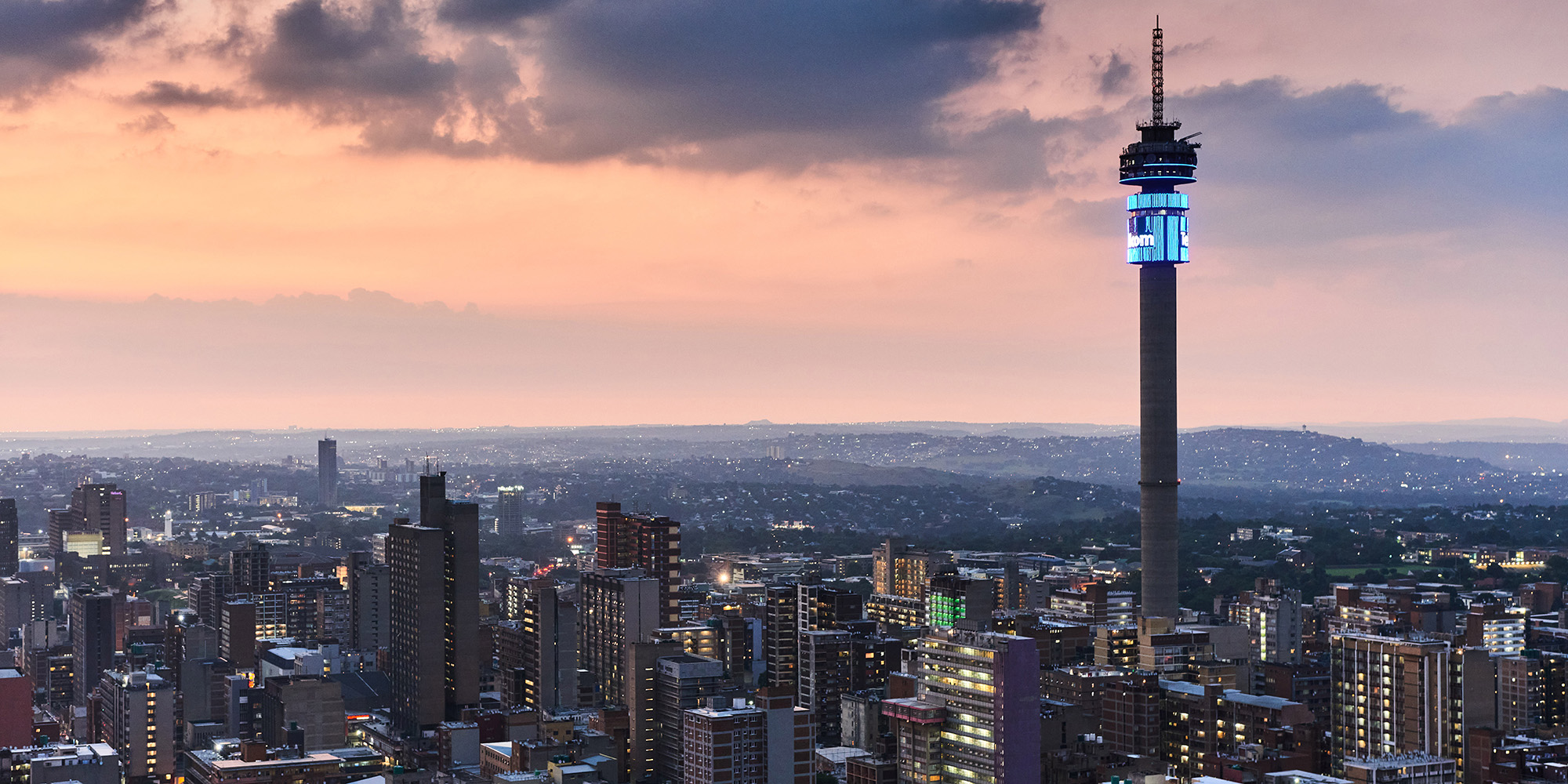
 The Telkom Tower, right, surrounded by residential tower blocks and commercial offices, viewed from the Ponte City Apartment building, in Berea, Johannesburg, on Thursday, 22 December 2022. (Photo: Waldo Swiegers/Bloomberg via Getty Images)
 The probability of it happening in the coming 12 months increased from odds of 35% in November, around the start of the longest streak of consecutive daily power cuts. That’s according to the latest Bloomberg monthly survey of economists, conducted between 9 to 12 January, with seven economists responding to a question about the chance of a recession.
The prediction comes as the country’s on-going energy crisis risks intensifying and dim global economic prospects threaten to further curb domestic output. The outlook for the economy in 2023 “isn’t impressive”, Finance Minister Enoch Godongwana said last week, citing electricity-supply constraints.
Eskom has for the past seven days subjected the country to record blackouts — as much as 12 hours a day — to protect the power grid from collapse as its ageing, mostly coal-fired power stations fail.
It has already used up money for diesel supplies allocated to fuel auxiliary plants for the year through to March and a unit at Koeberg – the only nuclear power station on the continent – is shut down for a revamp, meaning any additional faults among its assets and infrastructure could move SA to its highest level of outages yet.
Sustained rolling blackouts outages at the current “extreme levels” are the most significant downside risk to the country’s economic growth prospects, the Bureau for Economic Research’s Tracey-Lee Solomon, Romano Harold and Hugo Pienaar said in a note published on its website on Monday.
The economy is unlikely to grow by more than 0.3% quarter-on-quarter through 2023, according to Bloomberg’s survey. Economists see gross domestic product growth slowing to 1.2% this year from 2.3% in 2022.
While inflation is expected to ease, it’ll only be back near 4.5% – the midpoint of the central bank’s target range at which the monetary policy committee prefers to anchor price-growth expectations – in the fourth quarter, before accelerating again into 2024.
The SA Reserve Bank will probably extend its most aggressive monetary policy tightening in at least two decades, with the key interest rate rising to 7.5% by the end of the first quarter from 7% now. A gradual easing of borrowing cost will start in the fourth quarter, according to economists. The central bank will give its next decision on the benchmark rate on 26 January. BM/DM
Comments
Scroll down to load comments...