




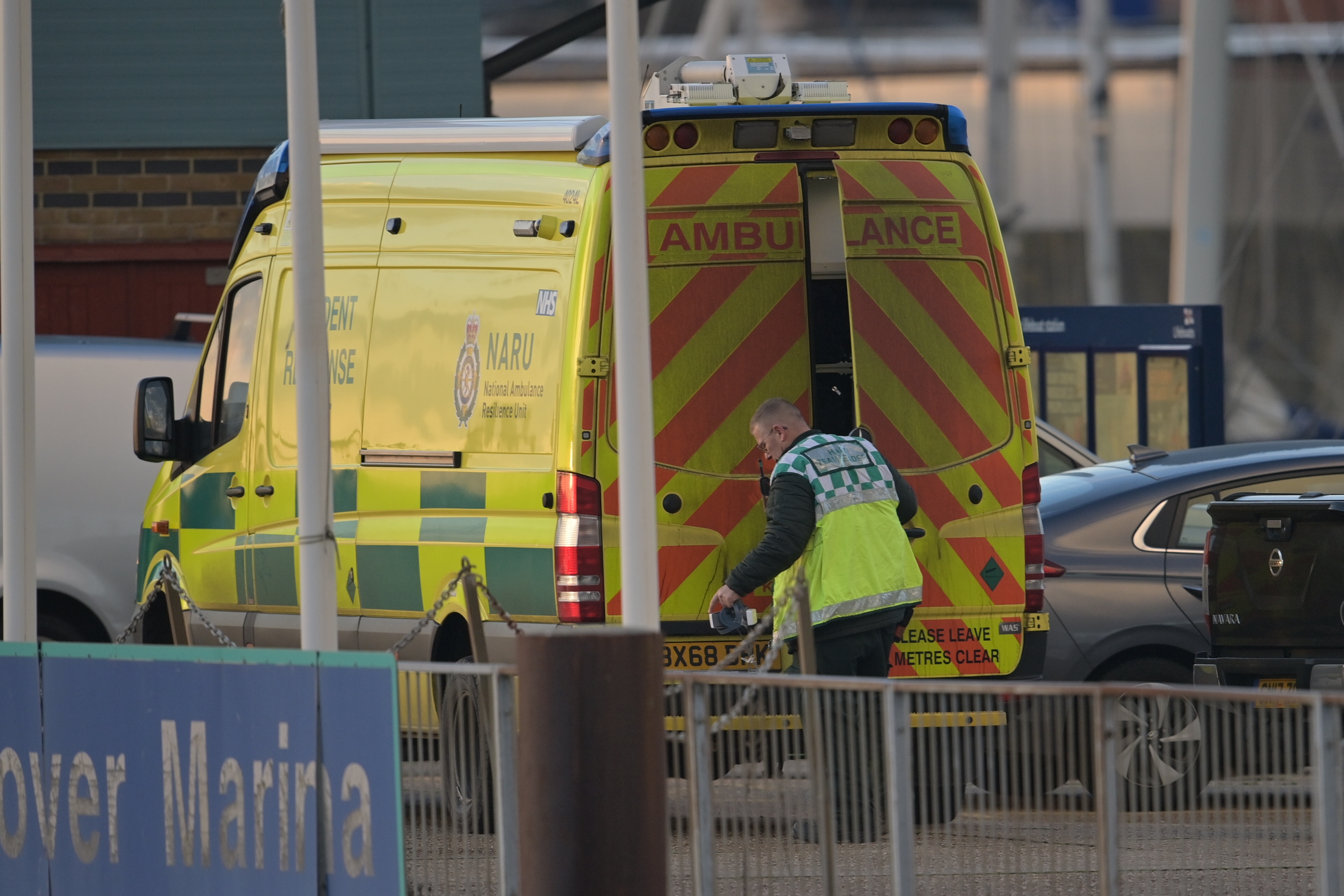
 Paramedics wait at Dover Marina, Dover, Britain, 14 December 2022. (Photo: EPA-EFE/STUART BROCK)
 The nation will get a mild respite from rail strikes this week after a series of stoppages all but brought the sector to a standstill in the first few days of 2023. Employees on the Elizabeth Line, as well as ambulance workers, still have walkouts scheduled.
Trade-union leaders from various sectors have been invited to talks on Monday in a bid to avert further strikes by NHS, rail and other workers. It comes after the boss of one of Britain’s biggest transport unions last week called for coordinated strikes involving tens of thousands of public sector workers.
Unions want immediate pay improvement, but the government is more willing to talk about public-sector wage settlements for 2023-24. Sunak’s government has signalled it won’t sweeten the package for 2022, which is what has triggered the strikes. The Guardian reported Sunak may be open to a one-off payment to workers.
Some have also been angered by government plans to bring in new legislation enforcing minimum service levels during strikes.
“We want to have a reasonable, honest, two-way conversation about pay,” Sunak said in an interview aired this weekend. “We’re about to start a new pay settlement round for this year.”
Restless Tories
The slew of strike action and scenes of disarray in the health service are becoming an increasing political problem for Sunak, swallowing up any chance of a political honeymoon and distracting from his attempts, notably in a speech last week, to assert his leadership.
That’s left him under pressure from members of his own Conservative Party and the wider public to fix the mess. With less than two years until the next election, his Tory party is more than 20 points behind the main opposition Labour Party in the polls.
The industrial action is also dampening economic activity in a country which is already likely to be in recession — it remains the only G7 economy with GDP below pre-Covid levels.
Monday’s meeting comes after Sunak hosted a “recovery forum” of health professionals and officials at Downing Street on Saturday to address issues including improving emergency treatment and speeding up social-care discharge.
He left the meeting “with a renewed sense of confidence and optimism that we can get to grips with this problem,” Sunak said on Sunday. “The NHS is undeniably under enormous pressure.”
Price warning
In the same appearance, Sunak said it’s not guaranteed that inflation will slow this year and stressed the need for continued wage restraint.
Easing inflation “is a function of having a responsible economic policy when it comes to things like pay”, Sunak said in a BBC interview. “It’s not a given that it just happens. You have to continue to be disciplined and make the right, responsible decisions.”
Surging energy costs due to Russia’s war in Ukraine propelled inflation above 11% last year, setting off a cost-of-living crisis. Sunak says curbing price gains is his top priority and the reason he’s been resisting calls to accept large pay demands in the public sector as they could further stoke inflation.
That position has come under increasing strain amid widespread disruption in the UK, most acutely in the NHS where a resurgence of Covid-19, the winter flu and industrial action — including the first major nurses’ strike in history — have forced hospitals across the country to declare critical incidents.
As part of their effort to ease the crisis, the government said on Monday it earmarked £200-million to buy thousands of extra beds in care homes and other settings to help discharge more patients who are fit to leave hospital. An additional £50-million of funding was announced to fund new ambulance hubs and facilities for patients about to be discharged.
Nurses have also been pushing for a 19% pay rise and recently urged the government to meet them “halfway” on their demands.
Meanwhile, the Resolution Foundation said Britain is half way through a cost-of-living crisis that will leave families £2,100 worse off.
The squeeze will reduce disposable incomes further falling than in the aftermath of the global financial crisis more than a decade ago, according to the research group’s report released on Monday.
The findings add to a bleak outlook for UK households, who are experiencing one of the worst cost-of-living squeezes in memory, after inflation jumped to double digits and borrowing costs spiked.
“Britain is only at the midpoint of a two-year income squeeze,” said Lalitha Try, researcher at the Resolution Foundation. “The crisis is already taking its toll on families, with over 6 million adults reporting they are going hungry as a result.”
Resolution said higher energy bills, mortgage costs, and personal taxes are set to reduce disposable incomes by 7% over two years. Mortgage holders could be the worst off, seeing declines of up to 12%.
The Bank of England has raised its benchmark rate nine times since December 2021 to battle spiralling inflation, pushing up borrowing costs and boosting mortgage rates by the most in 14 years.
The only group set to increase their income over the two year period were the richest 5% of households, for whom rising interest rates will add to income.
“The cost of living crisis is disastrous for family finances, particularly for those on low incomes and families with more than two children,” said Jennifer Dixon, chief executive officer of the Health Foundation. “The crisis is causing immediate damage to the nation’s health.”
Among the poorest 20% of working families, more than a third said their health had already been impacted by the rising cost of living. Almost a third were worried about their finances over the coming months.
Though the immediate outlook for living standards is bleak, the Resolution Foundation noted the future remains uncertain. Falling wholesale natural gas prices could bring inflation down faster than expected, which would ease the strain on households. BM/DM
Comments
Scroll down to load comments...