



 The Apple Inc. store at Sanlitun closed due to Covid-19 restrictions in Beijing, China, on Saturday, Nov. 26, 2022. China's daily Covid infections broke through 30,000 for the first time ever as officials struggle to contain outbreaks that have triggered a growing number of restrictions across the country's most important cities.
Data on Tuesday morning showed new US home construction continued to decline in November and permits plunged. However, closing prices climbed in the third quarter, and the Fed will continue to raise rates if housing remains costly, which could be detrimental for risk assets in the long-term.
Bond yields meanwhile remained elevated, but slightly trimmed their climb, with the 10-year Treasury yield hovering around 3.68% after touching 3.70% earlier in the session. Analysts reckon more losses lie ahead as Japanese investors — major players in US and European debt — have more incentive now to bring money home.
Until now, the BoJ has been an outlier among central banks, most of which have rapidly tightened policy. The Japanese monetary authority adjusted its yield curve control program to allow 10-year borrowing costs to rise to around 0.5%, versus the previous 0.25% upper limit, bucking forecasts for no change at its policy meeting.
“Tighter BoJ policy would remove one of the last global anchors that’s helped to keep borrowing costs at low levels more broadly,” Deutsche Bank analysts told clients, noting the BoJ move had come as markets were “already reeling” from the European Central Bank and Federal Reserve’s hawkishness last week.
Many economists now expect the BOJ to raise interest rates next year, joining the Fed, the ECB and others after a decade of extraordinary stimulus.
Read More: BOJ Blindsides Traders to Echo Christmas Day Shock of 1989
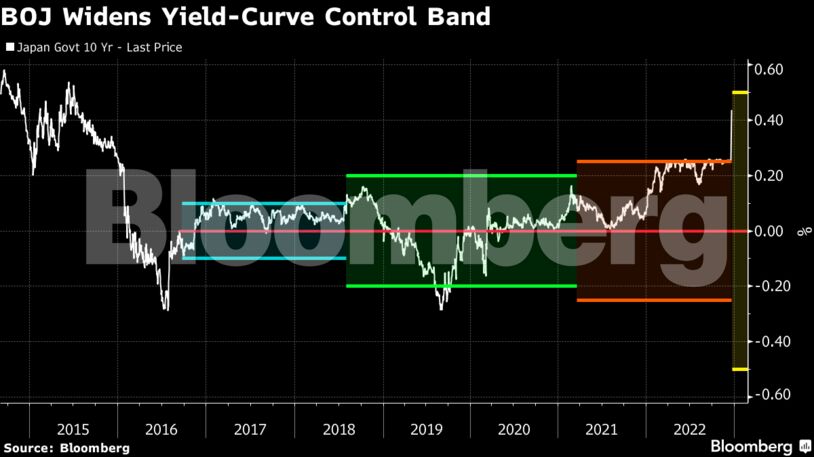
However, Evercore ISI’s Krishna Guha and Peter Williams said elevated FX hedging costs mean Japanese investors have already stopped being net buyers of US government debt. The BoJ as the biggest holders of Japanese government bonds would take most of the loss from duration risk on its own balance sheet, they wrote in a note.
“In other words, this is a disruptive jolt but not a cataclysmic event for global markets,” they said. “The BoJ may be demonstrating that it is actually possible to exit yield curve control in phases in a manageable way, though one that still has material implications for markets.”
The yen strengthened more than 3% against the dollar to the highest since August, while Japan’s 10-year yield rose the most since 2003. The dollar dropped.
On commodity markets, the weaker dollar gave gold prices a boost, while West Texas Intermediate crude oil futures rose above $75 a barrel.
A handful of major companies with poor results last quarter — including FedEx Corp. and Nike Inc. — will be reporting earnings in coming days. Investors will be closely watching what executives at these companies say about the outlook for their respective industries amid a tough macro backdrop. Food manufacturer General Mills Inc. fell after posting a greater-than-expected organic sales volume drop, despite largely beating estimates.
| MLIV Pulse Survey |
|---|
| What is your favorite asset for 2023? The MLIV Pulse survey focuses on outlooks for major asset classes. Share your views here. |
Key events this week:
- EIA Crude Oil Inventory Report, Wednesday
- US existing home sales, US Conference Board consumer confidence, Wednesday
- US GDP, initial jobless claims, US Conf. Board leading index, Thursday
- US consumer income, new home sales, US durable goods, PCE deflator, University of Michigan consumer sentiment, Friday
Some of the main moves in markets:
Stocks
- The S&P 500 rose 0.4% as of 10:44 a.m. New York time
- The Nasdaq 100 rose 0.3%
- The Dow Jones Industrial Average rose 0.5%
- The Stoxx Europe 600 fell 0.2%
- The MSCI World index fell 0.7%
Currencies
- The Bloomberg Dollar Spot Index fell 0.8%
- The euro rose 0.3% to $1.0640
- The British pound was unchanged at $1.2149
- The Japanese yen rose 3.7% to 131.87 per dollar
Cryptocurrencies
- Bitcoin rose 2.3% to $16,969.15
- Ether rose 3.9% to $1,222.07
Bonds
- The yield on 10-year Treasuries advanced nine basis points to 3.68%
- Germany’s 10-year yield advanced nine basis points to 2.29%
- Britain’s 10-year yield advanced 12 basis points to 3.62%
Commodities
- West Texas Intermediate crude rose 0.8% to $75.77 a barrel
- Gold futures rose 1.7% to $1,828.20 an ounce
Comments
Scroll down to load comments...