



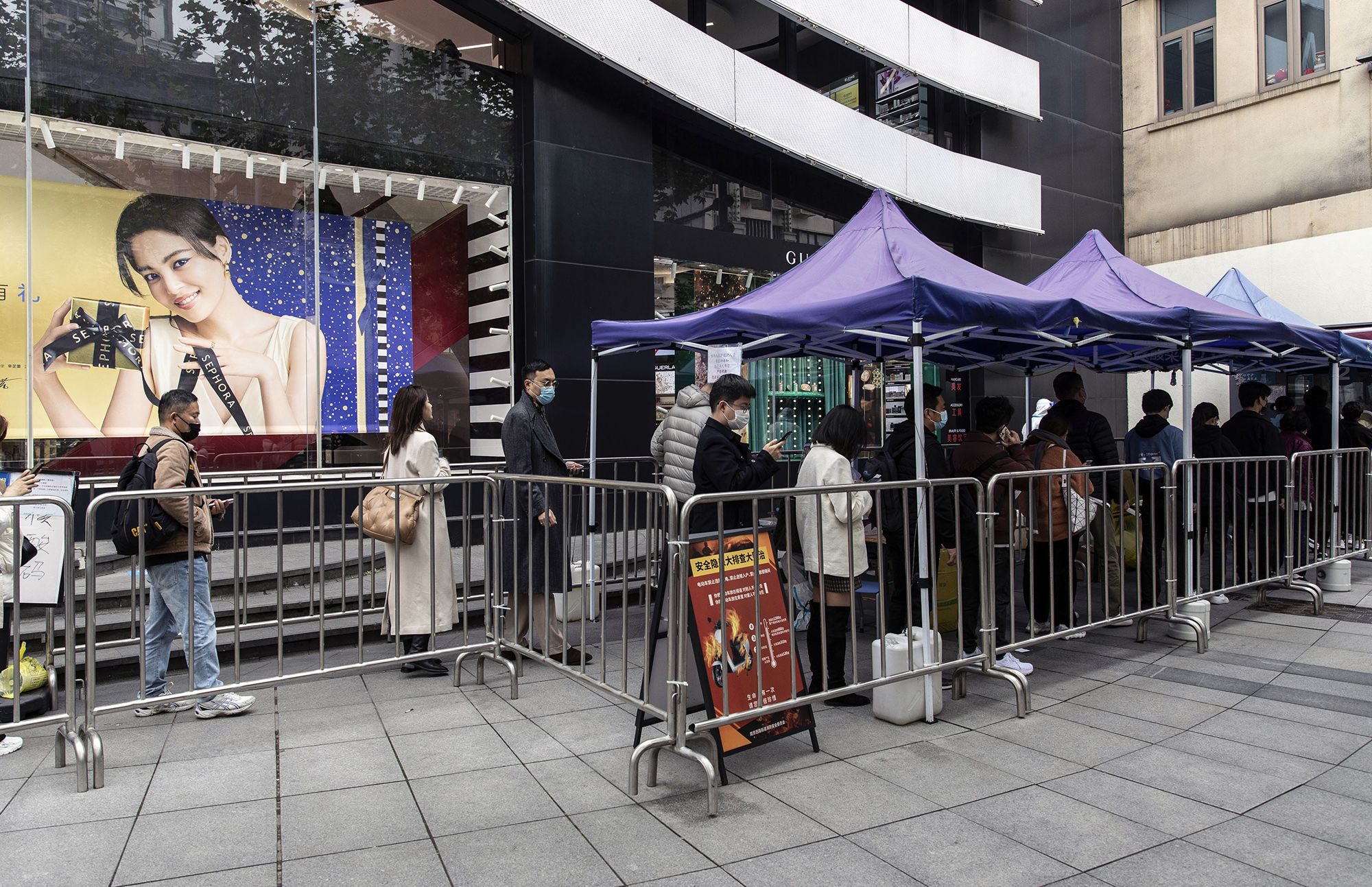
 Residents queue at a Covid testing booth in Shanghai, China, on Wednesday, Dec. 7, 2022.
China’s health authorities on Wednesday announced 10 new measures for dealing with Covid-19, moving definitively away with its previous approach focused on widespread lockdowns and centralized quarantine facilities. Officials were told to limit the designation of high-risk areas, rather than applying measures to an entire neighborhood.
“We’re going to be seeing probably the biggest set of policy experiments that we’ve seen in China in decades,” said Summers, a Harvard University professor and paid contributor to Bloomberg Television.
Economists have been boosting their forecasts for China’s economic growth in 2023 in light of the more aggressive dismantling of pandemic strictures. JPMorgan Chase & Co. economists said Thursday that an expansion of around 5% would be “achievable” with a well-handled reopening.
Role of Protests
“All of us are always watching China carefully, but we need to be watching China much more carefully over the next six months,” Summers said.
Not only will Chinese authorities be implementing the new approach toward Covid-19, but Beijing will also be completing the leadership overhaul that began with the October Communist Party congress. The premier and cabinet, or State Council, are set to change in March.
“There’s a big chance that China’s going to be a quite different country six months from now than it is today,” Summers said.
The former Treasury chief ascribed an influential role to last month’s street protests in persuading policymakers to shift toward a more rapid move away from Covid Zero.
“A big change in China happened because of an expression of popular will and protests,” Summers said. “That’s a profound thing for the governance of that superpower with 1.4 billion people.”
Comments
Scroll down to load comments...