




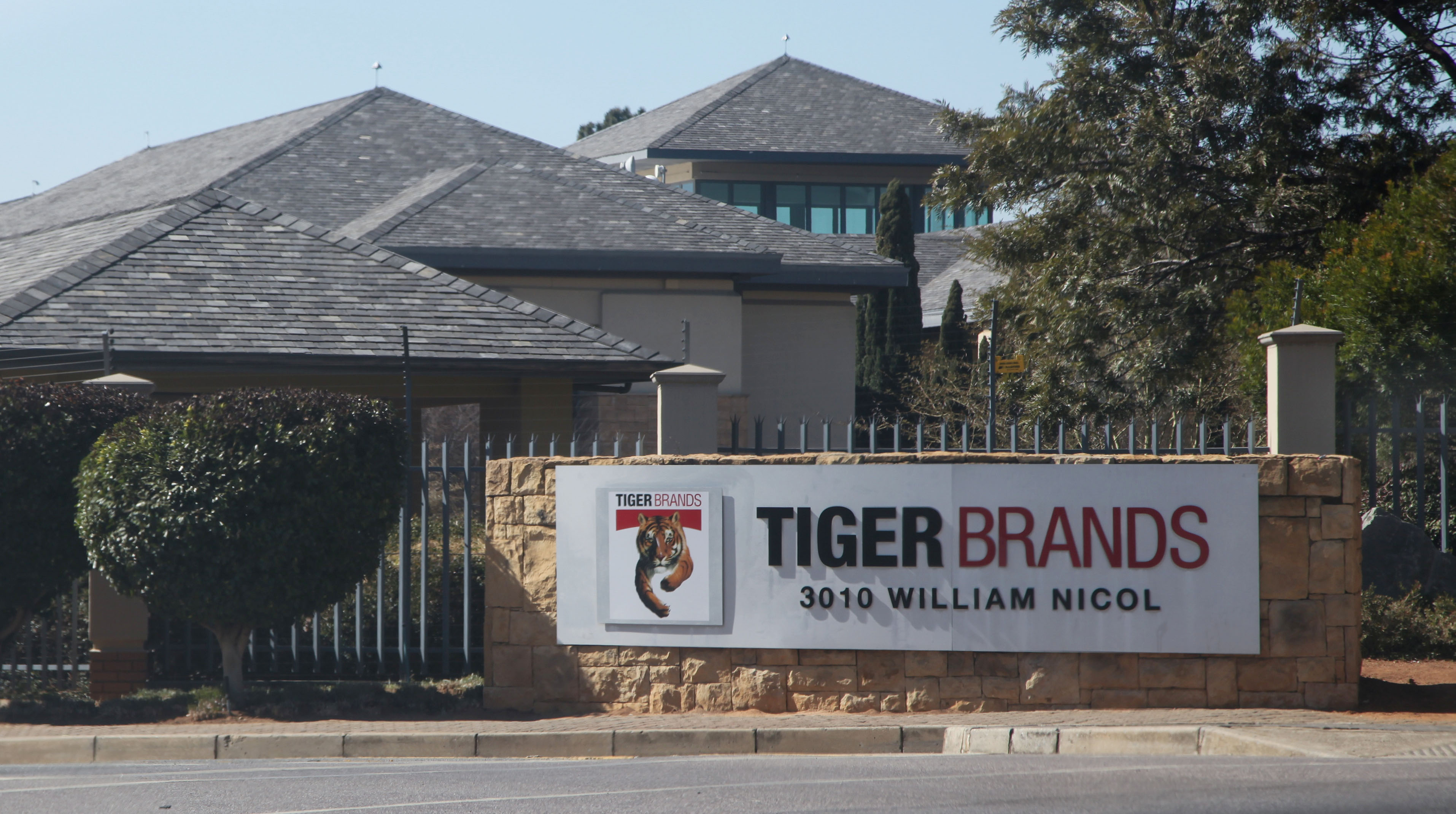
 The Tiger Brands offices in Bryanston on 27 July 2021 in Johannesburg, South Africa. (Photo: Gallo Images / Luba Lesolle)
 It was the best of times, it was the worst of times… Tiger Brands chief executive Noel Doyle said the year to September was a year of two halves for South Africa’s largest food company. Its performance in the second half of the year helped pull it out of the doldrums, with the company managing a 10% increase in total revenue to R34-billion.
“The first half saw our cost base severely impacted by unanticipated galloping inflation, and there were issues at our snacks and treats facility with significant and lengthy industrial action,” Doyle said.
The second half of the year, however, saw significant growth despite a continuation of the cost and supply challenges, exacerbated by prolonged periods of rolling blackouts.
This growth was largely the result of the effective implementation of category-specific margin recovery initiatives, as well as the execution of specific initiatives in the bakeries, snacks and treats and export divisions.
Doyle said revenue growth was driven by price inflation of 11% and a marginal overall volume decline of 1%.
“Cost-saving initiatives and supply chain efficiencies continued to make a positive contribution to the results. Group operating income [before impairments and non-operational items] increased by 53% to R3.4-billion,” he said.
Insurance proceeds
Chief financial officer Deepa Sita said operating income for the current period included insurance proceeds of R218-million, which was made up of R52-million for the product recall last year and R166-million for the civil unrest in July.
“Last year, the group’s operating income was impacted by once-off costs of R647-million related to the product recall and R85-million for the civil unrest. If we exclude the pre-tax impact of these costs as well as the benefit in the current period of the insurance proceeds, operating income increased by 10% compared to the prior year while group operating margin remained unchanged at 9.6%,” she said.
Net financing costs for the year amounted to R75-million compared with R54-million last year, due to higher average debt levels and higher interest rates compared with the year before.
Debt during the year was affected by higher raw material inventory levels and the impact of the share buy-back programme, which returned about R1.5-billion to shareholders during the year and reduced the weighted average number of shares in issue by 1.9%.
Revenue in the milling and baking division climbed 5% to R10.6-billion, influenced by price inflation of 16% and an overall volume decline of 11%.
Visit Daily Maverick's home page for more news, analysis and investigations
Refreshed leadership
Yokesh Maharaj, the chief growth officer for grains, said the improved performance of the value chain in the face of both pricing pressure and significant cost escalations reflects the impact of a refreshed leadership and management team.
The maize performance, however, was adversely affected by continued volume pressure as well as volatile raw material prices.
“This was compounded by the effect of higher conversion costs driven by increased generator utilisation amidst excessive load shedding and power outages,” he said. Overall, the total operating income for the milling and baking division fell 21% to R803-million.
Groceries’ strong top-line performance resulted in revenue growing 15% to R6.4-billion, driven primarily by price inflation of 11%, whereas total volumes increased by 4%.
Despite significantly higher selling prices, volumes benefited from innovation and support from retailers as well as growth in the wholesale channel.
Core offerings benefited from cost-competitive value packs and price pack solutions for value-seeking consumers, resulting in market share gains across most segments.
Stock levels
Earlier this year, Tiger Brands’ newly established Venture Capital Fund and Secha Capital bought a minority stake in Cape Town-based business, Herbivore Earthfoods.
The investment has enabled Herbivore Earthfoods to acquire additional machinery to increase capacity. As a result, it has now ventured into the food service and quick service restaurant market.
Cash generated from operations fell from R4-billion last year to R2.6-billion. Sita attributed this to a strategy to carry higher stock levels, ensuring continuity of supply in the face of ongoing global and local supply chain issues.
Tiger Brands ended the year in a net cash position of R143-million compared with R2.2-billion at the end of the 2021 financial year.
Looking ahead, the company said it expected the year ahead to remain challenging, to say the least: “Persistently high unemployment and inflation levels together with higher interest rates will place further pressure on overextended consumers,” Doyle said.
“In addition to local and global supply chains remaining volatile, our cost base is sensitive to rand weakness as well as higher commodity prices, whilst the cost of mitigating the regular occurrence of load shedding is significant. This will require ongoing agility and judicious price-volume management in the face of a challenged consumer.” BM/DM