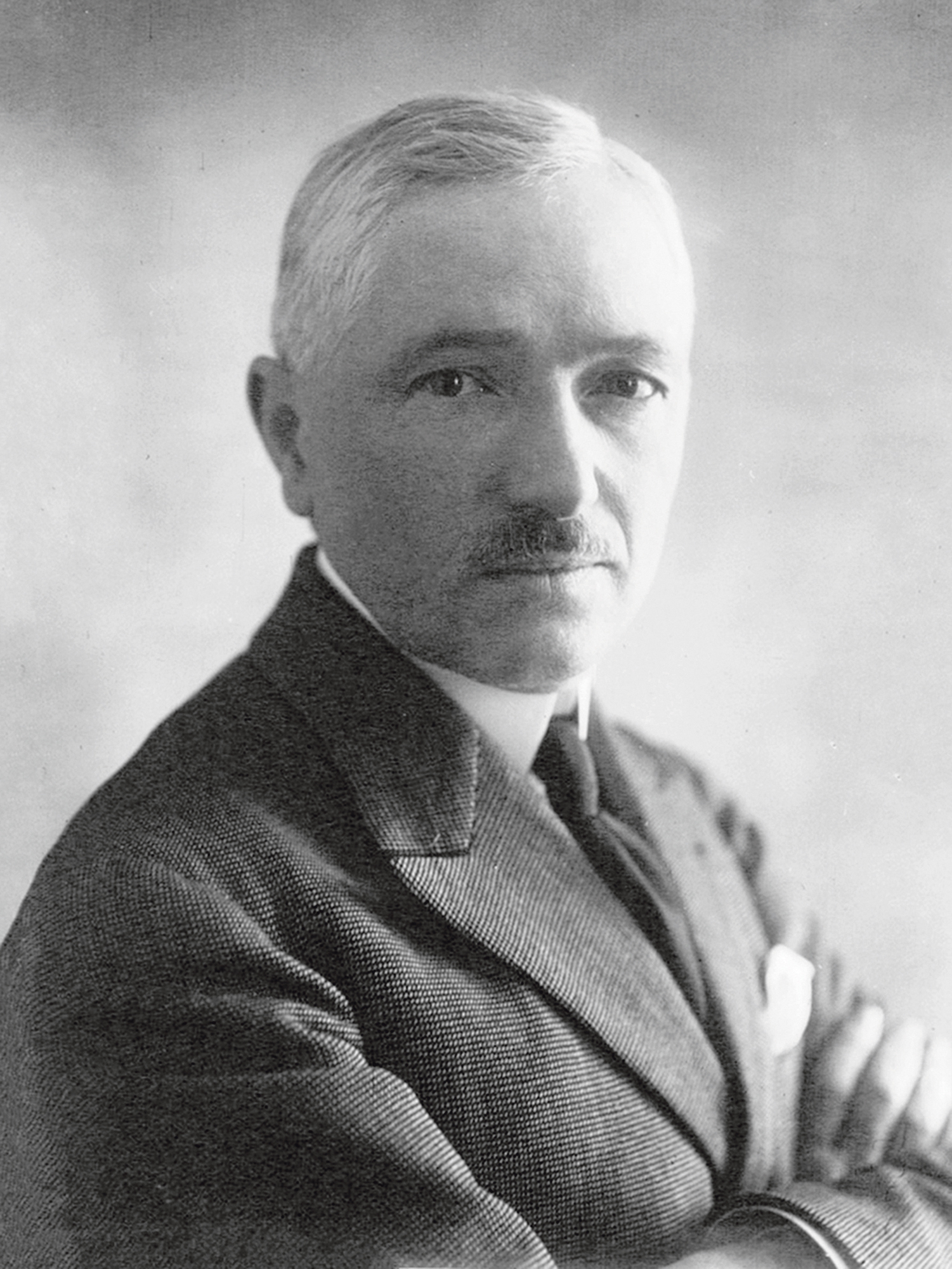
 Jules Rimet. (Photo: Wikiwand)
 Somewhere at the Stade Bauer, they have a painting of Jules Rimet.
Nobody is really sure where it is at the moment. The stadium, which is home to third-tier side Red Star in north Paris, is being almost entirely rebuilt and the stand where the painting used to be housed was recently knocked down. Storage of items during the process is a little chaotic.
It feels appropriate to visit Red Star, the “other” club in Paris, on the way to the latest edition of Rimet’s other big invention.
Rimet was one of the founders of Red Star back in 1897, some 73 years before Paris Saint-Germain, the club that now hoovers up all the footballing oxygen in the French capital. He and some like-minded contemporaries met in a café to found a club that would “work the body and feed the mind”.
He would later become the president of the French Football Federation before becoming president of the relatively new Fifa in 1921.
It was there that the second of his great brainwaves came to be, a global football tournament designed to pit the best teams against each other; a worldwide jamboree that would theoretically represent the best of the game and conform, on a bigger scale, to ideals similar to those of Red Star.
Diverging visions
More than a century on, it’s fascinating and jarring to see how far his two visions have diverged.
In Qatar, the 22nd edition of the World Cup is a bloated version of what he initially intended. Tainted by corruption, built by workers held in a state of what some consider slavery, driven by money.
In Saint-Ouen, a suburb to the north of the Paris city centre, Red Star – officially Red Star FC and not, crucially, Red Star Paris – have stuck a little closer to Rimet’s ideals.
They’re a genuine community club, one that has not achieved huge amounts of success by the traditional measures of trophies and medals. However, you could argue they have achieved a different sort of success.
‘PSG are the blockbuster. Red Star are the art-house film’
“Our ambition is to never change,” David Bellion, the former Manchester United player who is now Red Star’s creative director, said earlier this year. “We want to be where nobody expects us.”
They know they’re never going to compete with PSG, so instead, they think of themselves as the anti-PSG. It’s an example of football counter-programming. As one club employee put it: “PSG are the blockbuster. Red Star are the art-house film.”
Visit Daily Maverick's home page for more news, analysis and investigations
Rimet’s desire, some 125 years ago, was to have a football club that welcomed everyone, from every background imaginable, rich or poor. It was one of the early examples of someone recognising the power of the game and how it could be more than just 22 people kicking a ball around. He wanted to create a connection between football and culture, which he regarded as vectors of integration.
It was theoretically apolitical, but underpinned by socialist values – although it is worth pointing out that the name “Red Star” wasn’t necessarily picked for leftist reasons.
Nobody really knows, but the most common theory is that the name came from the Red Star Line, the company that ran the boats used by Miss Jenny, the Rimet family’s English governess.
The latest way the club has tried to stick to Rimet’s ideals is the Red Star Lab, a project designed to expose the young players in their youth system to as many cultural experiences as possible. It’s an attempt to create more rounded human beings, rather than just a football factory.
Since its launch in 2008, more than 800 children have benefited from the project.
They have made documentaries, gone on photography courses, worked with architects, filmed street dances and made their own jerseys.
We hear plenty about the Paris banlieues, the working-class suburbs that over the past few decades have produced an extraordinary number of top-level players, but, obviously, not everyone who tries to play the game will be Kylian Mbappé. Most will not make it, but Red Star aims to prepare those who don’t as best they can for a life outside football.
In one of the halls of their new training centre/office building, there are about a dozen pictures of Red Star youngsters in various cultural locations around Paris, including the Théâtre des Variétés and the Opéra Bastille.
The photos represent exactly what Red Star are attempting to do. They are also extremely wholesome, a selection of images to make you feel warm and fuzzy.
Red Star’s current shirt sponsors fit with all of this, too. Emblazoned across their green jerseys is the logo of LinkedOut, a riposte to the relentless careerism and pseudo-motivational slogans of LinkedIn.
The theory behind LinkedOut is to help people at the lower end of the economic spectrum, to connect those “deprived of any professional contact, often stigmatised and excluded from society in general” with employment opportunities. Candidates are paired with volunteers who help them to find work. Again: wholesome.
This year, Red Star took a group of youngsters to London to commemorate their first match at the Stade Bauer, which was against Westminster FC in 1909. They were all given cameras, the results of which will form another artistic project.
It is worth making clear that Red Star are not quite the purer-than-pure and most uncontroversial example of the football ideal. It’s part of a bigger global football group, for a start: they’re now owned by 777, an investment group that also owns Standard Liège, Vasco da Gama, Genoa and Melbourne Victory.
Their fans were not happy about that, to say the least: a game against FC Sète last season was abandoned owing to protests from the stands, which took the form of smoke bombs being thrown on to the pitch. A banner declaring “777: not welcome” was displayed.
In past years, a section of their ultras boycotted the club after they temporarily moved away from Stade Bauer. Those fans have also objected to a partnership with Vice, the lifestyle magazine and website.
That partnership, combined with a strong sense of their own aesthetic, plus a steady stream of branding and commercial employees who wander past as we’re shown around the stadium, could easily lead to the conclusion that the club is trying to market itself as a sort of pseudo lifestyle brand with a football team attached. It’s hard to say, given that the man died in 1956, but we suspect that wasn’t part of Rimet’s vision either.
But what does remain from that initial idea is a sense of community. At one end of the Stade Bauer is a block of flats that looks directly out onto the pitch and, at the moment, thanks to the redevelopment work, there isn’t much between these flats and where the players do their thing.
An old woman leans out of one window. That’s Sylvie: she watches every game from her perch and offers caustic “feedback” on Red Star’s performances.
It feels like another metaphor for how Red Star has retained something the World Cup lost long ago: a sense of immediate accountability.
Ultimately, it might be slightly pointless to compare a global football competition with a French third-tier club. But it is worth remembering, as we watch the excesses in Doha, that maybe things didn’t have to be this way. Jules Rimet’s two big ideas were rooted in the same thing, but they inhabit different universes now. DM168
This story first appeared in The Athletic.
This story appeared in our weekly Daily Maverick 168 newspaper, which is available countrywide for R25.