



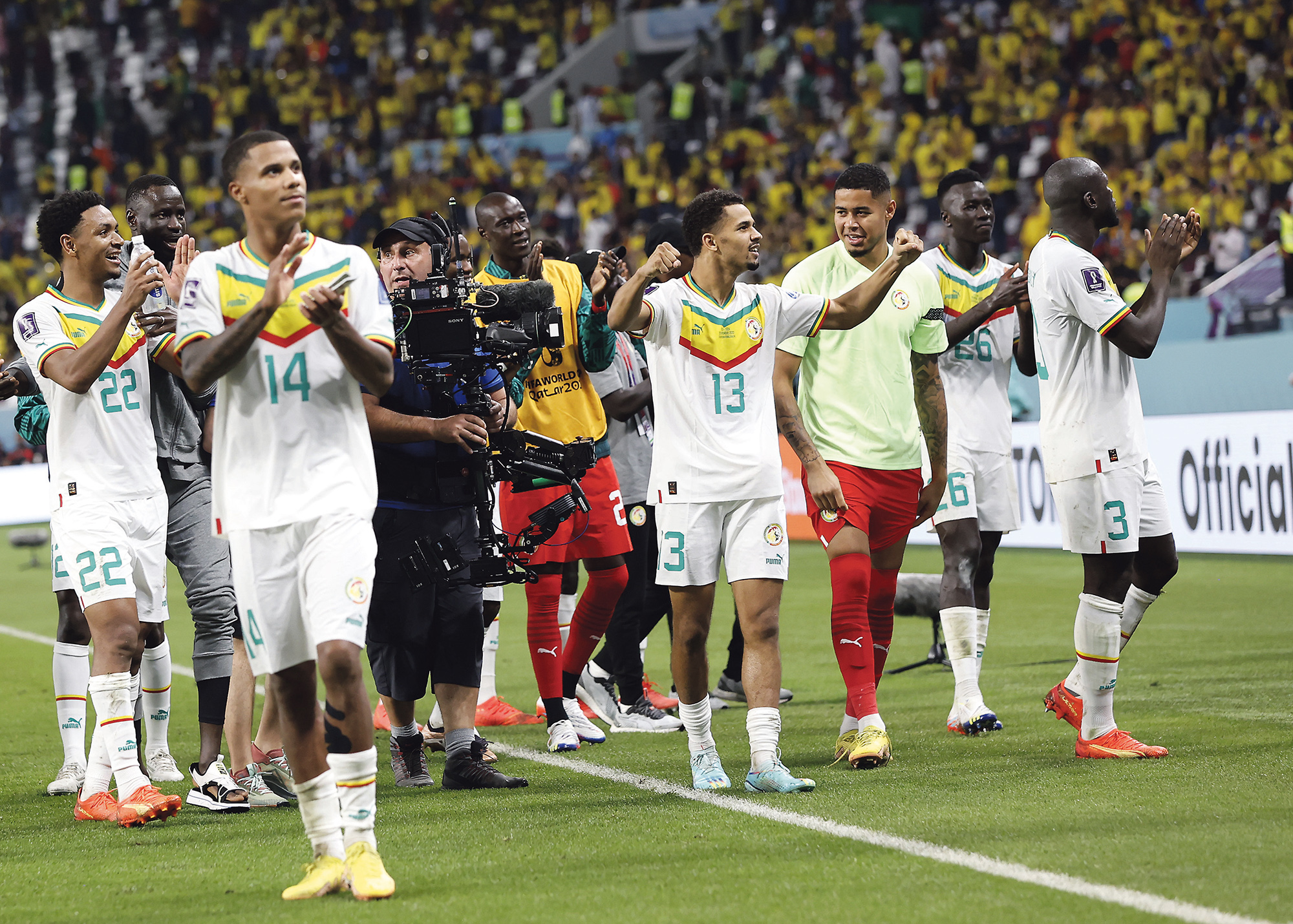
 Senegal players react after winning their World Cup match against Ecuador. (Photo: EPA-EFE / Rolex dela Pena)
They still remember the day in 2002 the news started to circulate around the training ground and, bit by bit, it became apparent something terrible had happened.
Aliou Cissé was new to English football at the time and, in the days before social media, it took a while before the full horrors started to emerge.
He turned up for training as usual. He went through his usual routines for almost a week, hiding whatever inner turmoil he was suffering. He fixed a smile because, as he explained later, he wanted “to protect the group from my state of mind”.
He boarded the bus taking the players of Birmingham City to a Premier League fixture at West Ham. They won 2-1 and, despite everything, Cissé played the full match.
“What he did that day tells us so much about the man,” says Michael Johnson, one of his former teammates. “The majority of people, me included, would have been looking to go back home and take time out. But Aliou wanted to play. That shows the strength and character of the individual.”
/file/dailymaverick/wp-content/uploads/2022/12/World-Cup-Aliou-Cisse-feature-1.jpg "Aliou Cissé, who suffered a devastating family loss when the ferry Le Joola sank in 2002. (Photo: Jean Catuffe / Getty Images)")
Africa’s Titanic
The previous week, Cissé had been watching television in his flat on the outskirts of Birmingham when the first reports came through that a ferry, MV Le Joola, had gone down off the coast of The Gambia.
The next day his phone rang and he learnt that 12 members of his family, including a sister, aunts, uncles, nephews and cousins, had been on board. All were missing.
Cissé put the phone down and, as he later acknowledged, started to panic. “The waiting was the hardest part,” he said. “Trying to find someone who had the right information. At one point, people were saying it wasn’t true. They were saying the boat had arrived ... you catch your breath only to be told 30 minutes later, ‘No, no, no, it’s not true, the boat still hasn’t arrived’.”
Le Joola, a government-owned ferry with capacity for 580 passengers, was dangerously overcrowded on its journey from Ziguinchor in south Senegal to Dakar, the capital.
The boat hit high winds and rough seas. In minutes it overturned, then slowly started to sink. Of all the people on board – children, women sleeping on wooden floors, men with a life’s possessions on their backs – only 64 survived. The death toll was 1,863, one of the worst maritime disasters in history, with more deaths than the Titanic in 1912.
Yet Cissé, then 26, found the strength to play on. “I kept it all to myself,” he would later say. “It was a very complicated and difficult day, but my family needed me to be strong for them. I couldn’t be weak.”
This is the man who has taken Senegal to the last 16 of the World Cup, facing England in Doha on Sunday, 4 December.
“It’s surreal he lost so many members of his family in this disaster and then, within days, was back playing for his club,” says Johnson.
“I look back at what he did and I think, ‘If that’s how you are as a man and as a player, then, my gosh, what kind of attitudes will you bring with leadership as a manager?’
“So it doesn’t surprise me that he has done so well for Senegal. This is a man who has real strength, real leadership, real values. What he is doing on the world stage is no surprise because I remember what he brought as a player and how, even in a really bleak time for him, he stood out.”
Visit Daily Maverick's home page for more news, analysis and investigations
To be around the Senegal camp in Doha is to be reminded Cissé has never wanted to be defined by the events of September 2002.
Cissé was the captain who led Senegal to their first World Cup quarterfinal in 2002, a few months before the Joola tragedy, and an Africa Cup of Nations final in which he missed the decisive kick of a penalty shootout against Cameroon.
Last year, he coached Senegal to the title for the first time since the tournament began in 1957. Cissé embodies the spirit of the Lions of Teranga, with all the din and colour their supporters bring to the World Cup.
Many of his players are too young to know much about it all. Players who do, understand how it shaped Cissé. They talk of a man who inspires respect and has fostered togetherness among players.
Cissé is seen as The Boss, which fits with Johnson’s memories of him as “similar to a Roy Keane-type personality, upfront, very outspoken sometimes… He was a leader and he always backed it up.”
“He had an edge,” says Matthew Upson, a former England international who joined Birmingham in January 2003. “You could see that by how he carried himself, how he coped with what he had been through. I look at him on the touchline now and there’s an intensity. It’s the eyes.
“He was always very serious in training. It was full-on because that was the type of player he was. He was the type of midfield player who was excellent at winning the ball back. He was aggressive, he had character.”
He had two weeks of compassionate leave in Senegal after the Joola disaster, playing in a charity match against Nigeria to raise money for the bereaved families.
When he returned to England, Birmingham’s fans displayed a giant banner showing the Senegal flag for his first match back against Manchester City. But it was not an easy subject for teammates to bring up.
Cissé had been at the club for only a few months. He just wanted to get on with the business of trying to win football matches – and everyone respected that.
It has been the same during Cissé’s seven years as Senegal’s manager. Occasionally he has been willing to discuss a tragedy in which the dead – including horrifying numbers of children – came not just from Senegal but also Cameroon, Guinea, Ghana, Nigeria, France, Spain, Norway, Belgium, Lebanon, Switzerland and the Netherlands.
The collective
On 29 November, when Senegal won 2-1 against Ecuador to navigate their way into the World Cup knockout stages, the players dedicated the victory to Papa Bouba Diop.
It was the second anniversary of his death, aged 42, and the team held up a banner in memory of a player whose career included spells at Fulham, Portsmouth, West Ham and Birmingham: “True Lion Never Dies”.
These are little touches that Cissé encourages as a manager who prefers to speak about “the collective” rather than individuals and who has led Senegal to the last 16 despite the absence of star player Sadio Mané.
“I remember Aliou as a midfield general who liked to clamp his authority on the game,” says Johnson. “His presence rubbed off on everyone. He was very thorough with his beliefs, assured with his style of football.
“He commanded respect and authority. Normally, when you come from abroad to England you take time to bed in. He wasn’t like that. He was straight in the mix, the cut and thrust of the dressing room.” DM168
This article originally appeared in The Athletic.
This story first appeared in our weekly Daily Maverick 168 newspaper, which is available countrywide for R25.

Comments
Scroll down to load comments...