




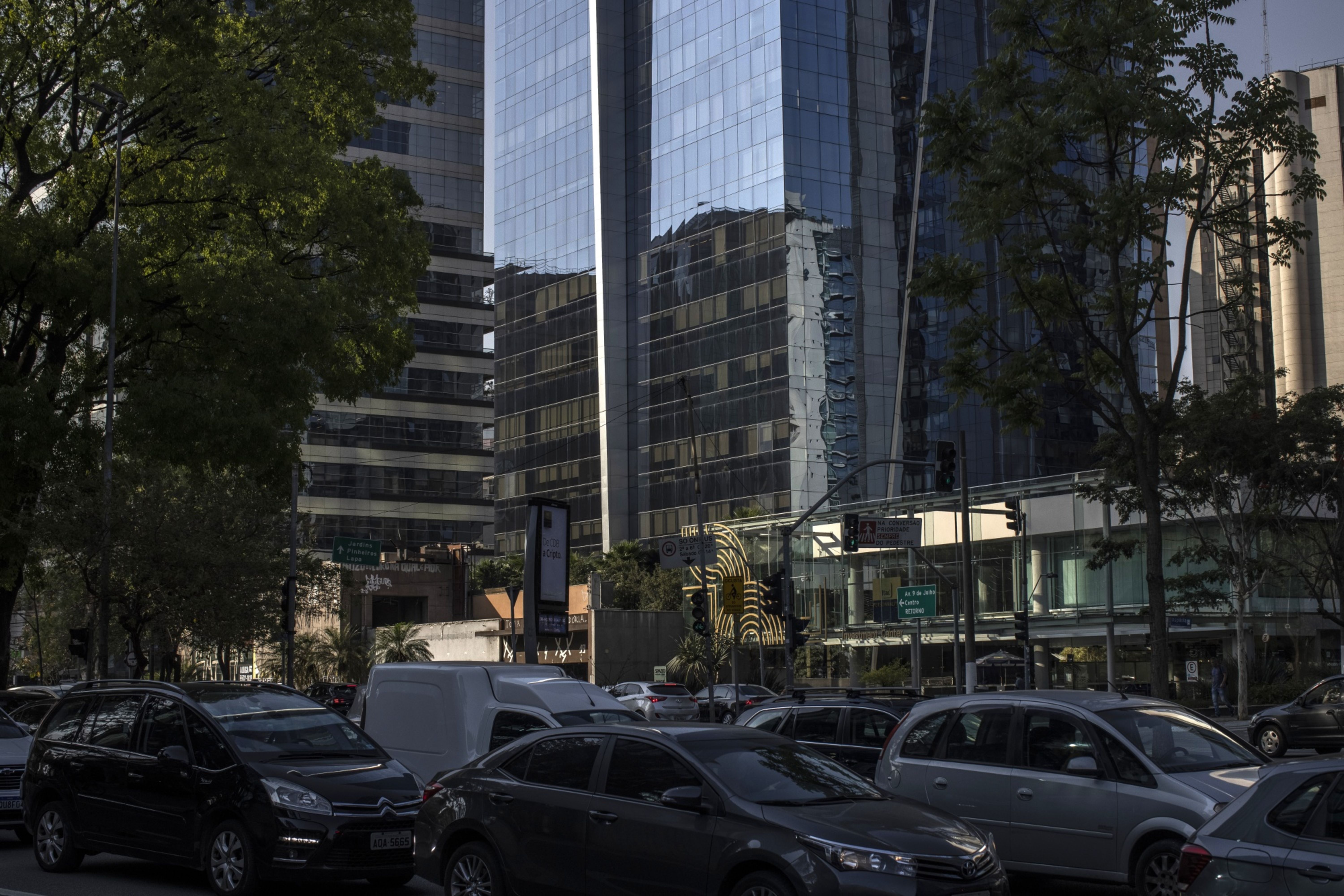
 Traffic passes in front of buildings on Faria Lima Avenue in the financial district of Sao Paulo, Brazil, on Friday, 1 September 2022.
 His team is suggesting that about 175 billion reais ($32 billion) in social spending be indefinitely exempted from the country’s main fiscal rule, the so-called spending cap that limits growth of public expenditures to the previous year’s inflation rate.
Read More: Lula’s Team Seeks to Exempt $32.4 Billion From Spending Cap
“If the spending cap were meant to keep us from paying interest to the financial system, and we kept social policies intact, that’d be fine,” he said. “But what happens is you take money from health care, education, science, culture.”
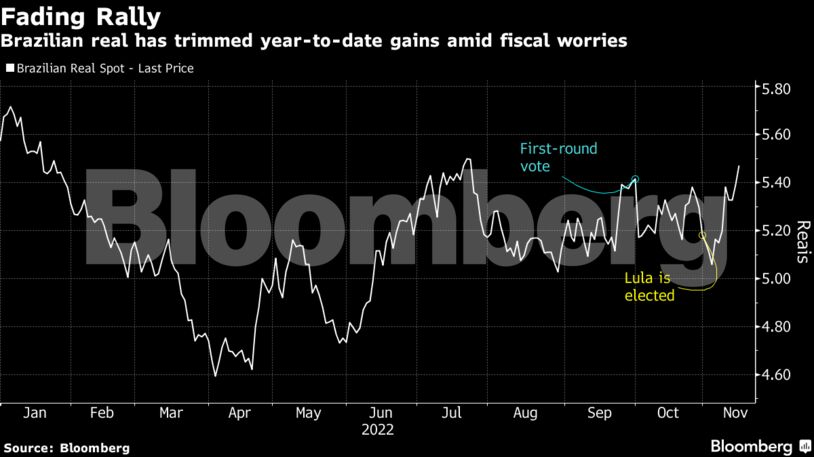
The real weakened as much as 2.3%, breaching the 5.50-per-dollar level. The benchmark Ibovespa equity index slumped 2.2%, while swap rates rose across the curve, with long-end contracts gaining over 50 basis points.
Lula acknowledged his comments may send Brazil assets tumbling.
“Too bad,” he said, adding that markets fall “not because of serious people, but because of speculators”
More Debt, Higher Rates
The central bank forecast that above-cap expenditures of 175 billion reais would increase the central government’s primary deficit to 1.5% of gross domestic product next year, from its current 0.8% estimate.
“The increase in public debt between 2022 and 2023, from 77.7% to 81.9% of GDP, would be even larger,” the bank’s chief Roberto Campos Neto wrote in a presentation made to investors in New York on Tuesday.
Investors, fearing that spending will fuel inflation, now price in that the central bank will no longer be able to lower interest rates next year. Some even fear that policymakers may need to resume an aggressive monetary tightening cycle that has already lifted the benchmark Selic to 13.75% this year.
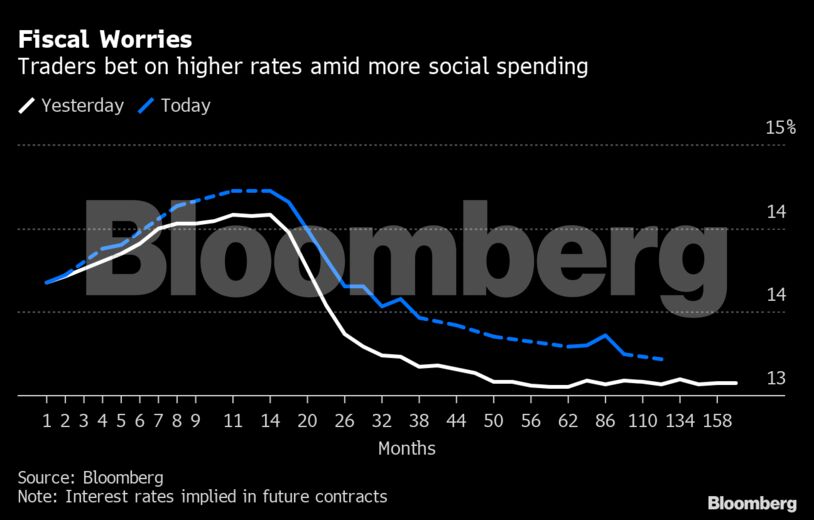
The spending proposal “reduces the degrees of freedom for the central bank to manage monetary policy,” said Alberto Ramos, senior economist at Goldman Sachs Group Inc. “At best it could delay the delivery of rate cuts, but at the extreme it could also lead to the unfortunate situation where the central bank would have to hike rates again.”
Brazilian assets topped peers for most of the year and remained relatively calm ahead of election on expectations that neither Lula or President Jair Bolsonaro were likely to be fiscally irresponsible. But the mood has shifted since the Oct. 30 runoff vote as Lula’s camp continues to signal more spending and further delays announcing cabinet names.
The nation’s stocks are down more than 12% in dollar terms this month, by far the worst among major global indexes. The real, which until the election was one of best performers of 2022, is the worst in a basket of 31 major currencies tracked by Bloomberg in November, down 5.4%.
Investors are now focusing on how the proposal will be received by congress.
“Our only hope is for the congressional leaders to fight back,” says Edwin Gutierrez, the head of emerging-market sovereign debt at Abrdn.