




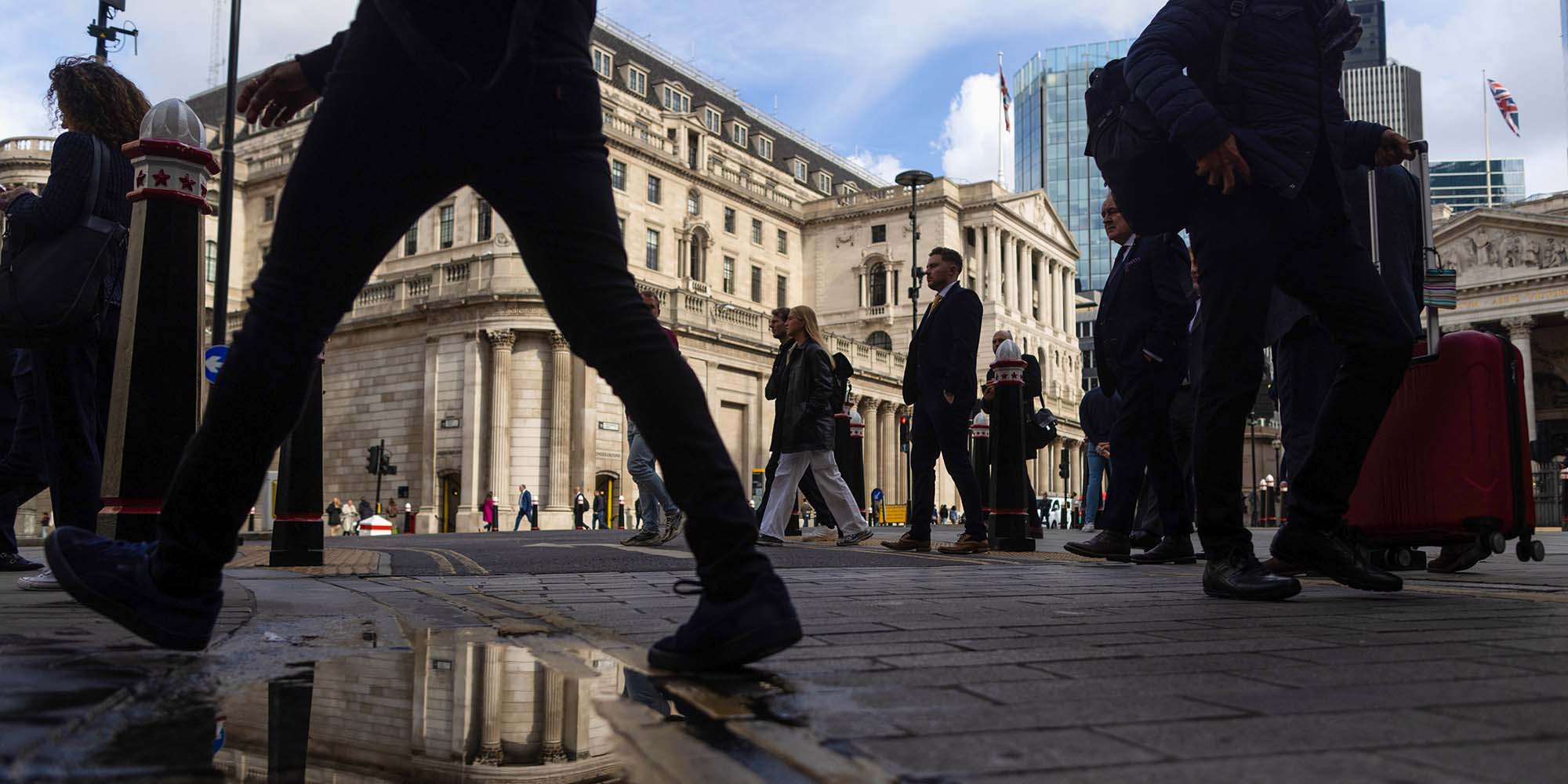
 City workers pass the Bank of England (BOE) during lunchtime in the City of London, UK, on 29 September 2022. (Photo: Chris Ratcliffe / Bloomberg via Getty Images)
 The UK central bank delivers its decision at 12pm London time, with Governor Andrew Bailey leading a press conference a half hour later. Officials will publish their outlook for the economy and inflation, likely confirming a long recession is now under way.
Upheaval in the government has clouded the policy-making landscape for Bailey and his colleagues. Liz Truss promised to stimulate the economy during her brief tenure as prime minister. That triggered a market panic and brought Rishi Sunak to power, who is slamming on the brakes with a warning that taxes will have to increase.
“We’re set for a prolonged period of sluggish, even stagnant, growth over the next couple of years,” said Paul Hollingsworth, chief European economist, BNP Paribas Markets. “We’ve got headwinds coming from both sides with the synchronised monetary and fiscal policy tightening.”
Here’s what to expect from the BOE’s decision:
Interest rates
A 75-basis point increase in the key rate is almost fully priced in by money markets and expected by economists. That would bring the base rate to 3%, the highest since 2008 and the biggest single increase since 1989.
A half-point rise would match the moves in August and September, which were the largest since 1995. Either way, the current tightening cycle that started in December is the quickest since the late 1980s, when the benchmark lending rate doubled to 15% in little more than a year.
Even so, those expectations are relatively mild when compared with the alarm that erupted after 23 September, when Truss’s government set out a plan to slash taxes and boost borrowing. Markets responded by anticipating the BOE would have to boost its key rate 2 percentage points by this month to contain the inflationary stimulus. Those bets implied the likelihood of an intra-meeting hike.
Truss’s departure and Sunak’s decision to reverse most of her promises brought expectations back to where they were before she took office on 6 September, with investors anticipating further sharp increases in the benchmark lending rate this autumn. Deputy Governor Ben Broadbent tempered some of that view last month, noting that rates may not have to rise as far as investors expect.
“The more tightening is done via the fiscal channel, the less the BOE has to hike,” said Bruna Skarica, UK economist at Morgan Stanley. “That has been visible in the repricing of the BOE hiking expectations following the mini-Budget U-turns.”
Dan Hanson of Bloomberg Economics said: “Expectations for the Bank of England’s meeting have whipsawed over the past month as investors and economists gauged how the central bank would respond to the market meltdown engulfing the UK. With the architects of the chaos no longer in power and the risk premium on UK assets fading, the pressure on the BOE to act aggressively has eased.”
Of the 45 economists surveyed by Bloomberg, most expect a 75 basis-point hike on Thursday. Three expect a full percentage-point increase, and three expect a half point.
Bigger rate rises were announced during a brief and unsuccessful attempt to bolster sterling during the 1992 exchange-rate crisis, an event known as Black Wednesday. However, the increases were unwound within a day.
Vote split
The nine-member Monetary Policy Committee split three ways at its September meeting, when Bailey and the majority pushed through a half-point rate rise. Jonathan Haskel, Catherine Mann and Dave Ramsden argued for a 75 basis-point increase. Swati Dhingra wanted a smaller, quarter-point move.
This time, the most popular view among economists is for a 7-2 split, with dissenting votes for a smaller move. About a third of those surveyed expect a 6-3 vote.
The arguments about what’s driving rates will help colour the discussion on how high borrowing costs will peak. The median forecast of economists is now 4.25% sometime next year. That’s below the 4.75% priced by investors.
Economic forecasts
Most economists think the BOE will raise its growth forecast and cut the outlook for inflation this year. Beyond that, there’s no consensus.
The situation is more complex than usual, since so much has changed since the BOE’s last forecasts at the start of August. Government support for household energy bills announced in September will restrain inflation – currently running at the fastest pace in four decades – and stimulate growth until April. Beyond that, the government hasn’t yet set out a plan.
Chancellor of the Exchequer Jeremy Hunt plans to set out tax and spending policies on 17 November, but hints about what’s in that package won’t colour the BOE’s forecasts for Thursday’s decision. Natural gas prices for next year have fallen sharply since August, but this year’s readings are slightly stronger than they were, and whether Europe has enough natural gas to get through the winter after Russia cut off supplies is still an open question.
“Monetary policymakers are flying blind because of the uncertainty, but saying that this is just because of fiscal uncertainty is missing the underlying real problem,” said Torsten Bell, chief executive officer of the Resolution Foundation.
With the cost of living crisis biting hard, the UK is likely now in a recession that will last for four quarters and cost around 1% of GDP, with economists predicting no growth until the end of 2023. That scenario is only slightly better than the BOE predicted in August. Inflation, which the BOE had expected to peak above 13% in October, may now top out around 12% in April when the energy-price freeze ends. That’s six times the BOE target.
Quantitative tightening
The central bank’s rate decision is also being taken against a new backdrop of quantitative tightening – a programme under which the BOE will systematically sell many of the bonds it bought during the period following the financial crisis to promote growth.
The BOE was the first major central bank to start a QT programme while simultaneously hiking interest rates. Despite speculation that the QT program may be delayed to avoid reigniting the gilt market, the BOE commenced with its first sale of £750-million (R15.6-billion) on Monday.
The auction met with surprisingly little drama and a huge £2.44-billion of bids, partly due to the bank’s decision to hold-off selling long-dated assets, where the turmoil was concentrated.
“We expect limited new information on active sales this week, given smooth initial auctions,” added Skarica. “The fact that active sales are now concentrated in the front end of the curve, makes them marginally more impactful, as the UK’s financial conditions are front-end linked. However, the bank rate remains the dominant policy tool, and we don’t see any major tensions here.” BM/DM
Comments
Scroll down to load comments...