




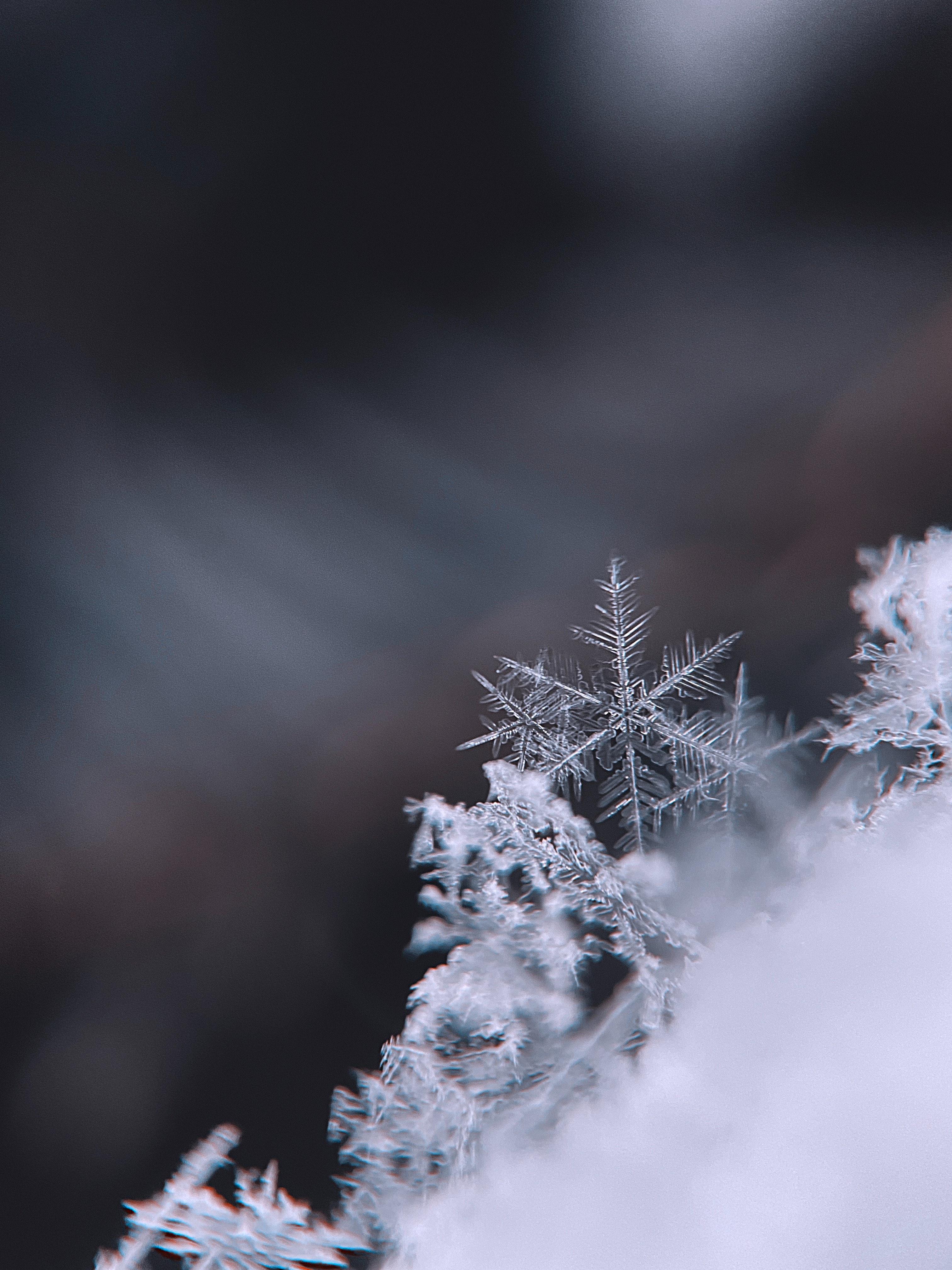
 Snowflake shot on iPhone and Olloclip macro attachment. Image: Aaron Burden / Unsplash
 The year is 1610 and Johannes Kepler is employed as the Imperial Mathematician in the court of Holy Roman Emperor Rudolph 11. His friend and benefactor, for whom he wishes to offer a gift, is the imposingly named Johannes Matthaeus Wacker von Wackenfels.
The gift, Kepler decides, should be an amusing idea or a clever argument. He considers a number and rejects them out of intellectual respect for Wacker.
Wandering around Prague, feeling guilty about his procrastination, Kepler notices some snowflakes landing on his coat, all with six corners.
He flashes on a topic suitable to engage a mathematician: “Why do snowflakes in their first falling always fall with six corners and with six rods, tufted like feathers?”
The letter he pens to Wacker will later be published as a small booklet, The Six-Cornered Snowflake. Among his other works, it will make no waves and hardly be mentioned in bibliographies.
/file/dailymaverick/wp-content/uploads/2022/10/Johannes-Kepler-Wiki-Commons.png "Johannes Kepler. Image: Wikimedia Commons")
A contemporary of Galileo, Kepler will invent the refracting telescope. He will become known as an astronomer, mathematician, astrologer, natural philosopher and writer on music. He’ll be a key figure in the scientific revolution of the 17th century and his books will provide the foundations of Isaac Newton’s theory of universal gravitation.
But how genius arrives at an idea is best traced through Kepler’s little New Year’s present to Wacker. It’s a journey from medieval alchemy and astrology to empirical science: testing ideas by thought experiment. Let’s follow him.
***
Why six-sided, he asks, and why flat? Is the cause to be found outside or within the snowflake, God-ordained and guided by Supreme Reason or something to do with its substance, its own nature?
Is it the wish to be beautiful, the reason for its form? It is beautiful, he notes. “It does not fall in an ugly or immodest fashion.” But no, this would imply that it has its own animating principle, its own Soul. That’s ridiculous, he says, its shape must instead be the offspring of a universal principle. What then is that principle?
And the number six, what is its origin? “Who carved the nucleus, before it fell, into six horns of ice? The cold cannot do this. It must be some internal cause related to the vapour.”
Why is it on a flat plane and not spherical? It must have something to do with the packing of balls of vapour and they must pack in terms of the total regimentation of the material and the internal organisation of each ball.
He seeks a solution in the hexagonality of honeycombs, in how rhomboid pomegranate seeds are stacked and why the petals of flowers are mostly grouped in fives. But he finds no answers there for snowflakes.
In his consideration of honeycombs, as a throwaway line, he suggests that the hexagonal packing of two-dimensional spheres is the densest packing possible. He is correct, but it will take 341 years to confirm this experimentally.
He wonders if the hexagon is the most convenient shape for bees to construct, with every wall being co-constructed with the neighbouring bee. He’s correct, its proof will be many years ahead, but he moves on…
Pondering on the best way to stack cannonballs – something he has discussed with the English mathematician Thomas Harriot – Kepler works out that stacking them in the dimples between three neighbouring balls is the densest way to pack spheres in three dimensions. It will take 387 years to prove that conjecture.
/file/dailymaverick/wp-content/uploads/2022/10/Kepler_sdiagram-of-stacking-of-spherical-objects.png "One of the diagrams from Strena Seu de Nive Sexangula, illustrating the Kepler conjecture. Image: Johannes Kepler / Wikimedia Commons")
But on the matter of stacking he is pursuing snowflakes, not cannonballs. He wonders if their shape has something to do with the logic of stacking and the best way for small planes of minute size to connect. In this he is incorrect – a snow crystal’s shape has absolutely nothing to do with dense packings in two dimensions. He moves on.
Why are they flat rather than three-dimensional? After some deliberations Kepler arrives at the following conclusion: snowflakes must originate when a warm front of air hits a cold front and since this can only occur in a plane, snowflakes must necessarily be flat. The explanation seems quite plausible but there is one problem: it’s not true. History does not grant him that conclusion either.
Their pattern, though, must be something to do with a crystalline structure that forms in a particular way as water freezes out of a vapour. But what is it that dictates the shape of the crystals? It must, he concludes, be in the property of the building blocks of the crystals which are so small that they cannot be seen.
/file/dailymaverick/wp-content/uploads/2022/10/Early-images-of-snowflakes.png "Early images of snowflakes. Image: Wilson Bentley / Wikimedia Commons")
Through a thought exercise for a New Year’s present, Kepler has arrived at the conjecture of atomic structure and notions of the densest way that molecules stack. Given the state of experimental science in the early 17th century, however, he cannot verify his conjecture of an atomic submatrix.
(Atoms had in fact been postulated by the Greek thinker Democritus in the fourth century BC but had fallen below the scientific radar.)
/file/dailymaverick/wp-content/uploads/2022/10/snowflake-5.jpg "Snowflake. Image: Kenneth G. Libbrecht")
/file/dailymaverick/wp-content/uploads/2022/10/snowflake-4.jpg "Snowflake. Image: Kenneth G. Libbrecht")
/file/dailymaverick/wp-content/uploads/2022/10/snowflake-2.jpg "Snowflake. Image: Kenneth G. Libbrecht")
/file/dailymaverick/wp-content/uploads/2022/10/Snowflake-3.jpg "Snowflake. Image: Kenneth G. Libbrecht")
/file/dailymaverick/wp-content/uploads/2022/10/Snowflake-1.jpg "Snowflake. Image: Kenneth G. Libbrecht")
As to the six-sidedness, he confesses failure. “I have not got to the bottom of this,” he confesses, and you can almost hear him sigh. “Enough if I have given others some slight notice.”
In the last paragraph of the booklet, he challenges future scientists to find the underlying reasons for the snowflakes’ hexagonal patterns. In particular, he says he has “knock[ed] on the door of chemistry” and he predicts that chemists would eventually be able to give the answer. They will, but only three centuries later.
By the mid-20th century we will discover that snow crystals are six-cornered because of the manner in which the water molecules are arranged.
When ice crystals start to grow around the nucleus, they initially retain the hexagonal shape of their molecular structure. As more water molecules travel through the vapour-filled air, looking for a good place to land, the swirling hexagons offer themselves as ideal airports.
Since the corners of the hexagons stick out farther into space than the edges, this is where the molecules like to dock. With more and more molecules attaching themselves to each other, tree-like structures grow out of the corners of the hexagon. This is why snow crystals are flat and six-cornered. Random patterns within a tightly ordered structure – and beautiful.
What would Johannes Kepler have given to know that? As to the reception of his letter by Johannes Matthaeus Wacker von Wackenfels, history does not record. It will take a future science to appreciate its remarkable wisdom.
The British physicist Brian Cox will say of Kepler: “He was as modern as the best physicists working today. In a world with so little scientific information, he’s asking the right questions. What are those patterns telling me? What’s the deep structure of nature? The patterns that shape snowflakes are those that shape galaxies.” DM/ML
Now, watch a snowflake grow.
Visit Daily Maverick's home page for more news, analysis and investigations