




 Luiz Inacio Lula da Silva, Brazil's president-elect, celebrates with supporters on Paulista Avenue in Sao Paulo, Brazil, on Sunday, Oct. 30, 2022. Lula won election as Brazils president in a dramatic comeback for the left-wing politician who was languishing in a jail cell just three years ago on corruption charges.
A note of caution lingered in markets on concern that the defeated incumbent, President Jair Bolsonaro, may seek to discredit the results. He hasn’t made any public comment since election authorities announced he had lost in the closest presidential contest since Brazil’s return to democracy about 40 years ago. In the run-up to the vote, he had cast doubt on the integrity of the election.
Read more: Lula Edges Out Bolsonaro to Win Presidency of Divided Brazil
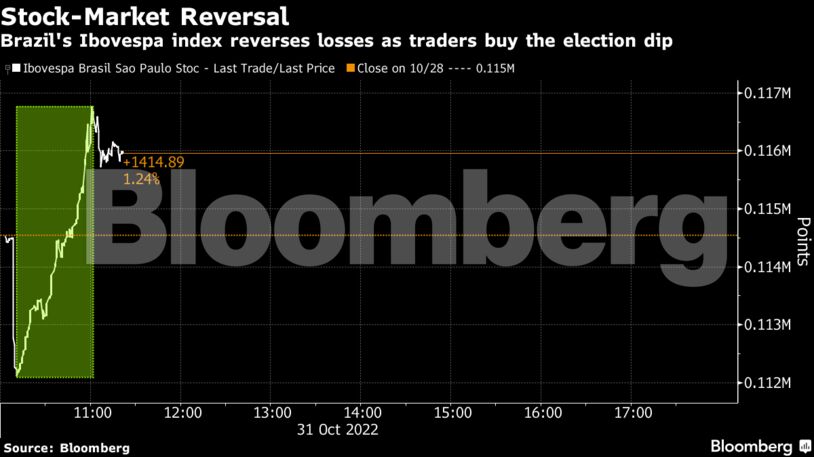
But after a sell-off early in the session, Brazilian assets turned mostly positive by mid-morning. The Ibovespa added 1.2% as of 11:22 a.m. in Sao Paulo. The real strengthened as much as 1.6% to 5.2108 per dollar.
“It’s too early to be negative,” said Dario Valdizan, the head of buy-side research at Credicorp Capital Asset Management in Lima. “The vote doesn’t alter our constructive view for Brazil, it just implies we need to pay close attention to political announcement rather than focus mainly on fundamentals.”
State-owned companies including Petroleo Brasileiro SA and Banco do Brasil SA were among the worst stocks, dragged down by speculation that a privatization push during Bolsonaro’s administration would be abandoned under Lula. Some investors also were seeking more details on Lula’s cabinet picks, particularly his economy minister, before buying in.
The main drivers for Brazilian assets will be the makeup of Lula’s economic team and clarity on his economic and fiscal proposals, according to Sarah Glendon, a senior analyst at Columbia Threadneedle Investments in New York.
“The market will want to know which Lula we are in fact getting as president of Brazil for the next four years,” she said.
Education company Yduqs Participacoes SA rallied for a seventh session. Anima Holding SA jumped as much as 10% after Morgan Stanley upgraded it to the equivalent of buy from hold. Lula is expected to increase funding for education, providing a boost to the companies.
The retailer Lojas Renner SA added 4.8%, headed for its biggest gain in almost a month, amid speculation that Lula would seek to bolster aid to the poor, increasing their purchasing power.
Goldman Sachs’s strategist Ian Tomb said the real’s initial drop was an opportunity to buy and recommended going long on the Brazilian currency versus the South African rand.
The president-elect will face a divided country and a divided congress, with Bolsonaro’s allies having captured a large presence in both chambers on top of controlling the country’s three most populous states, Sao Paulo, Minas Gerais and Rio de Janeiro. Money managers saw the narrow margin of victory as a signal that Lula is unlikely to pursue the most radical version of his left-wing politics.
“It will be hard for Lula to stray too far from the multi-party and more centrist alliance he built for his campaign,” RBC Capital Markets’ Elsa Lignos wrote in a note.
Read More: Four Petrobras Chief Candidates to Watch as Lula Shake-Up Looms
Money managers including Franklin Templeton and Robeco have been relatively optimistic about the outlook for Brazilian stocks no matter who won the presidency, figuring that the country was positioned better than peers, thanks in part to alluring valuations and a favorable outlook for interest rates. Its markets have outperformed other developing-nations this year.
“Assuming that an orderly transition of power duly unfolds, the effect should be to lower the political risk premium on deeply undervalued Brazilian assets,” said Udith Sikand, a senior emerging-markets analyst at Gavekal Research.
Comments
Scroll down to load comments...