




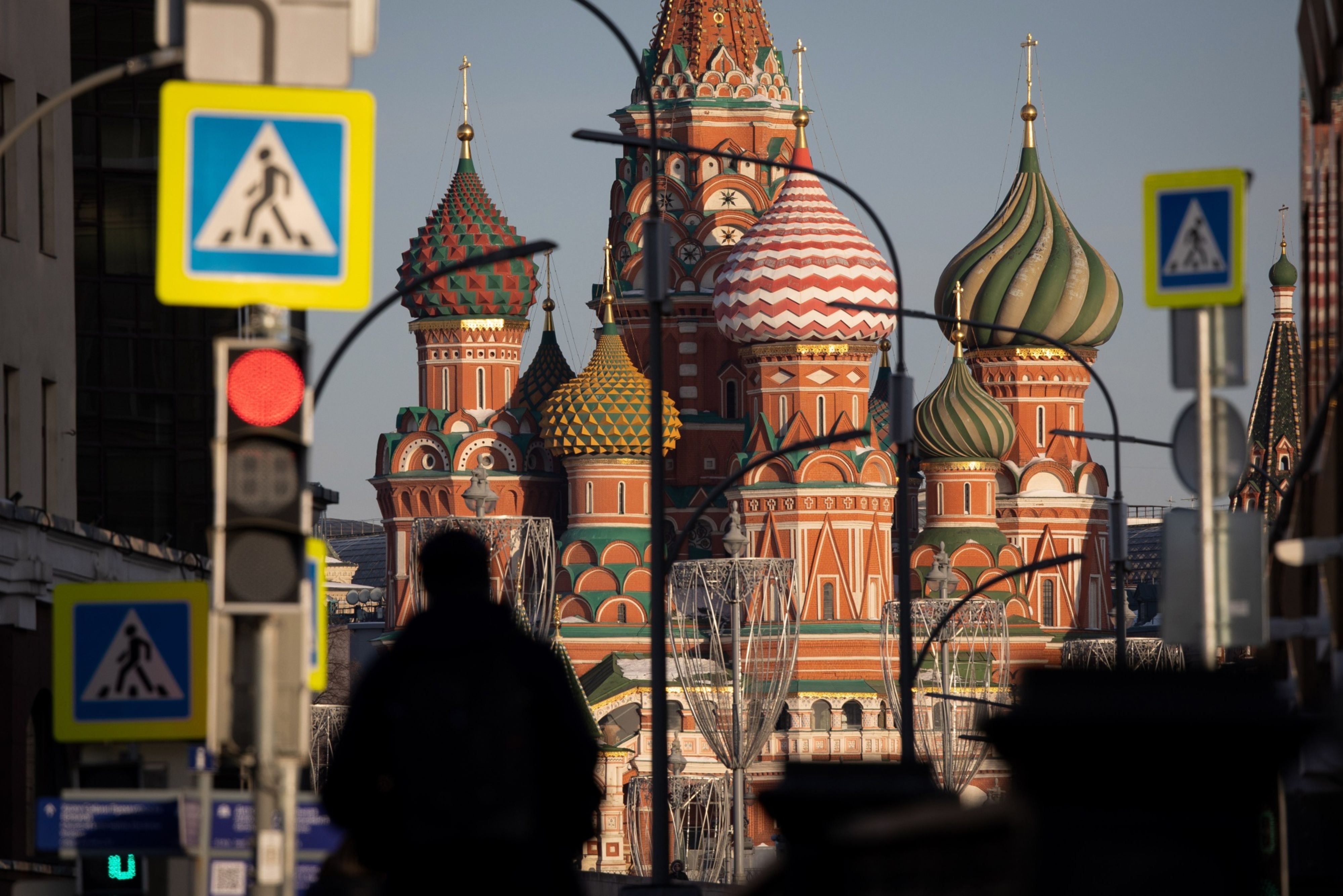
 The domes of Saint Basil's Cathedral in Moscow, Russia, on Tuesday, Feb. 15, 2022. Russia announced the start of a pullback of some forces after drills that raised U.S. and European alarm about a possible military assault on Ukraine. Photographer: Andrey Rudakov/Bloomberg
 The decision on Friday will probably draw a line under an unprecedented cycle of monetary easing that more than halved official borrowing cuts in six steps since April. Rising inflation expectations and the threat of economic spillovers from the invasion will only add to caution after governor Elvira Nabiullina already signalled a pause was becoming more likely.
Most economists surveyed by Bloomberg predict the benchmark will stay at 7.5%, with only a small minority forecasting a cut. Nabiullina will hold a news conference at 3 p.m. in Moscow and policy makers will also issue updated forecasts.
“The Bank of Russia may have plenty of macroeconomic reasons to continue cutting rates, but they may not be enough to ease policy at the current juncture,” Citigroup Inc. economist Ivan Tchakarov said. “The announcement of a partial mobilisation has led to elevated uncertainty, which in the past has tended to tip the scale against cutting rates.”
An inflation slowdown that allowed for rates to be cut below their pre-war level is still intact and weekly price growth remains subdued. The central bank’s current forecast is for inflation to end 2022 at 12% to 15%, down from a 20-year high of almost 18% in April.
But inflation expectations, a key factor for policy makers, have increased for four straight months. In September, Nabiullina said she was “worried” by their recent rise.
Economists at the central bank also said this month that the flight of foreign companies from the Russian market since the invasion in February was creating inflationary pressures as supplies of key consumer products ran short.
What Bloomberg Economics says...
“Spiking demand for canned food, large cash withdrawals from banks and falling mortgage applications make the effects of Russia’s war mobilisation resemble a light Covid lockdown. Will the Bank of Russia rely on its Covid era playbook and carry on with bold rate cuts? We believe the answer is no: The similarities are shallow and keeping inflation in check calls for keeping the policy rate unchanged.”
– Alexander Isakov, Russia economist.
The impact of the conscription on the economy is less clear. Consumer prices could come under pressure if the mobilisation of 300,000 reservists adds to workforce shortages and pushes up wages as competition intensifies among employers.
But it could also have the opposite effect by prompting consumers to turn thrifty. The call-up will also boost government spending and may result in a wider budget deficit than expected.
The future path for interest rates has become so murky that Nabiullina wouldn’t rule out that the central bank’s next move may be a hike.
A sharp pivot toward tightening is unlikely for now, given that cheaper money has helped Russia avoid a sharp recession despite sweeping international sanctions.
Still, the importance of inflation expectations to the Bank of Russia’s “reaction function” makes a pause more likely this week, according to Tatiana Orlova of Oxford Economics.
“I previously thought that the Bank of Russia had one more small cut up its sleeve to respond to the renewed weakening in household demand on the heels of the mobilisation,” she said.