




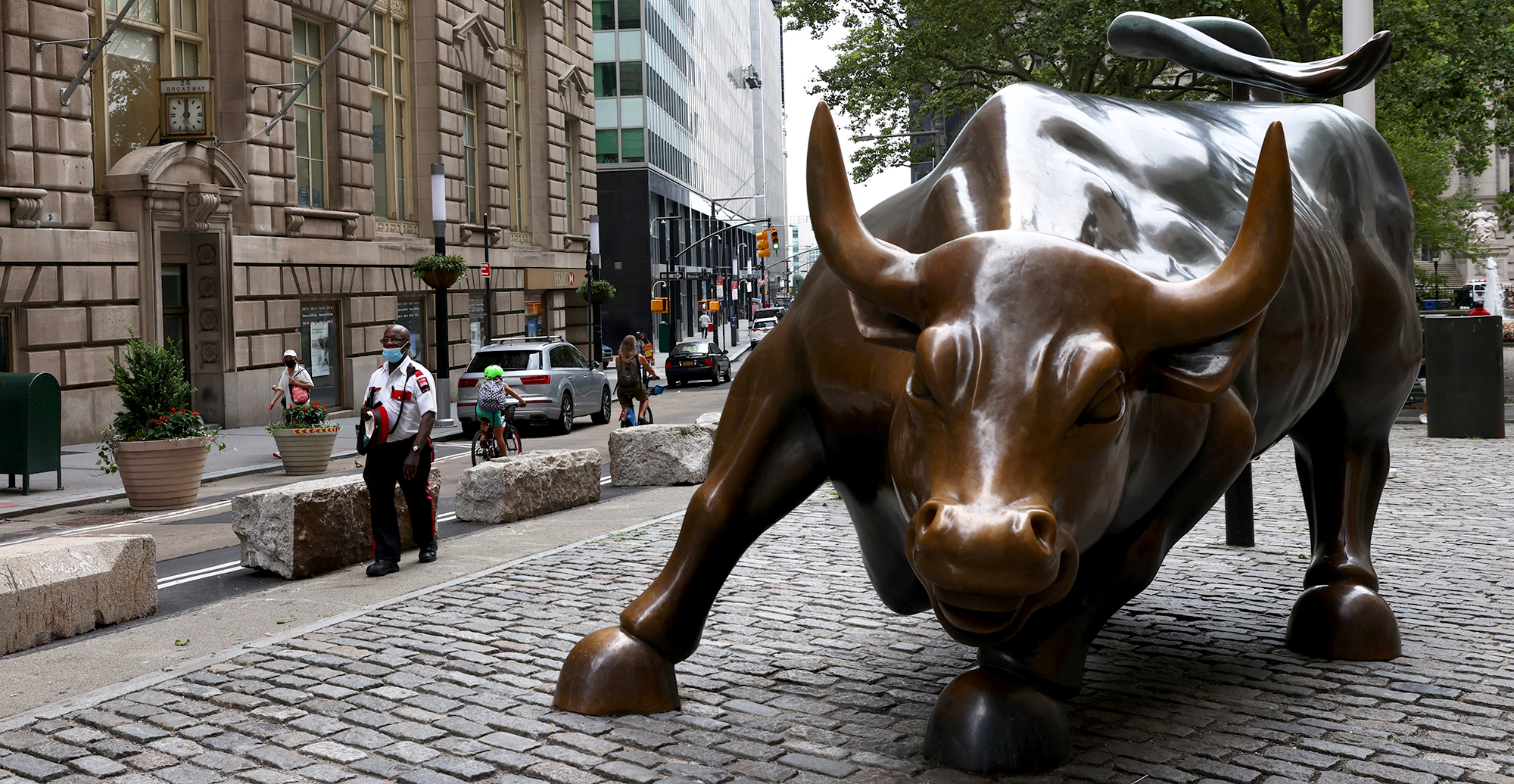
 People walk along Broadway as they pass the Wall Street Charging Bull statue on July 23, 2020 in New York City. (Photo: Michael M. Santiago/Getty Images)
An index of the region’s equities extended gains and was poised to snap a five-day losing streak. The S&P 500 defied expectations to rally 2.6% after consumer price data cemented bets for the Federal Reserve to deliver another jumbo rate hike in November.
Currencies in the G10 strengthened against the US dollar, but the yen remained on the back foot after falling to its lowest level in more than 30 years after the US CPI data release, only to reverse the move in a whiplash trade that raised chatter of potential intervention.
Treasuries fluctuated after the policy-sensitive two-year yield soared 17 basis points Thursday. The 10-year yield was slightly down, trading at about 3.92% in Asian hours.
Cryptocurrencies also got a boost from the improved risk appetite in global markets, lifting Bitcoin to a one-week high and putting the largest token on the cusp of retaking the $20,000 level.
With higher interest rates piling pressure on an already struggling global economy, the surge on Wall Street underscores the difficulties traders face in volatile markets. Speculation the yearlong selloff in equities had reached a bottom was cited as one potential reason for the rebound. Others included short covering, less-than-terrible earnings reports and sturdy positioning including well-provisioned hedges.
Technical levels factored into the bounce. At one point, the benchmark S&P 500 had given back 50% of its post-pandemic rally, triggering programmed buying. A wave of put options bought to protect against such a rout moved into the money, and as profits were booked, that prompted dealers to buy stocks to remain market neutral.
Market bets on rates still lean towards back-to-back 75 basis-point hikes at the next two Fed meetings and expect the central bank to push rates past 4.85% before the tightening cycle ends.
Meanwhile, the two-year Treasury note’s yield jump to 4.48% before the US inflation data out implied rate hikes of 75 basis points at the November FOMC meeting and 50 basis points in December, a Yardeni Research team wrote in a note. “Perhaps the market is starting to discount the notion that the Fed is getting closer to its terminal rate.”
One of the biggest challenges for investors in Asia is the ongoing strength in the dollar, according to Isaac Poole, chief investment officer at Oreana Financial Services. “Inflation print makes it more likely the global reserve remains elevated in the near term,” he said. “It is not time to be adding lots of risk, but also not time to be dialling risk back massively.”
Inflation figures in China proved relatively subdued, as a pickup in food prices countered the effects of lockdowns that are crimping economic activity.
Singapore’s central bank tightened monetary policy settings, keeping up its fight against inflation amid a darkening global economic outlook. The Singapore dollar rose by the most in more than a week.
Meanwhile, UK markets remained in turmoil almost two weeks after the government unveiled a plan to drastically cut taxes. The pound posted its biggest gain since March 2020 on Thursday after the government signalled a U-turn on a central part of its tax agenda. The currency steadied on Friday.
Traders will have a chance to hear more from the Fed on Friday.
Elsewhere, both oil and gold headed for a weekly loss as signs of a global economic slowdown and tighter monetary policy threaten to sap energy consumption. The International Energy Agency earlier warned production cuts agreed by OPEC+ risked causing oil prices to spike and tipping the global economy into recession. BM/DM
Comments
Scroll down to load comments...