




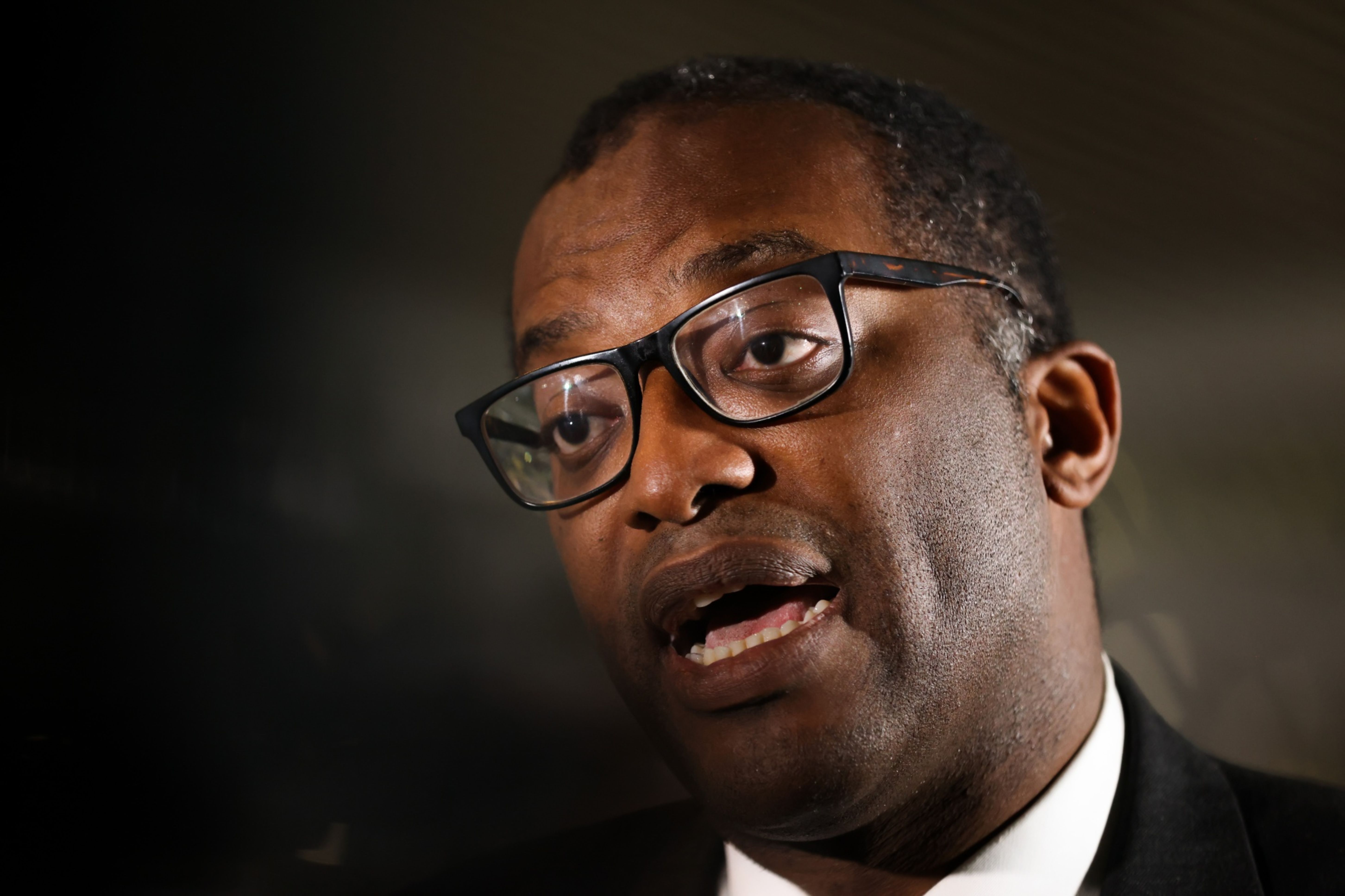
 Kwasi Kwarteng, UK chancellor of the exchequer, center, during a media interview during the Conservative Party's annual autumn conference in Birmingham, UK, on Monday, 3 October 2022.
 In the US, investment-grade corporate bonds are falling, with average prices of around 86 cents on the dollar compared with 90 cents on 21 September. UK pension funds have contributed to the selling pressure in recent days, according to one Wall Street trading desk.
In Europe, leveraged loans bundled into bonds known as collateralised loan obligations have been under pressure. In Australia, investors have reportedly been asked to bid on mortgage-backed securities that were being auctioned off. The yield premium on Asian investment-grade dollar notes is at a two-month high and headed for a third day of increase.
UK pensions are selling to meet margin calls on derivatives they used to help ensure they could keep paying retirees even if interest rates changed, using a technique called liability-driven investing. The offloading that first began after a spike in gilt yields two weeks ago was renewed this week, when the BOE confirmed that it plans to end an emergency bond buying programme on Friday. Investors are hoping the central bank will back down.
“The market simply doesn’t have the confidence, for now, that the LDI crisis won’t return and has increased concerns that other pockets of leverage may cause issues,” Janusz Nelson, head of Western European Investment Grade Corporate Syndicate at Citigroup said. “Until we see some stability in the rates market, wherever that may come from, investors will continue to be nervous around their holdings.”
End of intervention
The BOE had hoped its bond-buying support measures would create a bazooka so big that nobody would be in any doubt that they would intervene to quell market turmoil, according to a person with knowledge of the matter. Limits on the buying were increased to allay any concerns that anyone seeking to tap the program this week would have difficulties accessing it, the person said, asking not to be identified as the matter is private.
Then traders grew concerned about the end of BOE intervention. Yields on UK government securities tied to inflation, known as linkers, moved out again. Yields on sterling denominated investment-grade corporate bonds ballooned to over 7% for the first time since 2009. Their fears intensified on Tuesday when BOE Governor Andrew Bailey warned that the programme will end on Friday. The next day, the BOE made its biggest round of emergency purchases since the intervention began last month.
But the selling pressure in recent sessions has been spreading to other parts of the world as well. UK markets have been in a tailspin since Chancellor of the Exchequer Kwasi Kwarteng presented a package of unfunded fiscal stimulus on 23 September.
“Investors fear further selling from UK liability-driven investment managers in response to margin calls, including selling of USD high-grade credit,” JPMorgan Chase & Co strategist Eric Beinstein wrote on Wednesday. “There was some evidence of this selling yesterday.”
That selling was manifest in risk premium movements. On Tuesday, US investment-grade bond spreads widened five basis points, according to Bloomberg index data. But the Markit CDX North American Investment Grade Index, a proxy for credit risk, widened just 1.9 basis points. Similar underperformance of cash bonds happened two weeks ago when the UK pension issue first flared up, JPMorgan’s Beinstein wrote.
The end of forward guidance by central banks has roiled market strategies based around buying the dip and selling volatility on the assumption that correlations would continue to be stable as they had been for two decades, said Alberto Gallo, co-founder of hedge fund Andromeda Capital Management. Risk parity strategies and 60-40 portfolios are among those that could be vulnerable, he said.
“What’s happening in the UK could lead to further volatility also in the Eurozone market,” said Gallo, who previously ran money for Algebris Investments. “There’s a lot of assets that should not be priced where they are now. We’re just at the beginning.”
Meanwhile, Chancellor of the Exchequer Kwasi Kwarteng said the BOE will be responsible if UK markets suffer renewed volatility after its bond-buying programme ends on Friday.
Speaking on the sidelines of the International Monetary Fund’s annual meetings in Washington, Kwarteng told Sky News that any turmoil after the central bank withdraws support “is a matter for the governor”.
Kwarteng and the British government are preparing to make BOE chief Andrew Bailey a scapegoat for the turbulence that may hit the UK next week if stricken pension funds at the heart of this month’s selloff have not unwound their positions and raised the cash they need by the end of this week.
Bailey has given the funds two more days to use the Bank’s £65-billion (E1.32-trillion) emergency backstop facility before the programme is closed. The hard deadline raises the risk of more market chaos that could see some so-called liability driven investment strategies fail and would heap pressure on Kwarteng to unveil a revised set of tax and spending plans.
Markets have been in a tailspin since Kwarteng presented a £45-billion package of unfunded fiscal stimulus on 23 September. Kwarteng and Prime Minister Liz Truss argue that the measures are necessary to spur the UK economy into higher growth and brushed off concerns from institutions like the IMF and the Bank itself that the package risked adding to inflation pressures.
Bailey this week underlined his commitment to halting government debt purchases on Friday as planned, both to draw a line under a programme that is complicating his efforts to tame inflation and to encourage pension funds to get on with closing their positions.
Traders will be anxiously watching Thursday’s tender to see whether the funds have listened. On Wednesday the BOE bought £4.4 billion of gilts in its biggest intervention since the package was launched. Market conditions improved dramatically after the BOE’s move.
Even bigger purchases on the final two days of the operation would suggest that funds are hastily clearing their positions in preparation for the removal of the backstop. The BOE is offering to buy up to £10-billion of bonds on Thursday and Friday.
When the Bank introduced the emergency gilt purchases to head off a fire sale of UK assets, it stressed that the intervention was a financial stability operation. The problem is that the policy is a carbon copy of quantitative easing – an earlier bond-buying effort intended to stave off deflation – and that has confused the Bank’s signalling as it tightens monetary policy by raising rates and preparing to sell gilts.
Bailey wants to draw a line under that confusion and restore market discipline, arguing that it is not a central bank’s job to bail out pension funds.
What happens next?
Asset managers, regulators and bankers at the Institute of International Finance’s meetings in Washington were divided over how the next few days will unfold.
Bailey folds
Thilo Schweizer, head of European affairs at Commerzbank, said people were sceptical that Bailey would be able to hold his position. “The market may test him, and if they do he will eat his own words,” Schweizer said.
If the BOE does backtrack on Bailey’s pledge to end gilt purchases, that would raise credibility issues at a time when the government’s own loss of credibility is central to the market mayhem.
Kwarteng faces the market
Others said the BOE should not jeopardise its independence any longer by plastering over problems created by the government but instead step aside and force the Treasury to act. Senior Tories are also urging the chancellor to rip up his mini-budget to avoid a financial crisis.
Katherine Garrett-Cox, chief executive of the UK subsidiary of the Gulf International Bank of Bahrain, said: “There is not a silver bullet on this. The Bank has got to keep within the guardrails – its framework and long-term policy mechanism.”
A creative solution
Steven Major, head of fixed income research at HSBC, said another option to ease congestion in the markets would be for the Debt Management Office, which is part of Kwarteng’s Treasury, to change its funding plans. If the DMO opted to raise very short-dated money – a part of the gilt market that is not seeing demand problems – that might help ease the strains in longer-term debt sufficiently to avoid another rout.
Everyone gets lucky
And maybe the rout just might not materialise. Funds still have two days of emergency liquidity support to help them clean up their portfolios and after that the BOE also has a number of standard liquidity programs that can be used if pension funds need cash.
All the same, one senior financier warned that relying on that outcome was a risky proposition. They pointed out that those programmes require funds to go through the commercial banks and those lenders could be uncomfortable taking risk onto their balance sheets even temporarily. BM/DM